US president Donald Trump has claimed that Iran was not ready “to make the right deal” after promising to wage "Economic Warfare and Isolation on an unprecedented scale” on Tehran.
"They would love to make a deal, but they're not ready to make the right deal, in my opinion," Trump said of Iran on Friday.
Iran has accused Trump of threatening "economic terrorism" after the US treasury said it would introduce the “toughest sanctions in history" against Tehran.
Iranian foreign ministry spokesperson Esmaeil Baghaei on Saturday said that the imminent US announcement of new economic sanctions on Iran was an "assertion of extraterritorial sovereignty over every independent member state of the United Nations".
"Such secondary sanctions find no foundation in international law," he said in a post on X.
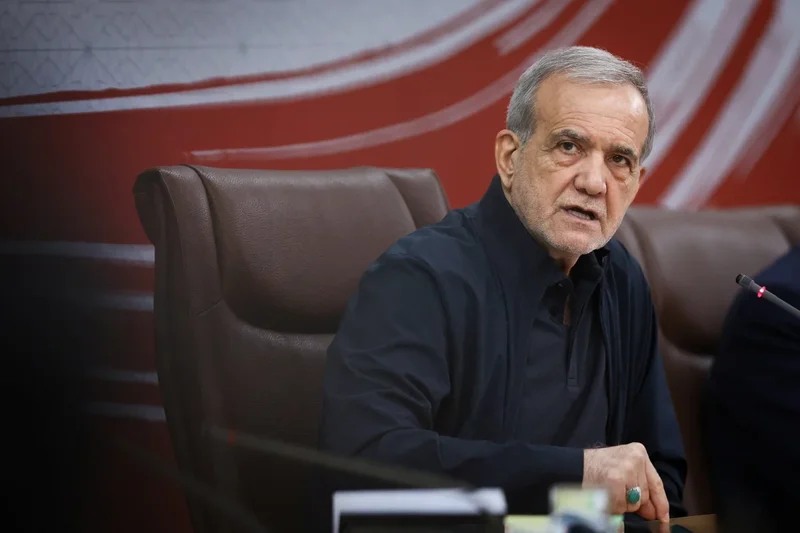
Iran’s president Masoud Pezeshkian has said that it is now time to end the war between Tehran and the US on Friday. "It is better that we bring the war to an end now as we are in a position of power and dignity," Pezeshkian said in a meeting with doctors in the country.
Iran says Trump's sanctions 'assertion of extraterritorial sovereignty'
Iranian foreign ministry spokesperson Esmaeil Baghaei said this morning that the imminent US announcement of new economic sanctions on Iran was an "assertion of extraterritorial sovereignty over every independent member state of the United Nations".
"Such secondary sanctions find no foundation in international law," he said in a post on X.
US president Donald Trump, who has warned of economic consequences against any country that provides "any type of lifeline to Iran," said yesterday that Washington was observing "what happens" in the conflict.
Iran asks Qatar to transfer 'detained pilots' to hospital on land
Iran has claimed that Qatar was holding its pilots captive in "poor physical condition" on water.
Iranian officials have called on Qatar to transfer the detained pilots to a hospital on land, according to the Tasnim news agency.
Qatar on Tuesday said that an Iranian delegation travelled to Doha and collected the remains of one of its pilots.
However, Tehran has claimed that three pilots who went missing after their aircraft entered Qatari airspace and were shot down in March were still in the country.
Pentagon says more than 750 US troops wounded and 18 killed in Iran war
The Pentagon says 756 US service members have been wounded and 18 killed in the war against Iran since late February, bringing total US military casualties to 774.
The figures, per the Defence Casualty Analysis System (DCAS) data, were updated after the Pentagon added 50 wounded personnel to its casualty database.
The update comes amid renewed US strikes on Iran, stalled efforts to reopen the Strait of Hormuz, and US president Donald Trump’s announcement of a major new economic campaign against Iran.
Iran grants Iraq permission for its oil tankers to pass through Hormuz
Iran has agreed to allow some Iraqi oil tankers to pass through the Strait of Hormuz, after Iraqi parliament speaker Haibat al-Halbousi requested special permission from his Iranian counterpart Mohammad Bagher Ghalibaf.
According to Iran’s official IRNA news agency, the move is aimed at protecting Iraq’s oil exports and economic interests, but Iran has not said how many tankers will be allowed through or for how long.
Reza Pahlavi condemns Iran fuel price hikes
Reza Pahlavi, the exiled son of Iran’s last shah, has criticised the government’s proposed fuel price increases, calling them an “unforgivable mistake” that would worsen hardship for Iranians.
In a post on X, Pahlavi wrote: “While the Islamic Republic squanders the nation's resources on foreign terrorists and domestic oppressors, the regime's officials and their cronies compete with one another in plundering national wealth, and the regime's ineptitude in governing the country has broken the backs of households and impoverished Iranians. Imposing fuel price hikes on the people is an unforgivable mistake and a profound betrayal. Fuel prices cannot be compared to those in other countries when Iranians' incomes are in rials and below the poverty line.
“Fuel and energy issues are managed on a daily basis without crisis in nearly every country in the world, even many with far fewer resources than Iran.”
He continued: “On one hand, the IRGC smuggling mafia siphons off tens of millions of litres of Iran's capital daily through tankers, pipelines, and smuggling docks; on the other, the automotive mafia foists low-quality, high-consumption vehicles on the nation. This criminal sect, incapable of solving the problem, uses its propaganda apparatus to shift the burden of fuel shortages onto the people, portraying them as the cause of increased consumption and fuel smuggling.
“The Islamic Republic is an incompetent, corrupt, and anti-Iranian regime that is itself the root of these disorders and will never be capable of resolving them.”
Iran army warns of ‘broader’ response to any attack
Iran’s military has adopted a more “offensive” approach from a “defensive” one following the experience of recent wars, army spokesman Brigadier General Mohammad Akraminia said, according to Iranian state media.
Akraminia said: “Our country’s military doctrine was defensive in the past, but gradually during these two wars, we witnessed the military doctrine moving from a defensive posture towards an offensive one.”
He said that the change “does not mean carrying out preemptive operations against the enemy.
“We will respond to any act of aggression immediately and on a broader scale than the aggression itself.”
According to Akraminia, Iran has restored military equipment damaged in previous fighting and brought additional systems into operation. “We are working continuously so that if the enemy again makes a miscalculation, we can deliver a more crushing response than before,” he said.
Akraminia also said Iran’s control over the Strait of Hormuz had become a “decisive geopolitical influence” following the war, while pointing to a new Saudi-Turkish-Pakistani defence partnership as evidence of what he described as waning US influence in the region.
Israel faces backlash over building of gallows site for hanging Palestinians
Israel’s far-right national security minister is facing a major backlash over the construction of a gallows site to execute Palestinians sentenced to death at a prison in Israel.
Itamar Ben-Gvir posted a video online showing the construction of the facility in an unidentified location, which will include viewing booths for the family members of victims to witness executions.
It follows the passage of a highly controversial “Death Penalty for Terrorists Law” earlier this year that made death by hanging a default sentence for Palestinians convicted in military courts of deadly attacks.
More here.
US energy secretary says 'oil flowing through Hormuz'
US energy secretary Chris Wright has claimed that the US military has helped transit more than 15 million barrels of oil out of Hormuz on Tuesday.
"Combined with pipelines, the total oil leaving the region was close to 20 million barrels," he said on X.
He added: "Make no mistake, thanks to the US Navy, oil is flowing through the Strait of Hormuz. The seven-day average of oil leaving the Strait is over 8 million barrels a day."
Donald Trump declares Strait of Hormuz an 'American territory'
US president Donald Trump declared the Strait of Hormuz as an "American territory" and said Iran must never be allowed to obtain a nuclear weapon.
Trump told reporters last night: “We cannot let them have a nuclear weapon; we cannot let Iran have a nuclear weapon, or you will see some very bad things."
“They want to make a deal so badly, we don’t even know if we want [a deal] because I view the Strait of Hormuz as an American territory right now, it’s an American territory,” Trump added.
The maps and charts that debunk Trump’s claim the route has reopened
Shipping through the Strait of Hormuz has plunged to single digits as US-Iran peace talks have ground to a complete halt.
Only seven commodity vessels passed through the waterway on Thursday, some of the lowest numbers seen in weeks, according to Kpler data. Four ships entered the Gulf while only three exited.
This number was down from 14 on Wednesday. No supertankers or liquefied natural gas carriers were recorded passing through the vital chokepoint through which one-fifth of the world’s energy passes.
More here.