You can't buy anything on these food delivery and shopping sites. Here's why that's the point
Simulated shopping sites offer the thrill of buying without spending a cent
LISTEN | The allure of fake shopping sites:The cart is full. The items have been picked. The checkout button is waiting. You click “place order” — and then nothing happens.
There’s no delivery driver on the way. No charge to your credit card. No package waiting at your door. And that’s the point.
A new wave of mock shopping websites is giving people the thrill of shopping without the bill, as younger, budget-conscious consumers look to curb compulsive spending.
The trend first took off in South Korea, where some turned to simulated shopping sites to recreate the satisfaction of making a purchase without the financial hit, amid high living costs and a culture of consumerism.
Now, the idea is spreading globally. Whether it’s "buying" everyday essentials, adding clothes to a virtual cart or pretending to order a meal, sites such as DopamineCart, FakeEats, DopaHaul and FakeHaul are recreating the familiar rituals of online shopping without anything ever being delivered.
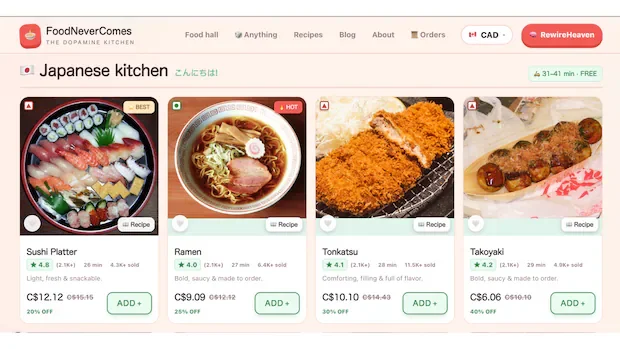
One example is FoodNeverComes, a fake food-delivery site launched in late June that has attracted around 92,000 active users over the last 90 days, according to the site's co-creator Anshul Sharma. They can fill their carts with meals and drinks, go through a mock checkout and follow their order being processed on a virtual map as it’s being “delivered.”
Sharma and his co-creator Purvansh Parmar, both based in Udaipur, India, say the self-funded, ad-free site has recorded about 1.1 million interactions.
The U.S. is its largest user base, says Sharma, followed by China, the U.K. and Vietnam, with Canada coming in third or fourth.
For Parmar, the project hits close to home. He says he struggled with excessive food-delivery orders himself, spending up to 20,000 rupees ($200.70) a week before realizing he had fallen into a cycle of compulsive spending for the convenience.
"I guess it was so easy, you just 'click-click-click,' get the food," he said. "You think you like the food, but in the end, it isn't actually the reason.”
To help users break the habit of online shopping, the duo also shares recipes to encourage people to cook at home instead of ordering in.
The psychology behind the cart
Rhia Catapano, an assistant professor at the University of Toronto who studies consumer behaviour and psychology, says online shopping simulators can activate “the same parts of our brain that doing the actual activity would.”
That's particularly appealing for budget-conscious young people.
“Like playing a video game or dreaming about a vacation that you're never actually going to take, we can imagine a thing,” she said. “In some way, it gives us some of the same psychological benefits.”
But whether the sites are truly helpful depends on why someone is using them, says Catapano.
They may be useful for someone trying to replace purchases they can't afford or don't really want, but not if they’re used to escape negative emotions.
Ajay Shrestha, a professor at Vancouver Island University who studies internet safety and young people, says people should also be vigilant about entering their personal information into the sites.
“When something is humorous, entertaining, gamified or deliberately made to feel consequence-free, people can naturally lower their guard."
Shopping without the environmental cost
The Imaginair store launched online at the end of March offers everything from clothes and footwear to accessories. Users can browse, add items to their carts and go through a mock checkout.
But woven into the familiar experience are environmental messages, like a pair of sweatpants described as “Protect the planet, in comfort," and a leather belt with a description "To reduce consumption, just tighten your belt."
Yves Gauthier, operations and mobilization manager at Earth Day Canada, says the site is intended to raise awareness about the environmental impact of online shopping, for an Earth Day campaign.
Indicative of how deeply consumerism has taken hold, the campaign proved popular, attracting about 30,000 visitors, with roughly 7,000 people spending "more than a minute going around the pages clicking on things." About half of those users, he says, went on to complete the mock purchase process.
Gauthier says platforms like Temu, Amazon and Shein have made it easier than ever to buy almost anything at the touch of a screen, fuelling a culture of overconsumption.
The site, he says, draws attention to the environmental costs of mass production, excessive packaging and transportation-related pollution, while encouraging users to pause before buying something new.
Users are prompted to consider alternatives such as shopping second-hand, exchanging goods with neighbours or repairing things they already own.
If everyone in the world consumed like the average Canadian, according to the Global Footprint Network, we would need the equivalent of 4.49 Earths to sustain that level of consumption.
A way out of the cycle?
The sudden popularity of these sites, says Catapano, shows just how deeply consumerism has become integrated into our everyday lives, with people willing to spend time and effort browsing and “shopping” even when they know nothing will ever arrive.
But she sees a glimmer of resistance, too.
Some people, she says, are realizing through these sites that their shopping habits aren’t serving them — and are looking for ways to consume less and make more intentional choices.
“They recognize that what they're doing is not good for them, so they're trying to make changes.”
Interview with Rhia Catapano produced by Meli Gumus