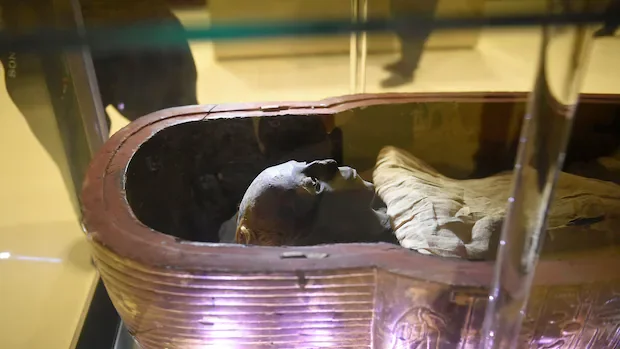
People are trading mummified human remains online. Some scientists say that may be bad for their health
New study warns body parts could have dormant fungi, bacteria — and that traders risk exposure to them
It's not something most people would picture being inside your average delivery package, but scientists say there's a global market online for preserved human remains — a niche hobby they say poses potential health hazards.
In a study published in the International Journal of Cultural Property, lead author Kirsty Squires and her team analyzed 128 web posts from 2015 to 2025 showing off or advertising remains from both humans and animals for sale.
"Mummified heads, hands and feet were very common," said Squires, a bioarchaeology professor at the University of Staffordshire in Stoke-on-Trent, England.
Mummified body parts can harbour dormant microorganisms — such as bacteria, fungi and yeast — that the researchers warn could cause health issues for some people when not properly handled, though some experts say there's not much cause for concern for collectors who know what they're doing.
How to safely handle a mummy
Squires said a number of the online images showed "visible signs of deterioration of remains, and this is primarily caused by poor storage conditions."
In museums, mummies are kept in safe storage where temperature and humidity are strictly controlled.
"But if remains are kept in, you know, homes or garages or wherever they are holding these bodies or body parts, they're not going to be … experiencing controlled environmental conditions," she said.
Handling those remains could release hidden fungal spores or bacteria, which can survive in mummified human tissue for centuries or more, into the surrounding air, the researchers say.
When Squires handles human remains as part of her research, she wears protective equipment.
In some of the photographs, she says sellers did not use gloves.
Squires says immunocompromised individuals could be at risk if exposed to airborne microorganisms, which she says could affect the lungs as well as irritate skin and eyes.
Some mummified body parts can also have traces of highly toxic chemicals on them, such as arsenic and mercury, that have been found in 19th and early 20th century embalming fluids, according to the study.
The real mummy's curse
The paper does not say how many people, if any, have become sick from handling human remains sold online, but there are cases where coming face to face with historical human remains has proved fatal.
In 1973, 10 out of 12 conservation scientists died after inhaling Aspergillus spores — a common mould — after opening the 15th century tomb of King Casimir the Fourth of Poland.
Some have speculated airborne fungal spores were a factor in the death of British archaeological patron Lord Carnarvon in 1923, who may have been exposed inside the burial chamber of Tutankhamun. His death six weeks after entering the chamber sparked rumours he had been "cursed" for disturbing the Egyptian pharaoh's resting place.
But James Scott, a professor at the Dalla Lana School of Public Health in Toronto who studies biological hazards, says he's more concerned about the ethical questions posed by this kind of trade than any potential health hazards.
"I feel like the concerns in this paper are a bit misplaced," he told CBC News in an email.
"Obviously no mould is ideal, but a small amount accords with a low risk. For a collector who is likely to store an item like this in a protective enclosure rather than handle it closely (and if so, probably with gloves), I don't see any issues."
A glimpse into Canada's mummified human remains market
Out of the posts examined by the researchers, 11 were made by individuals in Canada.
That does not surprise Shawn Graham, a digital archaeology professor at Carleton University in Ottawa who has studied the online trade in human remains. He says dealers in Canada are not hard to find, and that selling and buying is not regulated in a "meaningful way."
The Canadian Border Services Agency told CBC News that, for shipping across Canada's borders, officers "may make an admissibility determination and may refer the remains to a [Public Health Agency of Canada] quarantine officer for further inspection."
Canada Post said in a statement that they do not permit the mailing of mummified human remains. Only cremated human remains are allowed, and have to meet specific requirements for shipping.
Private shipping companies Purolator and UPS explicitly state they do not allow the shipping of human remains.
But sellers can often avoid prying eyes, Squires says.
"People can easily just state that they are sending archaeological samples when they are sending, you know, mummified heads," she said. "They're not being specific, they're not being checked. So it's a real problem that's easy to get around."
As a result, postal workers may not know what they are carrying.
"If packages become damaged, you know, anyone that's handling those remains [is] at risk," Squires said.
Should the online trade of human remains be banned?
Graham says mummified remains are particularly sought-after by this collecting community, and that social media has made it easier for sellers and buyers to find each other.
Only some dealers stated where the remains came from geographically. Out of those that did, the majority were claimed to be from Egypt and South America.
"It's not typically white European populations whose materials, whose ancestors, whose bodies, whose bones are being bought and sold and commodified," said Graham.
"It is a kind of colonialism and appropriating of other people's bodies as things to buy and sell."
In February, a bill was introduced in the House of Commons in the U.K. that sought to ban the online sale of human remains.
Graham wants Canada to consider a similar law.
"I would like to see trading in human remains to be something that's explicitly not allowed," he said.
"When you turn humans into things, I think that is a sign of nastier ideas."