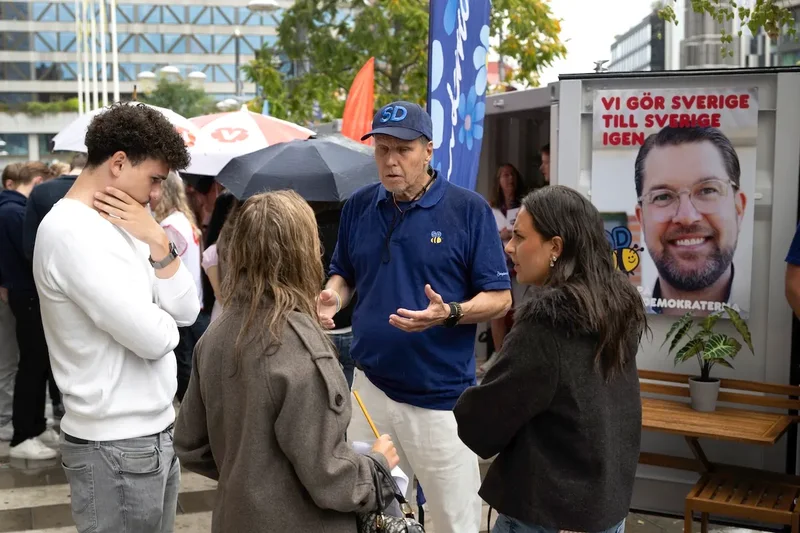
If you despair of the political polarisation ripping global societies apart, I can think of no better remedy than half an hour spent at one of the collections of valstugor, or election cabins, that will be springing up in town squares across Sweden this weekend.
You'll find groups of Social Democrats serving coffee, selling merchandise and answering questions right next to a rival group from the far-right Sweden Democrats or Moderates doing exactly the same. And you don't have to chat to the activists for long to realise that even those whose views you vehemently disagree with are by-and-large friendly and well-meaning.
Often you'll stumble upon a local city councillor, or even an MP, and they are normally willing to answer any question you ask them, one-on-one. It's a fantastic way of getting to understand, not just what a party stands for, but what its culture is and what sort of people support it. It's also a great way to practice your Swedish.
I recommend a visit even if you don't have the right to vote in the national elections. Remember that voting at a municipal and regional level can have an enormous impact on the resources parties have access to and the number of politicians they can employ, and this in turn can empower them to drive through policies at a national level.
I always walk away from a lunch break touring the cabins beaming. For me, it's a sign of the openness of Swedish society and of how impressively healthy and alive the country's democracy is at a local level.
Indeed, I liked them so much that I named them as one of twelve things about the country that make me smile in an article back in 2023 – and that wasn't even an election year.
**Election news **
Another key moment in the run-up to Sweden's election happened on Monday as voting cards started landing in people's inboxes.
There were two polls published this week, one from SVT and Verian and the other from Novus for TV4. Neither showed the pro-government parties closing the gap on the opposition in the dramatic way that a poll by Demoskop did last week. This is likely to damage the credibility of the pollster, which is owned by the right-wing lobbyist Peje Emilsson and in April published another anomalous poll which put the Liberals safely over the parliamentary threshold.
The party that saw the biggest jump in this week's polls was the Centre Party, and it used the attention to reiterate its preference for a centre coalition with the Christian Democrats, Social Democrats and Green Party, excluding the Left Party.
The far-right Sweden Democrats increasingly seem to have abandoned any attempt to help the right-wing bloc win the election, with Jimmie Åkesson saying it is 'not our role to rescue the Liberal Party', which he added was his party's ideological opposite, at least within the right bloc. Instead, he says, he is focusing on the 2030 election, when he hopes to become prime minister.
The party caused controversy this week after a bus company had to take down adverts the party placed on its buses encouraging Somalis to return home to Mogadishu using the government's new re-emigration grants. More than 20 Somali bus drivers called in sick, saying they would not return until the adverts were removed.
**Brexit news **
The issue of Brexit-related deportation orders remains in the news, with a Swedish MP submitting a written question in parliament to Migration Minister Johan Forssell, asking him what he planned to do about it.
I explained why Sweden is seeing a second wave of post-Brexit deportations, while James Savage argued in an opinion piece that the European Commission was failing in its duty to protect the rights of British citizens in Sweden.
We had hoped to get an interview with the Migration Agency's legal chief, but she called in sick just before our interview, so we instead interviewed the agency's press chief Jesper Tengroth.
He doggedly stuck to the agency's line that it has not applied the UK Withdrawal Agreement in a stricter way than other EU member states, arguing that at least part of the difference boils down to how data is collected.
**Migration news **
Sweden granted fewer than 100 citizenships in July, the first full month since the new citizenship rules came into effect, down from 1,646 in June and 3,970 in May. The Migration Agency warned that the statistics should be interpreted with caution, as it isn't at the moment making any decisions on applications awaiting a result on the citizenship tests.
The results won't come until October, but the first civics test was held on Saturday. The examinees The Local spoke to seemed mostly confident that they'd passed, although they did complain that the test included language and questions that had not been in the preparatory booklet.
With the family reunion bill last week, Sweden's government passed its last piece of migration legislation of the mandate period. So now the so-called 'paradigm shift' is complete, I summed up all the main ways that migration rules have become stricter for foreigners living in or coming to Sweden over the past four years.
Last but absolutely not least, we published the latest in Mandy Pipher's series on foreigners in Sweden divided by their immigration status. While Bijan, an associate professor at Chalmers Institute of Technology, and his eldest daughter are already Swedish citizens, his wife Shima and their youngest daughter are both on temporary permits.
If they'd known how complicated immigration rules were in Sweden, Bijan says, the family would never have moved from the UK. "It's too complicated, and also because of treating family members in different ways. I'm a bit sorry to use this word, but it's a bit medieval."
You can also hear Luisa and Gustav, the first in the series, explain their plight in this week's Sweden in Focus Extra.
**What else have we been writing about? **
A new study revealed interesting gender differences in job discrimination against people with foreign names. Men with foreign names seem to suffer worse discrimination than women, and while some jobs, like cleaning or driving, seemed not to suffer discrimination, others, like pre-school teachers and IT support roles, absolutely did.
We launched our own survey of readers to find out if any of you have suffered discrimination when applying for jobs in Sweden.
Good news for Indian readers (and Indophile tourists) in southern Sweden. SAS has launched a direct route from Copenhagen to Mumbai, its first direct route to India from Denmark in 17 years.
Niranjan Nithyanandam, an occasional The Local reader, was in the news this week when he and another passenger prevented a serious bus accident by steering a bus and slowing it down by deliberately nudging the central reservation barrier, after the driver fell unconscious with his foot on the accelerator.
Just as we were wrapping up for the day on Friday, news came in of a horrific sword attack at a school in Fagersta, 200km northeast of Stockholm.
One person died and three were wounded. Swedish broadcaster SVT reported that the perpetrator, who has been detained, had a previous assault conviction and was wearing a helmet and carrying a sword – reminiscent of an October 2015 school attack in the western town of Trollhattan.
On Monday, we'll publish an interview with another victim of post-Brexit deportation. I have also spoken to Annika Hirvonen, from the Swedish Green Party, who called on the government to bring back the "particularly distressing circumstances" safety clause to prevent more elderly and vulnerable British citizens from being deported.
We'll keep you updated on any developments in the school attack over the weekend.