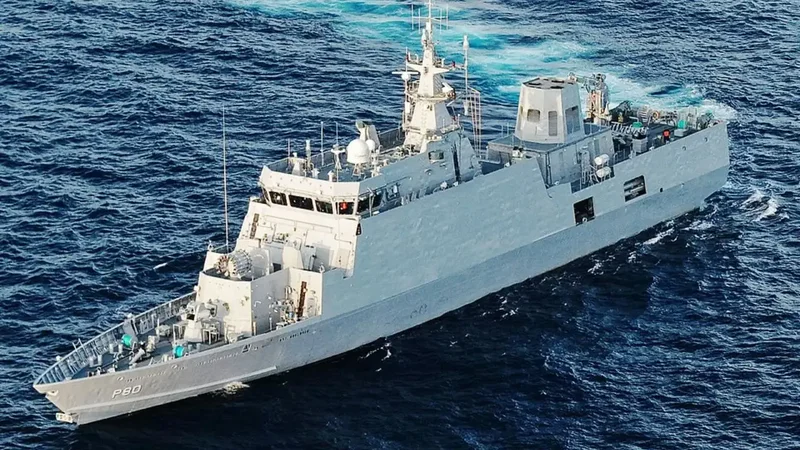
The
Indian Navy has received Mangrol, the third indigenous Anti-Submarine Warfare Shallow Water Craft (ASW-SWC) built by
Cochin Shipyard Limited (CSL), strengthening its ability to detect and counter underwater threats in coastal waters.
Mangrol, which was delivered on Friday, is part of an eight-ship programme and has more than 80 per cent indigenous content. It is equipped for underwater surveillance, anti-submarine warfare, mine warfare and low-intensity maritime operations.
The eight Mahe-class ASW-SWCs are being built by Cochin Shipyard Limited for the Indian Navy. The programme is focused on developing compact, highly manoeuvrable platforms for anti-submarine operations in shallow coastal waters.
Powered by waterjets, Mangrol is equipped with advanced torpedoes, anti-submarine rockets, radars and sonar systems, giving it the capability to detect, track and engage underwater threats in shallow coastal waters.
Mangrol is named after the coastal town and minor port of Mangrol in Gujaratâs Junagadh district, an important harbour for the regionâs marine fishing industry. The name also carries forward the legacy of the erstwhile INS Mangrol, an Indian Navy minesweeper that remained in service until 2004.
Indiaâs ASW shallow-water fleetThe Indian Navy is expanding its anti-submarine warfare capability through specialised shallow-water craft designed to operate in coastal areas. These vessels provide dedicated platforms for detecting, tracking and countering submarines in waters where larger warships may have operational limitations.
The Navy is pursuing two indigenous ASW-SWC programmes, with eight vessels being built by Cochin Shipyard Limited (CSL) under the Mahe-class programme and another eight under the GRSE-led Arnala-class programme, with Larsen & Toubro also involved in construction.
The Mahe-class vessels are designed for coastal and shallow-water operations, with their primary role being to detect, track and engage enemy submarines. They can also undertake coastal surveillance, search and rescue, low-intensity maritime operations and mine warfare.
The vessels are 78 metres long and have a displacement between 896 and 1,100 tonnes. They can reach a maximum speed of 25 knots (45 km) with a range of around 1,800 nautical miles ( 3,300 km) at a speed of 14 knots (25 km) and an endurance of up to 14 days.
A key feature of the class is its waterjet propulsion system. The vessels are powered by three marine diesel engines, each coupled to a waterjet. Unlike conventional propellers, waterjets draw water through the hull and expel it at high speed, providing high manoeuvrability and acceleration while allowing the vessels to operate effectively in shallow waters.
The propulsion system also helps reduce underwater noise and lowers the risk of damage from underwater obstacles, making it particularly suited to anti-submarine warfare operations.
The Mahe-class carries a dedicated ASW weapons suite, including a forward-mounted RBU-6000 anti-submarine rocket launcher, 324 mm lightweight torpedo tubes for advanced lightweight torpedoes and mine-laying rails. The vessels are also equipped with torpedo decoy systems for protection against incoming underwater threats.
For surface warfare and self-defence, the ships feature a 30 mm naval gun and two 12.7 mm stabilised remote-controlled guns, providing additional capability against surface and asymmetric threats in littoral waters.