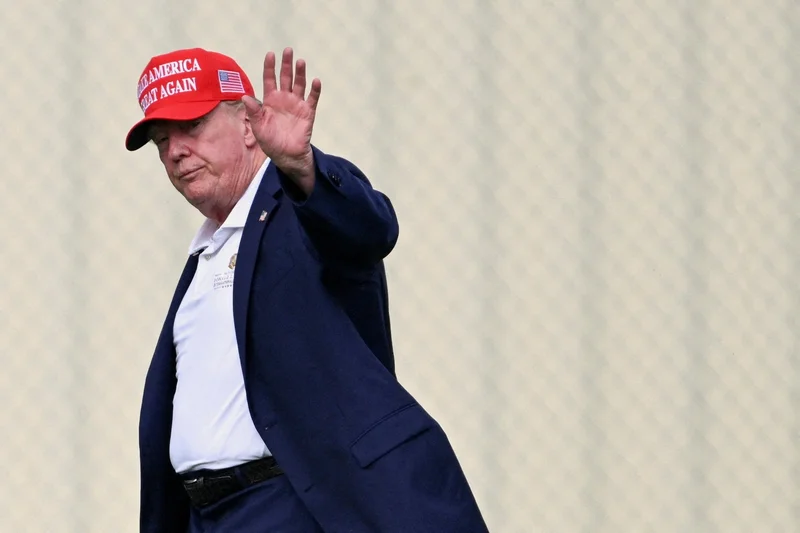
With the Iran war now locked in a costly standoff and conflicts from Ukraine to Gaza still unresolved, President Donald Trump's ambitious foreign policy agenda appears increasingly stalled as he heads toward November's midterm elections.
The setbacks are striking for a president who returned to office last year promising to be a "peacemaker" and made resolving international conflicts a central pillar of his second-term agenda.
Trump has grown increasingly impatient with questions from reporters and criticism from U.S. allies. This week, he lashed out at journalists pressing him about his foreign policy record and renewed his threat to bomb Oman, a U.S. ally involved in negotiations with Iran over reopening the Strait of Hormuz.
Labor Day, which falls on Sept. 7 this year, traditionally marks the point when U.S. election campaigns accelerate. Republicans now face the prospect that unresolved conflicts abroad, along with their economic consequences at home, could threaten the party's hold on Congress.
Trump has called off talks with Tehran after pushing for weeks for a diplomatic solution and announced Wednesday a new campaign of "economic warfare" against the Islamic Republic, in an apparent acknowledgment that months of military attacks have not forced the concessions the U.S. wants to see.
As inflation persists and the Iran war drives up gasoline prices, Trump's approval rating has fallen to another low point, with just 33% of Americans in the latest Reuters/Ipsos poll approving of his performance.
Other efforts to broker peace have also stalled.
On Monday, Trump's negotiator and son-in-law, Jared Kushner, left empty-handed from talks aimed at advancing a Gaza peace deal. An expected visit to Kyiv by Kushner and Trump envoy Steve Witkoff to revive long-stalled negotiations to end Russia's war in Ukraine has yet to happen.
After a string of early foreign policy achievements, including a Gaza ceasefire and the capture of Venezuela's leader, Trump's record has become increasingly defined by stalled diplomatic efforts.
"Trump has successfully challenged and disrupted the comfortable foreign policy consensus in Washington, but has not translated that disruption into a strategy with deliverables for Americans," said Asli Aydintasbas, a fellow at the Brookings Institution in Washington.
The conflict with Iran has weighed "intensely" on the president, and there is no consensus inside the White House on how to resolve it, one Trump ally said on condition of anonymity.
The pressure could increase if investors conclude the war will drag on, driving up U.S. borrowing costs and further constraining Trump's domestic agenda. Trump has said the economic costs are worth it to ensure Iran does not obtain a nuclear weapon, despite Iran's denials that it seeks one.
"President Trump has successfully made America respected again, and the results speak for themselves: Nine wars have ended, hostages have been freed from Gaza, trade deals are fairer, and now, Iran will be prevented from ever possessing a nuclear weapon," said White House spokesperson Anna Kelly.
A senior Trump administration official said U.S. sanctions and a naval blockade had crippled Iran's economy and left it "completely broke," adding, "There are many levers the president can crank harder in the weeks ahead."
Some experts give Trump credit for a willingness to grapple with issues they believe other presidents have been unable or unwilling to solve.
"The president wants a more stable world, and that means attempting to resolve disputes, whether hot like Ukraine or cold like trade and overcapacity," said Nick Snyder, a senior fellow at the Hudson Institute, adding that Trump also worked to settle conflicts between Rwanda and the Democratic Republic of Congo and between Thailand and Cambodia.
Trump has upended traditional diplomatic norms of peacemaking, relying on America's economic and military might, including against U.S. allies, but that unorthodox style has yielded mixed results.
He brought parties to the table with the aim of ending Russia's invasion of Ukraine, but the longest war in Europe since World War II is nowhere near ending, with the latest Russian airstrikes killing 16 people in the Ukrainian capital on Thursday.
In Gaza, mediators fear intensifying Israeli strikes on the enclave are undermining efforts to end the conflict as both Israel and Hamas balk at conditions needed to advance a peace plan Trump forged in October last year. In Lebanon, Israeli airstrikes killed 11 people Sunday even as a U.S.-mediated peace framework between the two countries remains in effect.
One notable success came in Venezuela, where the U.S. military captured President Nicolás Maduro without U.S. casualties. Analysts say the operation helped convince Trump that joining Israel in attacking Iran would also proceed smoothly.
But they say that proved to be a miscalculation. They argue Trump has relied too heavily on applying coercive pressure even though Iran's leaders have little incentive to back down and reopen the Strait of Hormuz despite the country's weakening economy.
"He is obsessed with applying coercion, and sometimes flattery, to bend others to his will, but oblivious to their strategic goals and domestic politics. As a result, he keeps flailing and failing," said Stephen Wertheim, a senior fellow at the Carnegie Endowment for International Peace.
Meanwhile, the political clock is ticking, with Trump's Republican Party facing elections that could cost it control of one or both chambers of Congress and sharply curtail his ability to advance his agenda during his final two years in office.
Analysts say Trump's reliance on coercive pressure can bring adversaries to the table but often fails to produce lasting settlements, a dynamic that may encourage rivals to wait him out.
"U.S. adversaries understand that his political clock is shorter than theirs, and that while the United States can apply enormous coercive pressure, it may eventually lose patience," Aydintasbas said.
"Putin, Xi and Iran may therefore want to wait out Washington. After November, the incentive to wait out Trump will become even more pronounced."