Sign in. It’s quick, free and it’s up to you.
An account is an optional way to support the work we do. Find out more.
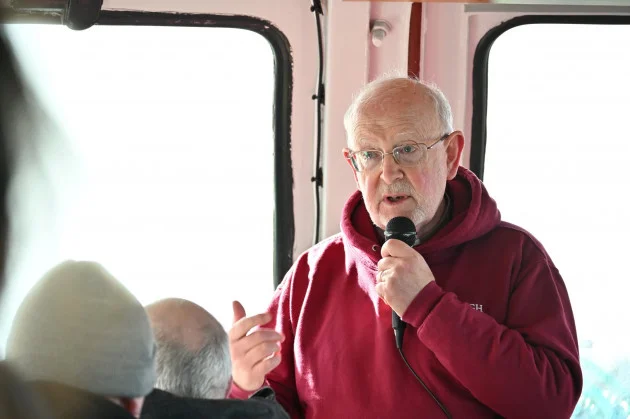
THIS MONTH, MONSIGNOR Laurence ‘La’ Flynn stepped down from his role as Prior of Lough Derg after a nine-year stint.
St Patrick’s Purgatory, more commonly referred to as Lough Derg because of its location in the lake of the same name in Co Donegal, is a pilgrimage site dating back to the 5th century.
It’s famed for its austere three-day pilgrimage in which people undertake a programme of fasting, prayer and quiet reflection in bare feet.
The Prior of Lough Derg leads the spiritual and pastoral life of the pilgrimage site, welcoming thousands of pilgrims each year for the three-day pilgrimage, one-day retreats and other programmes.
Flynn oversaw his final three-day pilgrimage at Lough Derg last week, though he didn’t participate in the entirety of this year’s pilgrimage himself.
After the final Mass on the pilgrimage, it’s tradition for the Prior to speak a few words on how it went.
“Although the official announcement wasn’t out, it had been no secret for some time that I would be finishing up this year.
“It was my chance to thank the pilgrims and to appreciate some of them who had been kind enough over the previous few days to say things like, ‘Oh, we hear, Father, that you’re going, you’ll be missed, and the island won’t be the same without you’.”
When asked what is so special about Lough Derg, Flynn said he could give a “thousand answers”.
He has undertaken the three-day pilgrimage over 40 times, first as a teenager in secondary school.
Sometimes he undertook the pilgrimage because he had “something in particular that I wanted to pray about”, but on other occasions he said, “I would have come here just because it was that time of year”.
He first arrived at Lough Derg as a staff member two years after he was ordained.
He says the pilgrimage offers people an “opportunity to talk personally, deeply and in confidence about where they are in their own faith journey”.
“It’s a very privileged space to be in,” said Flynn. “It was here that I have learned to listen to people beyond the surface.
“In our present world, deep listening is maybe being taken for granted and so much of what passes for communication is fast and furious.”
When Flynn was a teenager in the 1960s, there was nothing peculiar about someone of his age undertaking the pilgrimage at Lough Derg.
Flynn said the numbers of young people doing the pilgrimage “declined dramatically through the 1980s and 90s”.
However, he said “we are noticing the beginning of an increase in that cohort”.
Close to 4,000 people undertook the three-day pilgrimage this year and Flynn said that as a percentage, young people are on the increase.
“There’s a quiet and steady increase in young men, from their early mid-20s through into the mid-30s, who come here,” said Flynn.
“Last year, there were a group of five lads in their local GAA jerseys and here they were together on their pilgrimage.”
Pilgrims are asked to set aside their phones while on the island, but Flynn said “resistance” to this has declined over the years.
“We used to have to persuade and motivate people to do this, but there’s no sense that we have to police that now.
“We hear people, particularly that younger cohort, saying there’s a kind of freedom in not having to respond immediately to everything that pings on your phone.
“There’s a bit of space for your head, and people appreciate that.”
Flynn recently turned 75, the age at which priests submit their resignation. However, many priests continue beyond this.
Some continue beyond 75 because they want to, while others feel they have to.
“As far as I know, I’m healthy,” said Flynn.
“While I’ll not be running a parish, I’m going to be living in north Monaghan and I’ll be available to help out with ministry there.”
Flynn said he’ll be “taking my turn on Masses” and that he will “take on some funerals, especially in the case where three or four funerals turn up in the one week”.
However, Flynn said there are “contemporaries of mine, and people maybe a few years younger, that are looking forward to the time when they can step back a bit”.
Flynn then adds that he has always been aware of the need for “self-care”.
“Self-care is about the time to attend to the inner things, as well as the outer things.
“I know that there are priests who have not been well, priests who struggle sometimes with their emotional or mental health.
“I don’t take it for granted that – thank God – my head is in a good place and that I’m happy and contented.”
While Flynn acknowledges that he now “runs out of energy earlier in the day than I used to”, he added: “Thank God, emotionally and inside myself, there’s plenty of energy still there.
“There’s kind of a saying,”, adds Flynn, “and I suppose it’s true of any of us but as a priest, you have a choice: you can either burn out or rust out.
So please God, I’ll burn out rather than rusting out.
However, Flynn noted that priests are now being aided by laypeople, which was not the norm when he started.
“That’s the direction of travel, we are moving into a time when more laypeople, thanks be to God, get the message that the Church is their Church.
“Priests have become scarce, and so the Church has to face up to the reality that it does not belong to the priests in a way that it was seen to in the past.”
Flynn added that while he doesn’t view his ministry as a “burden or as an exhaustion”, his situation in Lough Derg, where he had a team around him, is different to the situation many priests find themselves in.
“I know in parish situations, one of the burdens is that a parish that had three or four priests in the past, now only has one or two, but the same number of funerals are coming.”
Flynn then paused and acknowledged that this isn’t entirely the case, as more people opt for funerals and weddings outside the Church.
Another area of change is in baptism rates.
The number of children baptised into the Catholic Church in Ireland has dropped by 30% in the past decade, according to figures compiled by the Iona Institute.
When asked about the future of the Church in Ireland, Flynn remarked that it is “ultimately in the Lord’s hands”.
He added: “One of the things that gives me hope is that we in Ireland – in the decline of the traditional Church as we knew it – is being challenged into rethinking the way that we have been a Church.”
His Diocese of Clogher, for example, is home to a priest from Kitui in eastern Kenya and two other priests from the region have been in Lough Derg for the summer.
“While they have plenty of vocations to the priesthood in Kenya, the Church is in no way controlled solely by priests, as it was in Ireland when we had plenty of priests.
“The increased number of priests haven’t taken over the running of the Church from the laypeople that are engaged at a local level.
“The Church in Europe is old and tired, but my sense is that it is learning to waken up to so much that is happening elsewhere that we in Europe can learn from.”
Monsignor Joseph McGuinness has now taken up the role of Prior of Lough Derg.
McGuinness helped Flynn for two weeks of the pilgrimage season during his time as Prior, and Flynn now hopes that he can return the favour to his successor.
“I’m hoping that I’m not by any means saying goodbye to Lough Derg just because I’m no longer Prior.”
To embed this post, copy the code below on your site