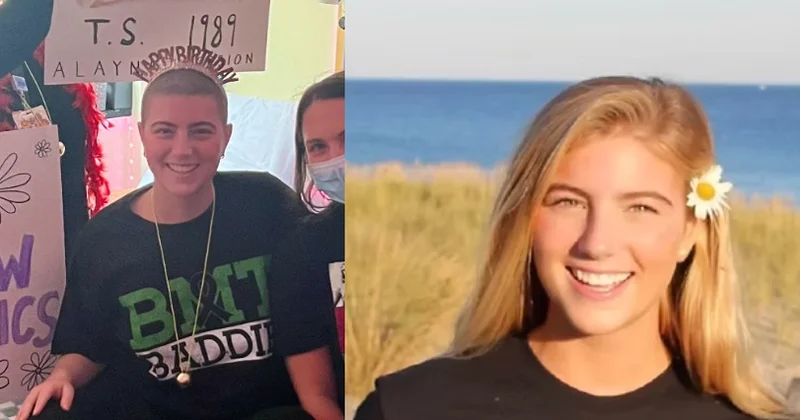
Alayna Riozzi-Bodine had expected the summer before her senior year of high school to be tiring. She was a lifeguard at her local New Jersey beach and training for a triathlon, all while preparing for the upcoming school year.
Still, she found herself utterly exhausted, "mentally and physically." The day before her race, she told her dad that she felt like she was dying. One month later, her mother noticed a mass the size of a golf ball over her right clavicle. The discovery set off a whirlwind of medical appointments and tests. High school faded into the background.
"I didn't even attend my full first week of senior year," Riozzi-Bodine said. "I was like, 'How is this happening to me?' I honestly couldn't believe the position I was in."
Riozzi-Bodine was diagnosed with Stage 2 Hodgkin's lymphoma in September 2021. For a young woman in the "prime of athleticism," the news was shocking — and devastating.
"I remember sitting in the room getting the diagnosis. The first couple thoughts that ran through my head — first, 'Am I going to live?'" Riozzi-Bodine recalled. "And then, second, it was 'Am I going to lose all my hair?' Being 17, being an adolescent, your hair is such a big part of your identity. When you think of a cancer patient, your mind goes to someone who is bald. I was really scared of losing myself through treatment. I was honestly terrified of it."
Fighting for "a sense of control"
Lymphomas are a kind of cancer that affect immune cells, said Dr. Brian Hill, the director of the Lymphoid Malignancies Program at the Cleveland Clinic's Taussig Cancer Institute and who was not involved in Riozzi-Bodine's care. Hodgkin's lymphoma typically presents with an enlarged lymph node, usually in the neck or armpit, Hill said. Patients may also have fatigue, unexplained weight loss, fevers or "drenching" night sweats, Hill added. Typically, chemotherapy is the first line of treatment.
Riozzi-Bodine wanted to fight the cancer while protecting her future. She and her mother quizzed her medical team at Memorial Sloan Kettering Cancer Center about preserving her future fertility, which led her to , and pushed for the use of a cold cap, a then-groundbreaking treatment that can prevent hair loss during chemotherapy.
At the time, the cap was not approved for lymphomas, said Dr. Maria Luisa Sulis, Riozzi-Bodine's primary oncologist at MSK. Riozzi-Bodine became the first pediatric patient there to use it.
"I feel like it did give me a sense of control, in a situation when you really have no control," Riozzi-Bodine said. "I felt like myself. I could look in the mirror and I could see myself."
Riozzi-Bodine underwent eight sessions of chemotherapy, juggling infusions and college applications. She had already been applying to schools with nursing programs, but her experience as a patient only strengthened her desire to enter the profession.
She responded "very, very well" to the chemo, Sulis said. During her freshman year of college, she was declared cancer-free.
But the relief didn't last long. A scan picked up a small abnormality less than a year later. Even before it was tested, Riozzi-Bodine knew it wouldn't be good.
"One thing about Hodgkin's, you get this feeling. I can't really describe it, but it almost feels like you're swollen or bruised internally," Riozzi-Bodine said. "I started to get that feeling again. I knew it was cancer again."
"Some of the hardest days"
The biopsy confirmed Riozzi-Bodine's cancer had returned. The development was "somewhat unexpected," Sulis said, because Riozzi-Bodine's initial disease had been low-stage.
The recurrence was more aggressive. This time, Riozzi-Bodine's treatment would not be compatible with the cold cap. She decided instead to shave her head.
"It was hard. I felt like I fought so hard to keep it all the first time, keep it part of my identity the first time, and to have it taken away a year later didn't feel real," Riozzi-Bodine said. "It didn't feel like my reality, but it was, and I had to step up and face it head-on."
Riozzi-Bodine underwent immunotherapy and more chemo, and worked on exams and papers to keep herself busy. She picked up summer classes to stay on track with her degree and decorated her hospital room so it felt more like home.
About halfway through her regimen, Sulis determined that she would need a stem cell transplant, something Riozzi-Bodine had hoped to avoid.
A stem cell transplant is often done for patients whose Hodgkin's lymphoma recurs, Hill said. Doctors collect stem cells from the patient's bone marrow. The patient then receives high doses of chemotherapy, which destroys the body's bone marrow and cancer cells. Then, in a process that "resembles a blood transfusion," the stem cells are infused back into the patient. The stem cells then essentially rebuild the body's immune system.
Riozzi-Bodine was "scared and nervous" to undergo the procedure. But her nurses and care team made the day of her transplant like a party, with music, Taylor Swift-themed posters and Eras Tour T-shirts. The two-hour infusion "felt like maybe 10 minutes," Riozzi-Bodine said.
"It was probably one of the hardest moments of my life. But they made the time go by so quick," Riozzi-Bodine said. "It was so much fun, which sounds crazy, but it was awesome."
The transplant was a success, and was followed by six weeks in isolation to allow her immune system to recover. Again, her care team was invaluable.
"I just wanted to stay positive, and I couldn't have done it without my nurses," Riozzi-Bodine said. "They really helped carry me through some of the hardest days."
"Thriving and surviving"
Riozzi-Bodine completed her treatment in July 2024, and celebrated by ringing the bell at Memorial Sloan Kettering. She recently passed a milestone: Scans taken in July show that she remains cancer-free two years later.
Riozzi-Bodine will continue to undergo regular scans, but will otherwise be able to live life "as if nothing ever happened," Sulis said. Hill said that if a Hodgkin's lymphoma patient remains cancer-free for five years, the odds of a future recurrence are "extremely low."
Today, Riozzi-Bodine is a cancer-free college graduate. After finishing her nursing degree in May, Riozzi-Bodine began pursuing qualifications to become a pediatric oncology nurse, so she can help future patients the way her nurses cared for her.
She also manages the Alayna Jayne Foundation, an eponymous organization that offers resources for teen cancer patients who are too old for the "tiny little baby chairs" of pediatric care but aren't yet ready for the "cold gray" sterility of adult oncology. It also advocates for the use of the cold cap and provides scholarships to high school and college students.
"I'm doing everything that I wanted to do. I'm looking towards the future," Riozzi-Bodine said. "Life is going good. I always say I'm thriving and surviving."