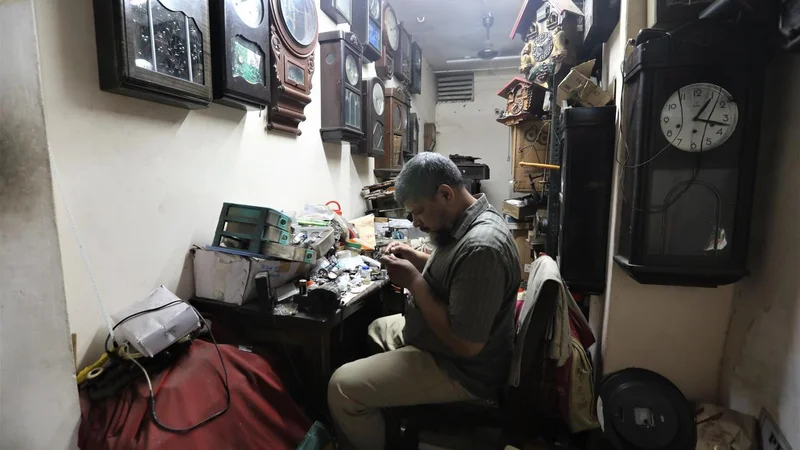
On that part of Kutchery Road, where the Buckingham Canal flows sluggishly under a bridge, S. Shakil Ahmed operates from a shop smaller than a niche in a dovecote. The shop was once larger, recalls Shakil, but as the owner reclaimed a part of it for another enterprise, it shrunk to its present dimensions. But this small shop still catches the eye for its wall displays: clocks, either demode or delectably antique, depending on the eye beholding them. Another eye-catching feature is the enseigne above the entrance that announces the enterprise as Peer & Sons. When quizzed about the name and its homonymic alignment with the iconic P. Orr & Sons on Mount Road, Shakil sounds a tad amused as he offers a reply: obviously, when they see this shop, they know the two are galaxies apart. But when they hear the name ‘Peer & Sons’ over the phone, they would be confused for a split second. And the name was not carefully chosen to evoke that iconic shop, remarks Shakil, just to reflect that it was started by his father S.K. Peer.
S.K. Peer had opened this shop in 1963 and continued in the saddle till his demise in 2008. Shakil relishes reminiscing about the unquestioning obedience with which he followed in his father’s footsteps, not in 2008 but way back in 1991 when the senior was at the height of his prowess as a mender of timepieces and he was just a school student. Shakil joined his father as his understudy in 1991, right after finishing his Class X board exams.
“I did not even wait for my results,” he says with a faint laugh at the memory.
“If my father asked for something, it was always a yes,” states Shakil, his decision driven by a straightforward logic: if his father needed him at the shop, that was reason enough to be there.
He observes that for parents to get a ‘yes’ from their children today, they would have to first answer a gazillion ‘whys’. Shakil, who has three children, two girls and a boy, all of them falling within the Gen Z bracket, is at peace with the current generation’s questioning mindset as they are spoilt for choice in terms of career options, and have information at hand to suss those careers out.
Hands-on training
What began as an attempt to help his father in this metier, turned into a deep-rooted passion for mending the keepers of time. Watching his father repair watches and clocks, he was fascinated by the work, the patience it demanded and the power one felt when they got the timepiece ticking again. He was actively trained in this craft by his father, and Shakil proudly admits the way he repairs timepieces is rooted in that hands-on training.
To the question, if he has ever regretted not having taken a different career path, Shakil’s answer is a ‘no’, but he qualifies it by admitting that on rare occasions, the thought has crossed his mind. That thought most likely occurred during the pandemic and in recent times, on account of Metro Rail work at the Luz Corner (where Kutchery Road meets Luz Church Road meet) restricting access to his shop. That thought gets counterbalanced by his awareness of the benefits of being one’s own boss.“If there is a function, I can attend it without prior leave complications; if I want to travel, I can take a few days off and do so,” he smiles.
He has commendably built a livelihood just by the practice of the craft of repairing timepieces, has managed to give his children good and meaningful education (the two daughters are in college and the son in school).
After his father’s death in 2008, Shakil has been running the shop in a veritable one-man show spending that vast chunk of his waking hours (that is, from 10.a.m. to 9p.m.), sitting hunched over timepieces, peering at them through a magnifying eyepiece. The punch-in punch-out time is sometimes longer: during the pandemic, he began taking delicate and major repairs home, a habit that has stuck with him ever since. His workbench has witnessed everything from a Seiko to a 1960s Omega; and also those ornate tall, weight-driven pendulum clocks, colloquially called grandfather and grandmother clocks depending on their height and size. His customer base includes collectors of antique clocks. He accepts every timepiece that comes his way, from the grand to the commonplace. Repairs of antique clocks can soak up considerable time.
Availability of spare parts can sometimes pose a challenge. When unable to find spare parts, he has fashioned them himself, says Shakil. But obviously, there is a limit to what you can fashion yourself; the sustainable option is to have dealers who can hand them over to you. On a normal day though, he sources spares from dealers. He also buys old clocks to salvage those parts that are in working order.
Now, the question that stares at any enterprise sustained by successive generations. Would the next generation take the baton from Shakil and continue the legacy started by his father S.K. Peer? His children might likely choose different fields, and Shakil admits the possibility of the business continuing through them being thin. For now, Shakil remains at his bench, turning back time by getting old timepieces ticking again. And he luxuriates in the sweet sound of a timepiece ticking and sounding back to life.
(Celebrating Madras Day (August 22), Resilience Series tracks old markets and enterprises in the city that are under the shadow of a major civic infrastructure work but are soldiering on with inimitable poise.)
Published - August 22, 2026 05:46 pm IST