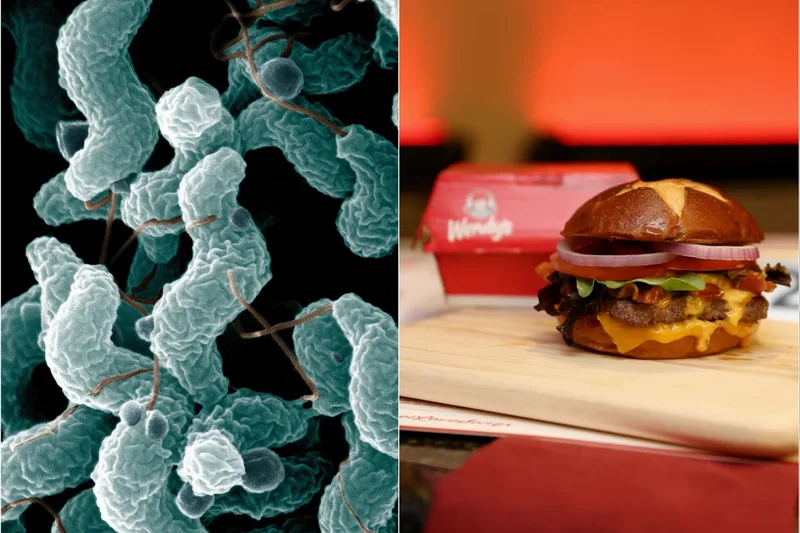
A Chicago woman was hospitalized with a severe gastrointestinal infection after eating a Wendy’s double cheeseburger she claims was “contaminated with Campylobacter and other illness producing bacteria,” according to a federal lawsuit reviewed by The Independent.
In her complaint, Roxie Ellis Douglas, 68, says the campylobacteriosis she contracted, which usually comes from exposure to, or cross-contamination with, raw or undercooked poultry, further led to acute infectious colitis, leukocytosis, dehydration, gastroenteritis and hypokalemia “secondary to diarrhea.”
Douglas trusted that the chain’s food had been safely prepared and “was not adulterated with a deadly pathogen,” the complaint states. However, it contends, “Defendant’s double cheeseburger meal was not fit for the uses and purposes intended – human consumption – and was therefore in breach of the implied warranty of wholesomeness.”
Campylobacter can be extremely risky to people over 65, according to the Centers for Disease Control and Prevention.
Douglas has thus far spent nearly $100,000 on medical bills since the meal last year, court exhibits show.
The suit by Douglas comes amid a nationwide outbreak of cyclosporiasis, a parasitic infection that causes explosive diarrhea, that the CDC says has been traced to tainted iceberg lettuce grown by produce giant Taylor Farms and served at Taco Bell restaurants spanning the U.S. The first case emerged in May, and has so far resulted in nearly 14,000 confirmed cases across 47 states, with at least two deaths reported.
A Wendy’s spokesperson did not respond to a request for comment.
On August 5, 2025, Douglas went online and ordered a double cheeseburger and a baked potato from a Wendy’s located on Chicago’s South Stony Island Avenue, her complaint begins.
The meal was delivered to Douglas at home, arriving in a “sealed, unopened bag by Doordash,” according to the complaint, which was initially filed in state court July 30 in state court and removed to Chicago federal court on August 20.
But while the food may have looked perfectly fine, the complaint claims it was in fact “contaminated with Campylobacter and other illness producing bacteria when it left Defendant’s control.”
A summary of medical expenses filed alongside the complaint shows Douglas has spent $93,578.24 on healthcare bills since August 6, 2025 – the day after she ate the Wendy’s double cheeseburger meal. The costs included $2,848.50 for EMS transport to Advocate Trinity Hospital; $24,434 for three days of inpatient treatment; $42,857 for a second, five-day stay at Advocate Trinity a week later; and nearly $13,000 for a colonoscopy in January 2026.
Douglas’s complaint accuses Wendy’s of failing to “properly operate, maintain and/or control the sanitary conditions in the kitchen,” failing to “use ingredients, supplies and other constituent materials that were reasonably safe, wholesome, free of defects, clean… and/or safe for human consumption,” and failing to provide “adequate warning to consumers… of the dangers of hazards inherent in the consumption of double cheeseburger meal.”
Wendy’s, for its part, has not yet filed a formal response to the allegations. At the same time, the chain proudly trumpets its food handling and sourcing practices.
Food safety is “foundational to who we are and how we operate,” the chain’s corporate site tells consumers.
“We take a preventive, risk-based approach to food safety that focuses on stopping issues before they occur,” it says, adding that all suppliers are subject to “regular food safety testing protocols and audits.”
More specifically, Wendy’s also touts its commitment to the safety and sustainability of its beef supply.
“The beef community has a long-standing commitment to caring for their animals and providing families with the safest, highest-quality beef possible,” Wendy’s explains on its site. “Beef Quality Assurance is a program that trains farmers and ranchers on best practice cattle management techniques to ensure their animals and the environment are cared for within a standard set of guidelines and regulations across the U.S. beef industry.”
It goes on to say that Wendy’s, since 2018, “has sourced 100 percent of its beef from Beef Quality Assurance certified sources.”
Wendy’s has been associated with occasional outbreaks of foodborne illness over the past quarter-century. In 2000, an E. coli outbreak was tied to a Wendy’s restaurant in Marion County, Oregon; a 2006 E. coli outbreak reportedly stemmed from food prepared at a Wendy’s in Ogden, Utah; and in 2022, more than 100 people in six states were infected with E. coli after eating at Wendy’s.
Douglas’s lawsuit lays out three separate causes of action: strict product liability, negligence and breach of warranty of wholesomeness.
She is now seeking a money judgment to be determined in court.