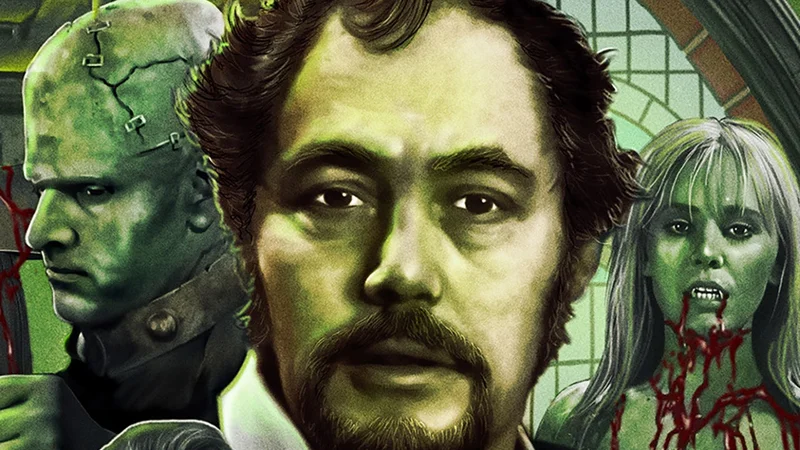
In the early ’70s, UK-based Hammer Films was winding down after defining a creative and colorful era of horror with lavishly produced films featuring lovely ladies, lethal living dead, and copious amounts of red, red blood. But even though their greatest years were behind them, the company that made Christopher Lee and Peter Cushing genre icons still had a few devilish delights to offer audiences before they reached the end of that dirt road in their runaway carriage (either 1976 for their last horror film, To the Devil a Daughter, or 1979, when they released their actual last film, Hitchcock remake The Lady Vanishes). One of the men most responsible for writing many of the movies that shaped Hammer’s style, Jimmy Sangster, even got a chance to direct during that final decade of Hammer’s classic output, and although the three films he helmed (two of which he also co-wrote, while the other — Lust for a Vampire — was scripted by Danger: Diabolik and Barbarella’s Tudor Gates) are not generally regarded as among the best the studio produced, they each have charms all their own and deserve reappraisal.
Now Severin Films is giving us that opportunity with their first-ever release of Hammer titles — Sangster Directs Hammer is an impressive set that brings The Horror of Frankenstein (1970), Lust for a Vampire (1971), and Fear in the Night (1972) to the US in 4K UHD for the first time, all wrapped up in a gorgeously gory green box. As usual for Severin, these movies have never looked this vibrant. Hammer was always well known for its lurid palette and stunning visuals, but now they practically leap off the screen. Fortunately, Severin also knows that preserving the true film experience is important, so grain is not absent but a wonderful texture layer along with everything else. One minor tweak: The box would perhaps be better named Sangster Directs Hammer’s Ralph Bates, because that actor — who forged a productive creative partnership and lasting friendship with the director — appears in all three films, and the story of their collaboration is the spine running through the patchwork body of material presented here. As for the extraordinary extras curated and collected to accompany the films — including a 312-page book! — there couldn’t be a better sign of the love and respect that everyone involved has for these movies and the creative team that made them.
Sangster was an endearingly self-deprecating man who, in his autobiography Do You Want It Good or Tuesday, titled the chapter on these three films “They Would Have Been Better Directed by Terry Fisher” (referring to the legendary Hammer director who helmed multiple entries in their Frankenstein and Dracula series starting with the first installments in 1957 and 1958 respectively). We’ll never know if that would actually be true, but that doesn’t mean these movies are the failures Sangster and others believed. Most folks apparently shuffle these to the bottom of their lists pretty quickly; the fact that Severin was only able to produce this box because no one else wanted to license these titles is baffling to me, but a boon for us and them. And no, I’m not saying these are classics on par with the films that launched Hammer’s legend, but they’re solid productions with something to offer both Hammer aficionados and casual fans alike. Let’s take a closer look…
The Horror of Frankenstein (1970)
Of the many tactics Hammer employed to distinguish their cinematic monsters from the unforgettable 1930s-1940s Universal incarnations that preceded them, one of the cleverest and most inventive was to follow the creator rather than the creature when making their series of Frankenstein films. And I know it’s blasphemy to many Hammer fans (appropriately enough) but this comedic remake of Hammer’s first Frankenstein foray (1957’s The Curse of Frankenstein) and the next-to-last installment in the seven-film Hammer Frankenstein series — with Ralph Bates replacing Peter Cushing as Victor — is my favorite of that entire run. While Cushing plays an utter sociopath or a more genial amoral Victor well (there are two timelines in the series; it’s complicated), Bates perfectly blends the sociopathy with a glib devil-may-care charm that makes him delightfully magnetic. Hammer was trying to make Bates a thing, positioning him as Frankenstein, Dracula (plans for that went awry when Christopher Lee came back instead, relegating Bates to a smaller role in 1970's Taste the Blood of Dracula), and Dr. Jekyll (in 1971's Dr. Jekyll and Sister Hyde). While things didn’t quite pan out, what we have is wonderful for all of us who value what Bates brought to the slab.
The film is ahead of its time with its black humor and gleeful lewdness; it feels like partial inspiration for the Re-Animator movies, and its lascivious tone resembles what people often thought all Hammer movies were like but weren’t. The sexual dynamics are interesting too, as Victor’s friend, Stephan (Stephen Turner), eagerly becomes his cook and wants very much to be part of Victor’s life, while the movie makes clear that a man working in the kitchen seems unusual to everyone. They also joke about Victor not being interested in men...or is he? He shows zero interest in Elizabeth (Hammer regular Veronica Carlson) even when she virtually proposes to him, and although he carries on with housekeeper Alys (the superb Kate O’Mara), that could be more about continuing a power dynamic established by his father rather than personal desire.
In a cute twist on Frankenstein tropes, Victor keeps track of creature assembly via a build-by-numbers approach. His friend Wilhelm (Graham James) even hits the nail on the flattop by speaking a version of the clichéd line: “You’re tampering with forces we don’t fully understand!” As for the creature itself, David Prowse (yes, Darth Vader) is a mute, hairless Karloffian monster with a creepy smugness that suggests he’s far smarter than his predecessors. He’s no tragic figure either; this creature’s a violent bastard. As the bodies mount up, Victor is willing to let those around him suffer if it means protecting his creation; the apple didn’t reanimate far from the tree.
The only disappointment is an abrupt ending that leaves you wanting Bates-led sequels, but it wasn’t to be; when Hammer tried one more time to draw on Shelley’s creation for movie material, they brought Cushing back. But we have this one, and it’s a twisted delight.
Lust for a Vampire (1971)
After mining Stoker for over a decade, Hammer turned to Sheridan Le Fanu’s sapphic classic novel, Carmilla, for inspiration, resulting in a trio of films focusing on a female vampire first played by Ingrid Pitt in 1970’s lush and top-heavy saucy romp, The Vampire Lovers. Lust for a Vampire is the second installment in what would later be labeled “The Karnstein Trilogy,” and it featured several missteps, not least replacing Pitt as Mircalla/Carmilla with Yutte Stensgaard. Yutte’s no Ingrid, but she’s also not as bad as some think. She does a damn good job of conveying that underlying air of menace and calculation that makes Carmilla a great villain; she just isn’t quite as good or as stylish as Pitt was.
Also carrying over from the first Karnstein film is the character of the “Man in Black,” a sort of/not really Dracula played this time by Mike Raven (there are odd cutaway insert shots of Christopher Lee’s eyes to muddy the waters). Unlike the mute grinning fool from the first movie played by John Forbes-Robertson, this one — now more specifically Count Karnstein — speaks with the dubbed voice of Valentine Dyall, but his role is still murky. He’s partnered with the Countess (Barbara Jefford), but more intriguing than the Man in Black’s part in this tale is the behind-the-scenes goss on Raven himself; for that, go to the extras and the book.
Ralph Bates (who replaced Cushing in this particular role) famously threw this movie under the bus, but damn if he doesn’t give his performance as the creepy teacher at a girls' school 110%; he’s one of the highlights of the movie. Our hero, new teacher Richard LeStrange (Michael Johnson), is based on Carmilla author Le Fanu, and his romance with Carmilla provides Hammer with a chance to immediately dial down the lesbian themes from the first film by focusing Carmilla’s attention primarily on the dashing scholar. Fans also remember (and correctly malign) this one for the insufferable song “Strange Love” that plays not once but twice in a row (the second time with a color-washed montage of previous scenes!) to provide padding as the story isn’t substantial enough for feature length.
The resurrection sequence is pretty spectacular, although you don’t see as much of Yutte as you do in the associated publicity stills (Severin helpfully puts one of those on the cover of the book). There are also nice stylistic touches like mesmerized girls approaching the camera in close-up so that the viewer shares Carmilla’s POV, and the strange mythology of the Karnstein vampires adding the odd twist that simply turning a cross upside down “deactivates” its effects. There are other tropes galore, like an old-school torch-bearing crowd and characters professing deep and abiding love for one another after knowing each other for about an hour. OK, so it’s not Hammer’s finest moment, or even the best of the Karnstein films, but it has its charms as all of them do, and it’s good to have it as part of this set.
Fear in the Night (1972)
Hammer did more than just produce gothic period-set horrors, and that included a series of psychological thrillers often featuring a character fighting for their sanity and their very life. Sangster wrote several of these “Mini-Hitchcocks”; although they were so named because of the debt they owed to the Master of Suspense, the real inspiration for Sangster was Henri-Georges Clouzot’s Les Diaboliques (1955). In fact, he drew on that source more than once, and when it came time not just to write but direct one himself, he reworked his script from an earlier production — 1961’s Scream of Fear — that leaned heavily on its Diabolique origins. Fear in the Night was the result, and despite its present-day setting, it still manages to be pretty gothic with an unsettling psychosexual edge.
Also betraying a possible influence from Italian giallos, especially with the stalker’s black gloved hands, and sharing elements with many of the thrillers and slashers that came before and after it, Fear takes us to a secluded country school where a mentally fragile young newlywed (Judy Geeson of To Sir, with Love) moves with her husband teacher (Ralph Bates of course) into a cottage on the grounds. The headmaster (Peter Cushing) and his wife (Joan Collins) are strangely fascinated with Geeson, and soon a battle of wills begins, with twists that are best left for you to discover.
Speaking of Cushing, he’s barely in it, but he predictably makes the most of it with an understated performance that exudes a creepy yet strangely gentle quality; you wouldn’t want to be in the same room with this guy, especially if you’re a woman, but there’s something about him that suggests he’s not the person you should really be worried about. One scene of him standing before a noose while trying to unknot Geeson’s scarf brings to mind a bit in 1932’s White Zombie, while the visual symbolism concerning the violation of Geeson’s innocence becomes even more overt when Joan Collins arrives at the halfway point to kill a cute little bunny right in front of her.
It has a quiet, deliberate atmosphere, and everyone is excellent; Geeson in particular delivers an emotionally raw performance that can be uncomfortably real and difficult to watch. But I have to say that I don’t enjoy movies predicated on gaslighting the protagonist and dragging us along for the frustrating ride before things resolve; some may call it suspense, but as someone prone to anxiety, I call it cinematic torture.
I have quibbles with the final act, but no spoilers. Right from the precision-crafted opening sequence, you’ll see what you’re in for, perhaps more than you realize. And in addition to the moment that shockingly punctuates the end of that montage, the movie has one other arresting image that will stick with you involving Peter Cushing and his circular glasses; you’ll know when you see it.
Bonus Features
As befits a box set that’s so clearly a labor-of-love tribute to this era of Hammer history, the extras are exhaustive and entertaining. The one criticism I have is that there are no captions on any of the extras, making them inaccessible for some fans. There’s no reason not to provide them, but Severin? Don’t ever generate them automatically; hire someone to write and edit them properly.
Since there are so many extras included on every film disc as well as an extra disc with Fear, let’s examine the 19 hours of material (!) by category:
Audio Commentaries
There are two commentary tracks for each film. The first features Sangster from years back (he died in 2011), moderated by Hammer historian Marcus Hearn with actress Suzanna Leigh joining on Lust. Leigh brings out more energy in Sangster, although he’s informative and enjoyable in all of them. The second tracks feature various authors and experts pontificating about the production history and cultural impact of each film.
Interviews
Besides the many newly produced interviews with cast and crew across all three films, there are archival segments featuring Cushing and Sangster. Many of them are relatively short, but they cover a wide range of perspectives, with some folks like production runner Philip Campbell talking about all three movies. Perhaps the most consistent mood is “wistful.” Kirsten Lindholm of Lust is a delightfully quirky highlight, and if (like me) you’re a Dracula A.D. 1972 fan, Christopher Neame’s interview serves as an overview of his entire career, including that film, his work in Lust, and the day Cushing told him the work was helping him to deal with his grief over his wife’s death.
Documentaries
That dedicated extras disc accompanying Fear includes three documentaries: one on Sangster (he’s credited with shaping the modern conception of Dracula and Frankenstein as well as demonstrating great versatility in multiple genres), one on Ralph Bates (it’s a heartfelt tribute from his wife, son, and colleagues), and one on Joan Collins (authors Kier-La Janisse and Amanda Reyes look at how the horror work Collins disowned led to her iconic turn in Dynasty).
Video Essays
Perhaps the most laudable aspect of this set is that with so much subject matter that should center a woman’s experience and perspective, they do just that, featuring an array of scholars and historians like Dr. Colin Azariah-Kribbs and Dr. Emma Liggins on the work of Mary Shelley; writer/producer Gillian Wallace Horvat and narrator Megan Stern on the history of Frankenstein adaptations; Carmen Maria Machado (she edited an edition of Carmilla) and Annie Rose Malamet on the cultural phenomenon of sapphic vampire tales; and two essays by Dr. Alexandra Heller-Nicholas on school-based stories and gaslighting as a thematic element of Fear.
The Book!
If all this isn’t enough, there’s a 312-page full-color glossy volume titled Horror! Lust! Fear! Sangster — an overwhelming compilation of interviews and essays, rare photos, and even comic adaptations. The book offers a ton of information not touched on in the other extras, but in order to fit everything in the box, the book (otherwise designed beautifully by Stephen Thrower) is rather small and just a little awkward to read. It’s still a lovely, and one might argue indispensable, part of this once-in-a-lifetime set.
Ephemera
There’s plenty of additional bits and bobs too, like trailers and promos, alternate “clothed” takes, and TV opening credits. It’s a treasure trove, and if the material becomes repetitive, it’s still worth it to include everything Severin could collect.