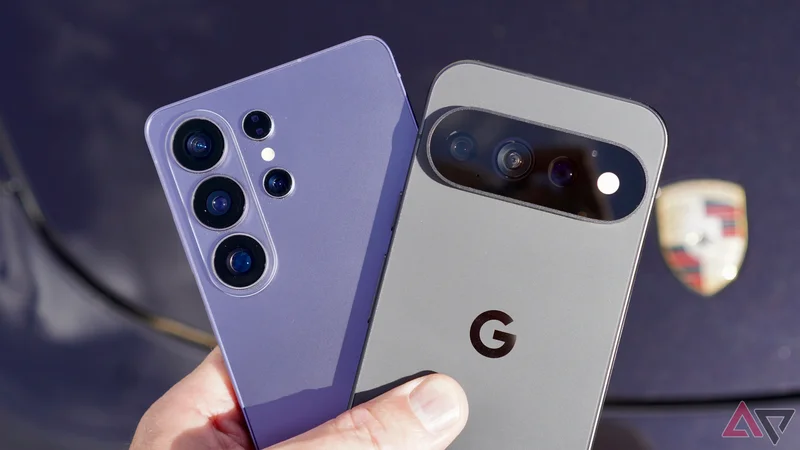
If ever there was a camera battle sure to produce fireworks, it's one where Google is pitted against Samsung. Both dominate the Android world, and both brands make a big deal about their cameras.
I took the Google Pixel 11 Pro and the Samsung Galaxy S26 Ultra to an evening Porsche car meet to test the cameras, and the results were so close, it was often hard to decide which one was the better shot. One thing's for sure, each camera brought its A-game.
Google Pixel 11 Pro and Samsung Galaxy S26 Ultra: Camera specs
Before we get to the photos, we need to talk about each camera's specifications
The Pixel 11 Pro has a 50-megapixel main camera with an f/1.7 aperture and optical image stabilization (OIS), a 48MP wide-angle camera, and a 48MP periscope telephoto with OIS for a 5x optical zoom.
Google uses its extensive computational photography expertise and AI skills to tune its photos and enhance zoom images beyond 5x. While its Camera Looks filters are one of the big new features on the Pixel 11 Pro, they were not used here.
Samsung has fitted a 200MP main camera to the back of the Galaxy S26 Ultra, with an f/1.4 aperture and OIS. It's joined by a 50MP wide-angle camera, a 50MP periscope telephoto with OIS for 5x optical zoom, plus a 10MP telephoto for 3x optical zoom.
We should also consider the processors used. The Pixel 11 Pro has the Google Tensor G6 inside, while the Galaxy S26 Ultra uses the Qualcomm Snapdragon 8 Elite Gen 5 for Galaxy. Both will affect camera performance.
To keep the comparison fair and a manageable length, I didn't compare the Galaxy S26 Ultra's 3x telephoto here. Take a look at our recent Galaxy Z Fold 8 Ultra review and our comparison between it and the Motorola Razr Fold to see why it's not worth a deep investigation.
In the photo galleries below, the Google Pixel 11 Pro's photos are on the LEFT, and the Samsung Galaxy S26 Ultra's photos are on the RIGHT.
Google Pixel 11 Pro vs. Samsung Galaxy S26 Ultra: Main camera
It's so close
After looking through the photos I took with both cameras, it's obvious both are superb. Yes, there are differences, but one rarely comprehensively beats the other. Look at the photos of the air-cooled engine first.
I love the depth of color in the Pixel 11 Pro's photo, and it avoids the Galaxy S26 Ultra's tendency to under-expose photos. It brings out more detail, as you can see from the texture on the gold vehicle plates in the Pixel's photo compared to the S26 Ultra's.
In the photo of the GT3 Touring, I wanted to show the lovely color combination, and the Pixel 11 Pro did it best. It captured the deep green and the tan interior well, with a depth that's missing from the S26 Ultra's photo, all because of its aggressive exposure level.
However, if I had only used the Galaxy S26 Ultra, I'd still have been pleased with the results.
Shooting across the fields behind the event and into the slowly setting sun, the Pixel 11 Pro balances the scene beautifully. Both cameras capture colors well and represent the environment as I saw it.
Standing back from the field, the photo of the red 944 highlights the differences between the two cameras.
The Pixel 11 Pro's balance is perfect. The red is vibrant, there are masses of detail, and the background retains clarity. The S26 Ultra's exposure issues mean it took a less attractive photo.
However, to show how both cameras take great photos in more general environments, here's a street scene from the day after.
There are differences, but I cannot say one is better than the other. Both look great, and that has generally been the case when reviewing the main camera photos.
Google Pixel 11 Pro and Samsung Galaxy S26 Ultra: 5x telephoto zoom
Some subtle differences start to appear
Both phones have a 5x optical zoom mode, but are the results similar to the main camera, where it was hard to choose between them?
What's most notable is the Pixel 11 Pro employs more smoothing than the Galaxy S26 Ultra, which cleans images up considerably, and it has a far more noticeable depth of field in its photos.
You can spot both situations in the shots of the yellow GT4 and the headrest in the blue Spyder.
Lighting may have affected the second shot, but not to such a great extent, and the GT4 image shows the differences may be down to software and tuning rather than the environment.
The differences are less noticeable when you get further away, and it appears the S26 Ultra's less intrusive software results in a sharper photo, as you can see in the image of the "safari" 928.
From the tire writing to the decals on the body, the S26 Ultra's photo is more stable, although the colors are slightly more muted.
Finally, the Gulf-livered GT4 once again shows there's not much to choose between these two cameras. Yes, you can spot some differences that may suit your personal preference, but if you only took one photo with one camera, I doubt many will care which one it was, as they both look great.
Google Pixel 11 Pro and Samsung Galaxy S26 Ultra: 10x and maximum zoom
AI plays its part
Both cameras can shoot beyond 5x, but not at optical quality. Here's what 10x shots look like from both.
For a non-optical shot, both 10x photos of the alloy wheel look excellent, but the Pixel 11 Pro's better exposure and balance, along with software expertise, result in a sharper photo.
In the second 10x photo, the S26 Ultra has a more attractive tone and rivals the Pixel 11 Pro for detail and sharpness. However, the Pixel 11 Pro's effective smoothing does a better job of removing noise.
The Samsung Galaxy S26 Ultra has a 100x maximum zoom, while the Pixel 11 Pro can reach 120x, where it uses some clever AI to enhance the image. It takes a few seconds to process when you open the photo in the gallery, but the results can be dramatic.
The two examples above show the differences. While I probably wouldn't use either mode often, the Pixel 11 Pro's AI-enhanced 120x shots are very impressive.
Google Pixel 11 Pro and Samsung Galaxy S26 Ultra: Night and wide-angle
Pixel 11 Pro pulls ahead
Finally, we get to a part where one phone pulls ahead of the other. Shoot in lowlight, and the Pixel 11 Pro is streets ahead of the Galaxy S26 Ultra.
The photo of the lantern shows the massive gap between them, and needs little explanation from me. It was the same for every test photo I took in low light.
The S26 Ultra's night mode activated more often, and often resulted in blurred photos as it took three-second exposures, compared to the Pixel 11 Pro's instant shots.
Regardless of whether the Pixel 11 Pro uses more AI to improve its night shots than the S26 Ultra, its photos will please more people more often.
Wide-angle photos return to the status quo, though, with neither pulling ahead of the other, and the same differences we saw with the main camera return.
Google Pixel 11 Pro and Samsung Galaxy S26 Ultra: The verdict
Almost too close to call
When I said both cameras brought their A-game, I meant it. At the Porsche event, it was genuinely hard to choose between them, and I'd have been happy if only one of the two cameras was in my pocket. It almost didn't matter which.
I say almost, because looking through my gallery of about 100 photos from the evening, the Pixel 11 Pro's photos often stood out a little more. Whether it's the AI enhancements, clever tuning, or nailing the fundamentals, the Google phone slightly pulled ahead.
The Pixel 11 Pro crushed the Galaxy S26 Ultra in lowlight. However, at 10x zoom and with the wide-angle camera, both are equally impressive. If you want to take obviously AI-enhanced images at 120x, the Pixel 11 Pro is also the phone for you.
One thing to note about taking photos with these two phones. The Galaxy S26 Ultra's screen is brighter and more visible, more often, and at more angles than the Pixel 11 Pro's. It made getting varied shots easier, and it continues to be one of the best screens on any phone available.
This aside, the Pixel 11 Pro wins the comparison. It's a close thing, and I think most people will get a great deal of fun and enjoyment from either, but the Pixel 11 Pro just edged out its closest rival here.