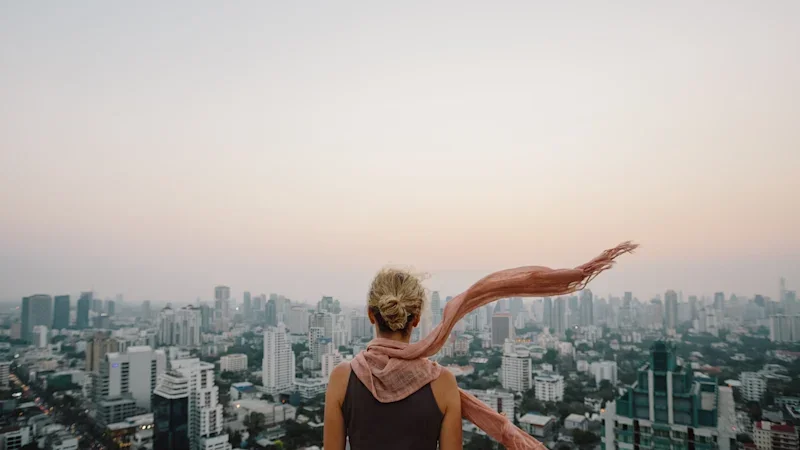
When I was little, someone asked me what superpower I’d most like to have. I chose invisibility. To my young mind, it meant freedom. The ability to go anywhere, eat anything and do whatever I wanted without asking permission or worrying what anyone thought. As the youngest of six children in a chaotic household, disappearing into the background felt like a delicious kind of independence.
Of course, like many childhood ideas, invisibility became more complicated as I grew older. I learned there are people for whom invisibility isn’t a superpower but a sentence. People pushed to the margins because of their race, disability, sexuality or age. I also absorbed the familiar warning handed to women: enjoy being noticed while it lasts because one day you’ll be invisible, too.
When I was travelling through Italy in my 40s, I remember the first time someone addressed me as signora instead of signorina. It was only a word, but it rocked me. I’d crossed a threshold, and I soon began to mourn the woman I’d apparently left behind, especially when menopause began to wreak havoc and my body told me it had crossed its own personal Rubicon.
My 50s arrived, and my menopausal symptoms started to subside, but the predicted invisibility didn’t arrive. Men still flirted with me, often at moments I’d have preferred they didn’t. The world hadn’t suddenly stopped looking. But the way I responded to it was changing.
Now that I’m in my 60s, I’m contemplating all this from a different perspective. Is society really rendering older women invisible? Or have I, after years of feeling scrutinised, judged and assessed, stepped into a different relationship with visibility? I suspect the answer is both.
I’m starting to believe invisibility after a certain age is actually the superpower I craved as a kid.JULIETTA JAMESON
There’s no denying that ageism exists. Women over 50 encounter it in obvious and subtle ways, from job interviews to everyday interactions that leave us feeling overlooked or patronised.
But somewhere between the cultural warnings and my own experience, I’m starting to believe invisibility after a certain age is actually the superpower I craved as a kid. As a travel writer, I spend much of my life moving through places where nobody knows me. Every new destination offers a potential reset. I’m not somebody’s daughter, sister, colleague, neighbour or patient. Nobody knows my history. Nobody knows my age, unless I choose to tell them – though as an au naturel girly, experience is proudly writ large on my face, albeit with a dash of mascara and a slick of lippy.
Putting aside the so-called telltale signs of ageing, every morning I wake up with complete freedom to decide how visible I want to be. Some days I embrace anonymity. I find a corner table in a cafe, order a coffee, open a book and happily disappear into my own company for an hour or two. There can be an enormous luxury in being left alone. Just ask any mum.
On other days, I decide to be rampantly visible. I’ll chat to the woman beside me on a train – if she seems approachable and up for it. I love to compliment people. If I see a hairstyle I like, or a coat that’s particularly great, I let the wearer know. Honestly, it makes their day and ends up making mine, too.
I’ll strike up a conversation with a market vendor – usually by butchering the local language, and everyone usually gets a laugh. I’ll stop to pat every dog that will let me, though this did get me into a bit of trouble in Barcelona recently. There I was, cooing to a pretty doggo called Sophia at a set of traffic lights when her owner, Marco, decided my admiration for Sophia extended to himself. It took me several blocks of walking to shake Marco off. Even in my 60s, it seems, men can still pick up the wrong signals from me.
Related Article
Generally though, those small acts of openness have led to some of my favourite travel memories, and they have very little to do with the destination itself. It’s about who I choose to be at that moment. It’s about exercising my freedom to do so.
Travel isn’t the antidote to feeling discarded, disrespected and disappeared. I know how societal pressures can prey on our vulnerabilities. I’ve felt tired, flat, flustered and lonely during my journeys, and in those moments, the impossible standards and ageism of the world at large can bear down on me with an awful force.
But it’s on my travels where I practise choosing when to step into the light and when to enjoy the freedom of remaining blessedly in the background. And I’ve brought that lesson home. I’m far less concerned with whether other people notice me than whether I’m noticing the world around me.
As a child, I thought invisibility would let me move freely through the world. It turns out I was right. And like every good superhero, I get to decide when to use my power.