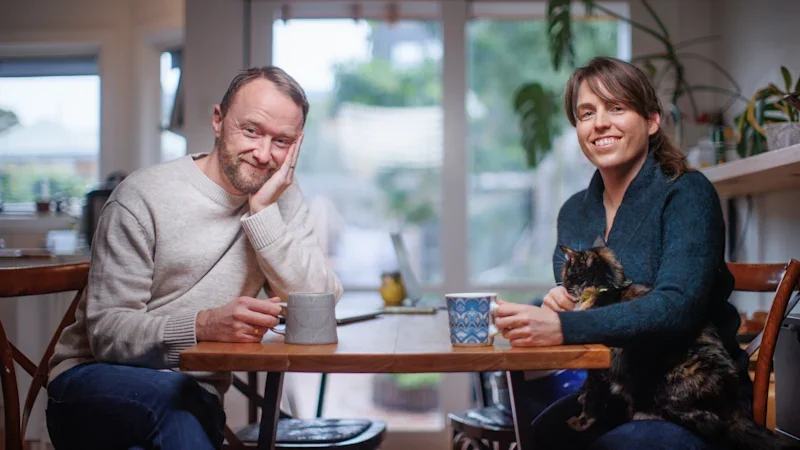
The hot cross buns emerge swollen and golden from the oven, and we pile them onto the old wooden table. Plates and spreads emerge from the kitchen, and children and grandparents emerge from who knows where.
And only then, when large and small mouths are full and the house is suddenly quiet, do we talk.
What I want to know, I say, is this: what does it feel like to be a parent in 2026? How is it different from what came before? If you take the joys and the agonies and the honestly quite boring bits in between and boil them all down, what rich essence is left to coat the bottom of the pot?
Rachel Williamson and Alex Liddington-Cox look at each other over the pile of baked goods, pondering for a moment. Beatrix, four, breaks in. Can she have honey on her bun? Yes, she can.
“See, that’s the difference,” says John, Rachel’s dad. “We would have said, ‘This is yours – eat it.’”
I’ve come to talk parenting with Rachel and Alex because (full disclosure) they are my friends, but also because I think they represent what I’ve come to think of as a particular archetype of modern parent, of which I am also a member: the choosers.
In lots of ways, I experience my life happening to me. My career, my partner – I can pretend to myself I planned them, but really they are serendipity.
But I chose to have a child, to have just one – a gloriously red-haired four-year-old daughter – and to build a life around that choice.
We choosers are the outcome of several trends.
Birth control means families have tighter control over how many kids they have, and when.
Today’s parents are richer and better educated than their parents, and must weigh helping their children get the most out of life against getting the most out of their own lives.
And being childless is increasingly socially acceptable (with the looming climate crisis, maybe even virtuous). “Are we going to pass on a standard of living, a lifestyle, a world that is of the same quality we inherited?” says Alex. “I think most parents are pretty worried the answer is no.”
For prior generations, having children was the norm after marriage and home ownership. Now it’s a choice.
“We realised we only have enough bandwidth and resources to provide the sort of environment we want to for two children, as opposed to three or four,” says Alex.
“Dead right,” nods John. Without widespread contraception, “when they arrived it was, ‘Oh god, I guess we’ve got to look after them.’”
All this choice, I think, changes the experience of parenting.
“We fully choose to have a child. Nothing is imposed on us. That’s a big mindset shift,” parenting coach and mother of two Dina Cooper says. “That was a mindset shift to go, ‘Actually, you know what, I chose to have this child. I have a responsibility to learn how to parent this child.’”
My daughter was born in the early summer. I spent the first couple of weeks of paternity leave flopping from cafe to cafe, drunk on sunshine and joy, while she snoozed in her pram under a thin sheet.
Then – as everyone assured us would happen – she “woke up” and the real work of parenting started. I remember, mixing formula at 3am while deep in the midst of sleep deprivation, telling myself: she did not choose this. I chose this for her.
And that makes me feel like I have to try harder.
Out of all the studies on modern parenting, one data point speaks to me most strongly: American Millennial dads spend 400 per cent more time parenting than Boomer dads.
A modern dad spends almost as much time parenting as a Boomer mum.
This extra parenting from dads hasn’t allowed mums to parent less. Somehow, they are still spending twice the amount of time with their kids, on average.
We don’t keep similar data, but my experience suggests something similar is happening here.
There is no benign neglect for our kids. One dad friend tells me he is driven to spend as much time with his kids as possible “because soon they will be at school – and then they are not yours any more, are they? They are the world’s.”
The cultural standard-setter for this mode of high-effort parenting – and focus of parental ire, shared under the breath at playgrounds around the nation – is Bluey’s dad, Bandit. Dr Heeler (for he is highly educated) works full-time as an archaeologist, while still managing to be perpetually available to be a robot or a gorilla or undergo emergency cat-removal surgery.
He sets an unreachable standard – yet there we are, trying so hard to be princesses or superheroes or rescue pups. Our children have never been so parented*. *
“There is an expectation of parents, and from children, you will be much more participatory in their life,” says Rachel. “The number of parents who say, ‘I hate imagination games.’ But they are sucked in every time.”
Rachel’s mum, Ann, is quite open about the fact they rarely played with Rachel and her siblings. The kids were equipped with motorbikes and pushed out the front door into the farm. “They were just told: Go!”
Some modern parents, raised by parents who didn’t play with them much, are having to invent for themselves a new way of parenting on the fly.
“When my child was a toddler, no one ever sat down and played with me – so it was very foreign to me, and very difficult, even though I knew it was so important for connection,” mother of one Melissa Hiemann says. “It’s like we were raised a certain way, and we know a better way, but to actually do it …”
Part of the pressure we put on ourselves is the knowledge that we chose this. Part of it – and this is common to all generations – is the knowledge our children are growing and at some point soon that look of childish admiration will be replaced with teenage resentment. And part of it, I think, is the explosion in advice on what good parenting actually looks like.
Rachel’s mother remembers staring at her daughter’s sleeping form and thinking: “Please don’t wake up. I don’t know what to do!” And my parents knew the way they were parented wasn’t right – but they were groping blindly for something better, building the plane as they piloted it.
While some level of terror is probably common for all first-time parents, today’s parents swim in an ocean of advice.
Capacity coach Michelle Kerr says: “We have all of these tips and tricks getting thrown at us: what’s the right way to parent? How should they sleep? What should they eat? It can add an extra layer of pressure to feel like you’re doing it the right way.”
Decades of parenting research have now converged on a “best style” – authoritative parenting, which governments now promote to prospective parents. It calls for high control, high love and high involvement, as opposed to being either strict or permissive. It is, I suspect, a highly time-intensive way to parent your kids.
And we’ve also become much more anxious about the house’s most effective babysitter: the TV. Kids have been watching TV since it was invented; they aren’t getting much more screen time than they were in the ’90s, when today’s Millennial parents were growing up on a diet of Saturday-morning cartoons. Yet, I have to suppress a feeling I’ve failed as a parent when I give my daughter an hour of TV.
Then there’s childcare, which plays to the same fears that we just aren’t trying hard enough. Despite the evidence that it’s good for children, many parents carry a level of guilt. A close friend tells me, with a hint of defensiveness, that his kid is never the first there and never the last to leave.
“You just get this feeling of what’s the point of having children if they’re going to spend all this magical time at daycare?” says Alex. “Because one day they’re going to grow up, be a teenager, and not want to spend time with you.” Both Alex and Rachel work, as do my partner and I, so our kids have to go to childcare.
That’s what modern parenting feels like, to me. Because we’ve made a choice, there’s a strong pressure to get the most out of it, to be present, to be the best parents we can be – rather than merely to survive. To borrow from the modern lexicon, we’re parent-maxxing.
But here’s the thing about parenting: it’s the ultimate long-term play. Today’s parents are parenting harder than ever before, but you don’t get to see the results of that until the kids are older. Until you can exhale and look at the confident, happy young person you’ve helped usher into the world.
Ann, Rachel’s mum, often finds the conversation among her friends drifting to how the children they raised are now raising their grandkids.
“Every one of us has said the same thing,” she says. “We are really proud of how our children are bringing their children up. We sometimes raise our eyebrows. But we think they are much better parents than us. We think they are bringing up their children much better than we did.”