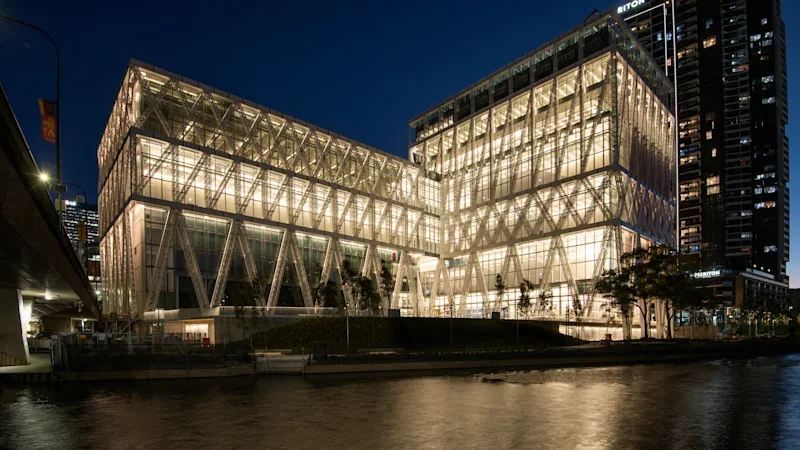
All five opening exhibitions at the billion-dollar Powerhouse Parramatta will be free to visitors aged 16 and under when the landmark museum opens on November 7 – a debut the state is hailing as its biggest investment in the city’s cultural life since the Sydney Opera House.
The NSW government confirmed first details of the ticketing structure as the final three temporary shows have been unveiled - a dedicated children’s exhibition flipping the script on darkness as a place of fear and nightmares, a dive into Indigenous perspectives on water management and Australia’s first show of the works of British designer and artist Es Devlin.
While admission to the museum will be free, those over 16 will be charged an as-yet-undisclosed entry fee to the museum’s flagship exhibition, Task Eternal, its blockbuster that will unpack humanity’s fascination with stars, flight and space.
Access to a six-storey purpose-built steel tower topped by a room featuring the work by US artist James Turrell will likely carry an additional charge. For comparison, entry to a sister work at Tasmania’s Museum of New Art is $10. A full schedule of charges will be disclosed closer to opening.
“Western Sydney is a rapidly growing population, and it’s much younger than the rest of the city,” Arts minister John Graham said of a region where one in five people are aged 14 years or younger. “We want to make sure all communities, all audiences, feel welcome. And particularly at this time, when cost of living pressures are real, we want to make sure as many people – young and old, families, and individuals – can come to and enjoy the Powerhouse Parramatta.”
Representing a $70 million-plus investment, the five temporary opening exhibitions will run for between 18 months and three years, and there will be periodic object rotations. More than 3000 objects will be displayed, with at least 1600 drawn from the Powerhouse collection.
Replacing original plans for a planetarium is the first Australian exhibition by Devlin, who has won Tony and Olivier awards for theatre scenic design, and collaborated with Beyoncé and U2 on recent concert tours.
The opening line-up marks a shift towards immersive technology and visitor participation rather than traditional spectator models, reflecting broader global trends. Temporary and immersive hands-on installations may add, however, to scepticism about matching the educational engagement of permanent displays, such as the classic transport and steam exhibits at the Ultimo site.
Chief executive Lisa Havilah confirmed the museum will not have a standalone dedicated exhibit for western Sydney, saying local stories were embedded in all exhibitions within broader national and international contexts.
“These five foundational exhibitions place audiences at the heart of the museum, bringing to life stories of technology, creativity and excellence,” Havilah said.
The five shows
**Es Devlin: The Turning: **
Visitors can explore Devlin’s work in five parts: Forest of Us; Memory Palace – an immersive 3D cityscape; Screenshare – a hybrid cinema and installation presenting sketches from 365 books Devlin has made; hand-drawn studies of flora and fauna in Redraw the Edges of Yourself. For Collective Portrait, audiences are invited to draw portraits of a stranger.
The Dark: This dedicated exhibition for children aged 4 to 12 years reframes the fear of darkness into a “playground of curiosity” using interactive storytelling, a crystal tunnel, and 100 borrowed childhood toys. Also featured are items from the Australian Museum mineral collection, and newly commissioned First Nations animations.
** Overflow: **Developed in collaboration with Kalari Clan and Wiradjuri curator Emily McDaniel and working with seven Indigenous community organisations, this show considers the importance and care of salt and freshwater ecosystems around Australia. Highlights include First Nations filmmaker Ivan Sen’s documentation of the importance of caring for water country.
Task Eternal: Occupying the museum’s largest gallery, this headlining exhibition traces the history of aviation and space exploration in partnership with the Smithsonian and the British Museum.
Highlights include a Qantas Avro 504k aircraft, an Apollo rocket engine, next-generation spacesuits, integrated First Nations sky knowledge, and a 10-minute immersive James Turrell light installation (for a likely additional fee). There are also eight delicate 15th- and 16th-century Leonardo da Vinci “flight machine” drawings on loan from the Biblioteca Ambrosiana, Italy. Fragile and historic, they are to be displayed four at a time for a maximum of 90 days before being rotated.
The Mall: With its Americana title, this show examines the history and global impact of shopping centres, centring on western Sydney’s role – notably Blacktown, where a landmark 1959 Westfield design helped export modern retail architecture worldwide. Highlights include the iconic Levi’s 501 jeans worn by Apple co-founder Steve Jobs, early designs for the first barcode, recently digitised material documenting the United States’ first fully enclosed shopping mall, iconic 1980s arcade game machines and a bitcoin mining rig.
More than a decade in the making – it received the green light in 2015 – the Parramatta Powerhouse project involved a $915 million base build covering the riverfront construction, a new Castle Hill storage facility and the digitisation of 371,000-plus collection items. Additionally, $140 million was spent by the state government to secure the riverfront property from the City of Parramatta. The museum’s pre-opening expenses, including a documentary on its opening costing about $1.7 million, have exceeded $70 million.
The museum says it has raised $80.28 million in philanthropic contributions to be banked over 10 years, meeting its capital fundraising target for the base build, which was set at $75 million.