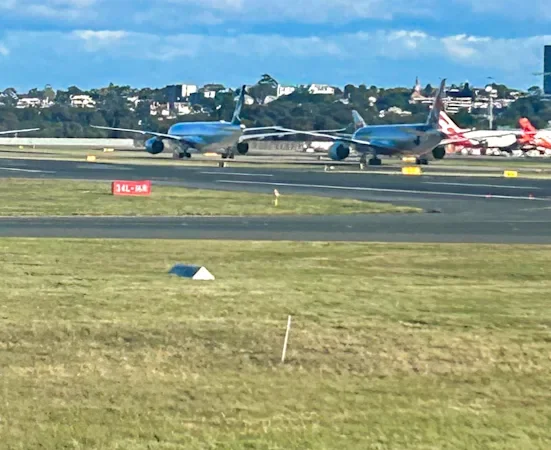
Pilots say a capacity crunch at Sydney Airport’s arrival bays is forcing planes to sit idle on the tarmac after landing, delaying passengers from disembarking at Australia’s busiest airport.
The pilots say the bottleneck is slowing international flights from getting to gates – where they discharge passengers – during peak morning hours, 7.30am to 9.30am, resulting in extensive waits on the taxiway and potentially compounding air traffic control issues.
There have been several periods in recent weeks where air traffic control at Sydney Airport has been so short-staffed it has had to delay flights so that they can safely manage the airspace around the runways.
But the airport has rejected the pilots’ allegations that as many as a quarter of arrival bays can be out of action at some times, saying it has invested heavily in its facilities. “These claims are false,” a spokesman said.
The pilots interviewed in this story, who work for Australian airlines, asked that their names not be published because they are not authorised to speak on the topic.
“Every morning during peak times multiple aircraft wait for as long as 90 minutes for a bay or parking position,” said one commercial pilot, who frequently flies in and out of Sydney. He blamed the waits on “the lack of capacity at Sydney” and the “parlous state of [its] infrastructure”.
A second commercial pilot claimed that waits of half an hour were common. “The real busy time is 8am,” he said. “That’s when we start seeing aircraft sitting out waiting for bays.”
Sydney Airport typically manages up to about 500 arrivals and departures daily, largely restricted to the hours outside its 11pm-to-6am curfew.
Throughout the day, arrivals, departures, towing operations and gate availability are continuously managed by airlines, air traffic services, ground handlers and the airport operators, the airport said.
When parked at a bay, planes can usually switch their power to a supply provided on the ground, rather than burning fuel to run their auxiliary power units (APUs), which they use when stuck on taxiways. At the bays they can also switch to air-conditioning ducted from a ground source, called pre-conditioned air.
Pilots say the planes’ extensive waits on the taxiway can also lead to higher carbon emissions.
The first pilot, who has flown extensively nationally and internationally, said he believed that nearly a quarter of Sydney’s international gates don’t have consistently functioning ground power units (GPUs) or ground-supplied air-conditioning. “Many of [Sydney’s] bays … have no ground power or air available, and those that do are often unserviceable,” he said.
“We can’t shut down the APU unless the ground power works and conditioned ground air is available.”
This results in planes burning jet fuel to keep the cabin lights and air-conditioning on.
But the airport said ground power is available at every contact bay across the airport. “Sydney Airport has invested in upgrades to ground power and pre-conditioned air equipment across the precinct as part of its ongoing asset renewal program, and this work continues,” a spokesperson said.
The airport said all international remote bays also have access to ground power through either a fixed GPU or mobile power units, which are typically owned by airlines.
The second pilot said he hadn’t experienced issues with Sydney Airport’s upkeep of bays. He said stand-off bays – those not attached to the terminal – typically have ground power and air. But when the ground power is not working, it will “sit unserviceable for days before repair”, he said.
A third pilot said the bottleneck varies from day to day, depending on traffic flow and gate availability.
Last week he landed an international flight and “sailed straight to the gate with zero delay”. As he proceeded to the bay he looked over and saw another plane that had been sitting on a taxiway for 40 minutes and would probably be waiting close to an hour, he said.
The airport likely had “neglected upkeep” of GPUs historically, he said, and appears to be playing catch-up on the maintenance. The 737 pilot said it was not unheard of for the GPUs at Sydney to be unserviceable. However, he didn’t think they were more prevalent at Sydney than at other major airports.
Air traffic controllers also identified a persistent bottleneck at Sydney Airport. “As soon as any delays occur, there are inadequate bays, hence the ‘parking’ on taxiways frequently for arriving aircraft [in Sydney],” said one.
There can be multiple causes for delays at airports. They include planes needing unscheduled repairs, passengers being ill aboard an arriving plane, and the weather disrupting operations. Delays in one area can throw off schedules for subsequent flights and cascade across the airport’s operations.
Jet engines emit substantial amounts of carbon into the atmosphere. Measured in weight, an Airbus A380’s four engines burn between 1100 and 1450 kilograms of jet fuel per hour while idle on the ground.
Sydney Airport has pledged to “minimise air emissions from ground-based airport operations and activities”. The airport has “also invested in infrastructure which enables airlines to minimise the use of jet fuel-powered auxiliary power units and, as a result, minimise impacts on local air quality”, its website says.
Sydney has released its 2045 master plan, which forecasts a 75 per cent increase in passengers over the next two decades, including a jump of 16.3 million international passengers in 2024 to 36.4 million international passengers by 2045.
The Business Briefing newsletter delivers major stories, exclusive coverage and expert opinion. Sign up to get it every weekday morning.