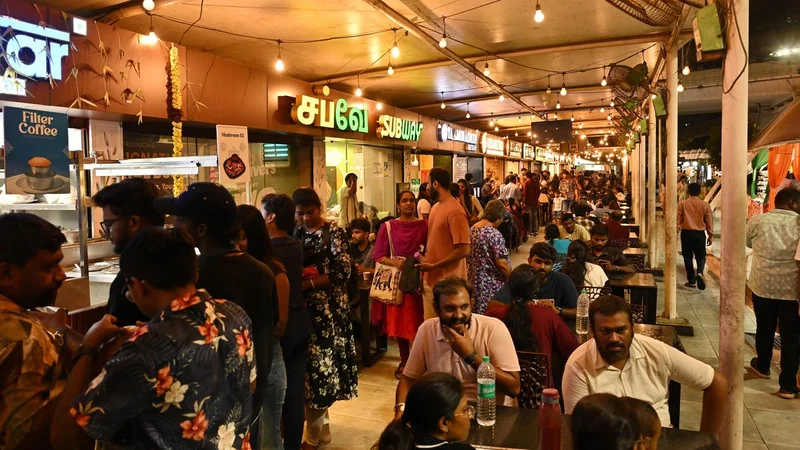
Decades ago, Madras was a city that believed about 9 p.m. was bedtime. After sunset, shutters came down, streets emptied, and roads fell into almost complete silence, with barely a vehicle in sight.
Chennai’s two prominent railway stations, Central and Egmore, were among the few places that remained active at night largely because of the steady flow of passengers.
The city began changing in the 1980s, when pubs slowly emerged, followed by the Information Technology (IT) and Business Process Outsourcing (BPO) boom and a growing night-shift workforce in the late 90s. Slowly, the night became an economy of its own, acquiring the character of sleepless cities across the world. Tea shops stayed open, eateries followed tech corridors, and businesses discovered a new customer as work hours changed — the night owl. The Madras that once went to bed early, forgot how to sleep after it became Chennai.
“In the 80s and 90s, nightlife saw more activity than the city was used to, with a few hotels having discos. A few of us who hung out together, resorted to disco hopping [a precursor to the pub hopping of today]. The Adyar Park Hotel had the vibrant Gatsby, a disco-cum-nightclub. Similar to this was Pasha at The Park. Suffice to say, the discos were always packed with youth of those days showing off their John Travolta moves,” said Nikhil Raghavan, a resident of Shenoy Nagar who writes about nightlife in the city.
“Much later, HFO (Hell Freezes Over) at Hotel Aruna on Sterling Road became a hot night spot. I visited this place so many times and remember running into Kamal Haasan who was shooting some film scenes,” he recalled. “After a late-night film or a disco, it was mandatory to head to Buhari__s__ on Mount Road, which was open till beyond midnight. Tasty mutton samosas or bread butter jam with hot tea was the best way to stay awake at that time,” he added.
Hotels such as the Taj Connemara played an important role in the social fabric of upper-class Madras, offering some of the few spaces where people could meet and unwind beyond the routines of the day. “While it may not have had a “nightlife” culture in the way Chennai understands the term today, the bar was certainly a lively social spot for its time, with evenings extending into the night depending on the prevailing regulations and social norms,” said Shilpa Rameja, General Manager, Taj Connemara.
The late 1990s marked a turning point in Chennai’s night life, as IT firms spread across the city. The Old Mahabalipuram Road and places near Tidel Park saw new buildings crop up. Construction work continued through the night. Initially, the familiar chai wallahs on bicycles would pedal through the night, delivering tea and coffee to those working late. Soon, small eateries mushroomed around IT corridors, followed by hotels and 24/7 cafeterias within IT parks. “Those days, IT and BPO companies offered Sodexo vouchers, which were accepted at eateries across the city. This gave techies the freedom to spend during night hours. Then, in the early 2000’s, many IT firms opened gyms where employees could work out at night,” said S. Sooriya, who has been a techie for three decades now.
In the early 2000s, when migration to the city grew, its beaches began coming alive after sunset. While the Marina drew thousands of families, Besant Nagar Beach became a popular haunt for couples and youngsters. Youngsters began the nights with a walk on the beach. Turtle walkers gather at Neelankarai Beach late at night and walk along the shore until dawn, often spotting Olive Ridleys swimming ashore to lay eggs. The eggs are carefully collected and taken to hatcheries. People visited them even in the 80s and 90s, but commuting was a challenge then. “From the 2000s, as more households began owning vehicles, traveling became easier,” said Mahalakshmi Ramalingam, a long-time resident.
From the late 2000s, food became one of the biggest drivers of Chennai’s late-night culture. Food streets and night-time eateries mushroomed and biryani became the most sought-after food post-sunset. The city today has several biryani brands that sell only at nights, with thousands queuing up to grab a plate. One can get a plate of biriyani even at 3 a.m. now.
Anna Nagar, once primarily residential, now sees crowds and activity well into the night. P. Kruthivas, president-elect, CREDAI Chennai and Managing Director, Pushkar Properties, attributed its growing popularity to improved Metro connectivity. “Every suburb has become a micro-market because of last-mile connectivity.” The Kora Food Street in Anna Nagar draws over 5,000 visitors a day, with footfall surging by 20% to 30% over the weekends.
Another night hot spot is Uptown, Kathipara Urban Square, which attracts more than 10,000 visitors every day and over 30,000 visitors during weekends. Charan Boya, Executive Director at BNR Estates, which operates Kathipara Urban Square, said: “Chennai has had a reputation as an ‘early city’ compared to Bangalore or Mumbai, and I think that’s changing... not because people suddenly want a club scene, but because there is finally the infrastructure to make staying out past 11 p.m. feel normal and safe: lighting, parking, security, and Metro connectivity.”
“What’s growing here is a food and family-oriented night culture rather than an alcohol-led one, and I’d frame that as a genuine strength for the city rather than something to measure against other metros. Our focus is on building a night economy around good food, safe public space, and somewhere for shift workers, students, and families to be after dark,” he added.
The Anna Salai stretch has a different nightlife story with older restaurants such as Buhari and Mount Road Bilal, along with a range of newer, smaller eateries and joints, keeping the city’s appetite alive with all kinds of cuisines. Customers even travel 10 km to 15 km to have a bite.
From OMR and Ambattur to ECR and K.K. Nagar, Chennai’s nights are creating a new economy along the way. Late-night hot spots are opening up employment opportunities for youngsters, with students and women turning pushcarts, cars, and pop-up stalls into tiny businesses, selling everything from homemade products and artwork to jewellery. Anna Nagar alone has more than 200 such roadside setups, often operating from nothing more than a small table.
Entrepreneurs and established enterprises too, rush in to serve the night-time crowds. Sports businesses are extending their hours, with late-night turfs, pickleball, and padel courts keeping the city active even after 10 p.m. Even gyms are joining the movement, keeping their doors open the entire night.
Meanwhile, the police are stepping up their presence after dark, deploying additional personnel, and keeping a closer watch to ensure that the city stays safe as it stays awake. Chennai has discovered the night and has no plans to sleep in future.
Published - August 23, 2026 12:35 am IST