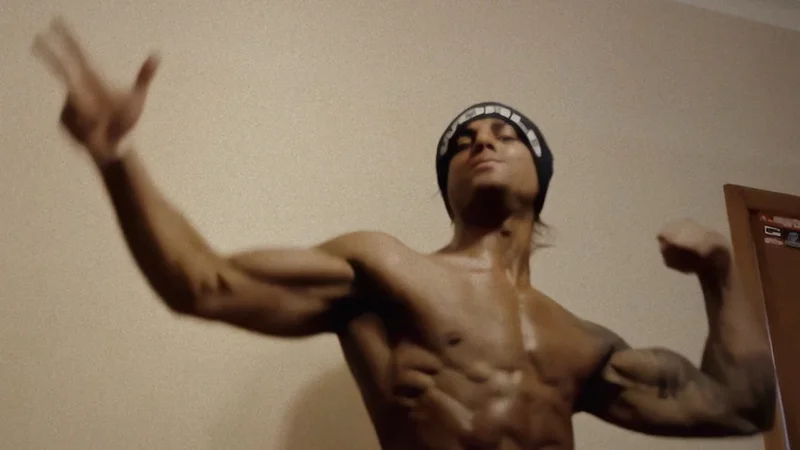
For a certain generation of Australian men, the path to the gym began with a photograph of a shirtless young man from Sydney.
His videos were brash, his poses were deliberately ridiculous, and at times he said deliberately provocative and offensive things to garner attention.
His catchphrases spread through bodybuilding forums, YouTube and social media, and some are now resurfacing as a new documentary hits our screens about one of Australia's earliest social media celebrities.
Aziz Shavershian had the muscles, the tan, the hair, the confidence, and he's the subject of Stan's new movie, Poster Boy: Becoming Zyzz.
But for all this renewed attention, Aziz won't hear or see it, having died in Thailand at just 22 years of age in 2011.
Fifteen years after his death, Aziz, known by his online moniker Zyzz, has become part of a new wave of online content celebrating an earlier era of gym and rave culture.
But it also comes at a time when a new generation is encouraged to pursue physical perfection through so-called looksmaxxing by a slightly amorphous online world of male influencers pushing misogyny broadly referred to as the manosphere.
It is a strange moment to watch for his older brother, Said Shavershian, also known as ChestBrah.
He says the culture around young men's bodies and masculinity now looks very different to the one he and Aziz helped create.
"What me and Aziz always preached was we're all going to make it," he said.
"It's a message of just that, 'Hey man, if I made it, so can you.' And that was what we're always about, just uplifting the little guy and uplifting anyone to be the master of their destiny."
Before Tate, there was Zyzz
Andrew and Tristan Tate are now among the world's most recognisable figures in the online manosphere, building enormous audiences around a highly performative version of masculinity, wealth and status.
The brothers are currently in custody in the United States as the British government tries to extradite them to face charges of rape, assault and facilitating trafficking for sexual exploitation.
In Poster Boy, it is put to the audience that the blueprint for the modern male influencer was being tested years earlier in Sydney, with Zyzz at the head of an "aesthetics movement".
But Said does not see the Tates as inheritors of his brother's message or goof representations of masculinity.
For him, masculinity is something far less flashy than fast cars and fancy watches.
"Being someone that's vulnerable, that's kind, that's loving," he says.
"Young men out there, young boys don't really have many positive role models to look up to in society and ones they can kind of feel relatable to."
From Sydney gyms to the looksmaxxing era
Together, the brothers helped turn bodybuilding into something less about standing on a competition stage and more about being part of a lifestyle.
"Shredding for Stereosonic" became a cultural in-joke, and Aziz became its poster boy.
But the pursuit has become much more extreme online since the height of Zyzz, with communities obsessing over facial structure, perceived attractiveness and where an individual sits in a hierarchy of male beauty in what is known as looksmaxxing.
Said sees the connection and the merits in taking pride in your appearance, but says "deep, deep down, it's quite toxic".
He points to practices, including "face pulling" and "bone smashing" as examples of where the pursuit of physical perfection can go, with men ultimately ranking themselves against others.
"With the digital age and social media, there's more information out there," he says.
"Anyone could just post anything, rage bait, any kind of content to kind of reel an audience in."
And once the algorithm finds an audience, it can keep serving them the same message, particularly targeting boys and young men at impressionable ages.
Documentary asks pertinent questions of peptides
Beyond its examination of modern masculinity, the film examines Zyzz's death and his use of steroids and peptides.
For years, the story repeated online was simple: the impossibly fit 22-year-old had suffered a heart attack in a Thai sauna.
The film reveals that Zyzz died from acute respiratory failure after taking a combination of morphine, cocaine and benzodiazepines.
He also had an enlarged heart, although the cause of that enlargement remains unclear.
There is no direct attribution to his use of steroids and other performance-enhancing substances.
Said, who is not a medical expert and uses some performance-enhancing drugs, has defended their use in controlled and managed settings.
"I think they definitely have their place in competitive sports, in bodybuilding, and in recovery," he said.
The ABC has reported not only on the booming unregulated trade of peptides, but also the severe health complications they can pose.
There are also medical concerns about the illicit trade of peptides and separately the side-effects of prescribed peptides.
It is a particularly pertinent question for the legacy of a man whose image has become synonymous with the pursuit of the perfect physique, and a confronting detail in a story that has otherwise been relentlessly mythologised, because Zyzz became something larger than the person his brother remembers.
"To me, I always would see him as my younger, goofy, dorky, highly intellectual brother," says Said.
He understands why people still idolise Zyzz, but is less comfortable with the comparisons that have turned his brother into a larger-than-life figure.
"Az was just as much human as you and I," he says.
Reflecting on Zyzz's life, Said said his flaws are what make him relatable.
"Why does a role model always have to be completely virtuous?" Said asks.
Aziz, he argues, was "imperfectly perfect".
A young man with faults, ambitions and insecurities who happened to become extraordinarily good at making people watch him.