The story so far:
President Donald Trump posted on his social media platform, Truth Social, that India’s Chief Election Commissioner Gyanesh Kumar had asked his administration how elections are held in the U.S. without a valid photo identity card.
He also pointed out that just 1% of India’s 64.64 crore electors who voted in the last general elections voted by mail (unlike the large number who do so in the U.S.) Mr. Trump reiterated his demand that Congress pass the Safeguard American Voter Eligibility (SAVE America) Act, which would require documentary proof of citizenship to register to vote in federal elections and a photo ID to cast a ballot, among other restrictions.
How are elections conducted in the U.S. and how do they differ from elections in India?
Article I, Section 4 of the U.S. Constitution (the Elections Clause) empowers the State legislatures to determine the “times, places, and manner” of federal elections, even as it allows Congress to alter or make such regulations. There is no national election authority like the Election Commission of India. There is the Federal Election Commission, but it is only empowered to regulate campaign finance as registration, balloting, and counting are done by the States’ county and municipal jurisdictions. This is due to the strongly federal nature of the U.S., unlike India’s quasi-federal system.
The U.S. Congress also passed the National Voter Registration Act, 1993, which required States to offer voter registration at motor vehicle and public assistance offices, and the Help America Vote Act, 2002, which provided funding for States to buy new voting machines and called for State-wide elector databases.
Voter eligibility in the U.S. is therefore a State concern, and registration is elector-initiated. While documentary proof of citizenship is not demanded, a potential elector has to affirm citizenship under penalty of perjury on the registration form. Thirty-six States ask for some form of identification at the polling place and 23 ask for a photo ID.
This is unlike India, where electoral rolls are compiled in each State via house-to-house enumeration conducted by the ECI, which has superintendence over the whole process of registration. Eligible electors are then issued the Electoral Photo Identity Card (EPIC), though other documents, including Aadhaar, can be used as identification at the booth as well.
Is non-citizen voting a real problem in the U.S. as Trump has made it out to be?
Independent studies have found that almost all non-citizen registrations in the U.S. are accidental and only a small proportion of them votes. The Trump administration’s claims have not survived scrutiny. The New York Times reported that after announcing in July that it had identified 2,78,000 non-citizens on the rolls of four States, including 15,903 in Nevada, the Department of Homeland Security told Nevada’s election administrators this month that it had identified just 185 potential non-citizens so far. It described the earlier figure as a “ceiling” and shared a list without names.
Surveys show that a large majority of the electorate supports the requirement of photo identification at the polls. Yet, even this is short of the more onerous requirement of proving citizenship at the point of registration, which is what the SAVE America Act requires.
What is the SAVE America Act, and why is it opposed by Democrats and others?
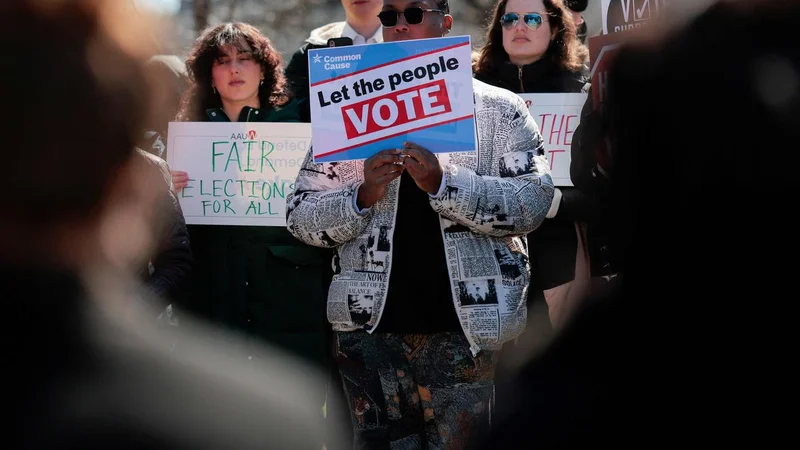
The SAVE America Act was passed by the U.S. House of Representatives in February along party lines, with Republicans outnumbering Democrats. It requires every new registering elector or an existing elector who wants to update his/her record to produce a passport, or a birth certificate, or naturalisation papers along with a government photo ID. Mail-in voters — a widely used option in the U.S. — have to enclose a copy of their photo ID. States will then run names on electoral rolls through the U.S. Department of Homeland Security and the latter could flag non-citizens for removal. Election officials who register people who lack the documents can face up to five years in prison.
The Bipartisan Policy Centre in the U.S. estimates that over 20 million eligible American citizens do not have ready access to a passport or a birth certificate. Newly registering young adults have also faced problems producing these documents. These concerns have led the Democratic Party to oppose the SAVE America Act, which has stalled in the Senate.
Is India’s Special Intensive Revision (SIR) process delivering the “pure” rolls that the ECI promises?
The SIR, launched by the ECI to “purify” the electoral rolls, uses a peculiar methodology in which electors must self-enumerate on forms distributed door-to-door by the ECI before being included in the draft roll. After scrutiny by election officials, who will compare the forms with the previous SIR conducted more than two decades ago in the States, the draft rolls will be updated (the corrections and clarifications phase) before new SIR rolls are released.
The three phases of the SIR conducted by the ECI have been beset by anomalies in each State. By phase 2 of the SIR, for instance, more than 7 crore names were deleted during the process. The issues with the SIR are reflected in the drastic fall in gender ratio in the new rolls across most States. In West Bengal, in particular, an analysis published in The Hindu showed that there has been a religious skew in the deletions as well, which mattered in the way the election results panned out in the State. Despite these infirmities and anomalies, the Supreme Court held that the exercise was well within the ECI’s statutory mandate.
The SIR in India has shifted the onus of verifying voter eligibility onto electors, unlike the earlier process in which election officials prepared the rolls by identifying and enrolling eligible citizens through house-to-house surveys. Opponents of the SAVE America Act have raised a similar concern about the Trump administration-backed legislation.
Published - August 23, 2026 01:00 am IST