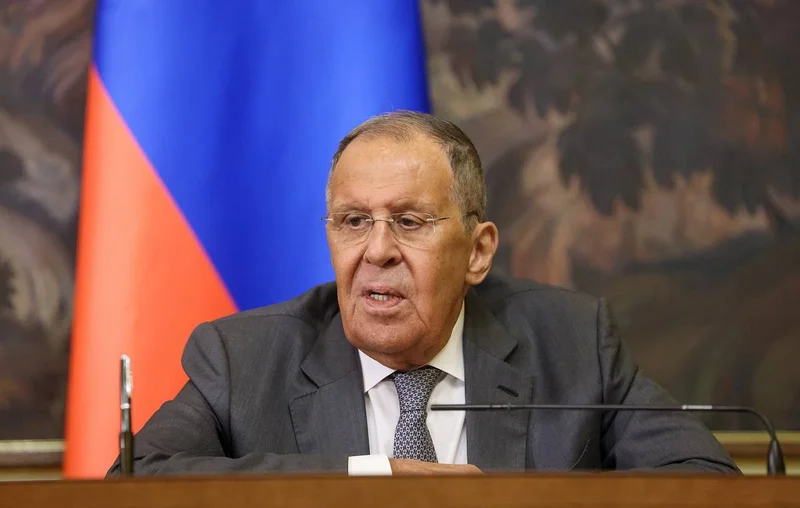
MOSCWO, August 22. /TASS/. The West, which is trying to wage a war on Russia with the hands of Ukrainians, will try to disrupt the September elections to the Russian parliament, the State Duma, but will fail, Russian Foreign Minister Sergey Lavrov has told reporters.
He said that despite multiple attempts to target the Russian flag in the West, it has become a symbol of the struggle for justice for many.
Below are the top Russian diplomat’s key remarks made during an interview to Vesti and a media stakeout during the 23rd United Russia party congress.
Attempts to disrupt elections
The West’s attempts to disrupt the upcoming parliamentary elections will intensify as the voting day approaches, but they all will fail: "Our law enforcement agencies, our security services are doing their best to nip these attempts in the bud."
"The Foreign Intelligence Service and the Federal Security Service are receiving timely information about which country is plotting what, and I can assure you that these plans will thwarted."
"[Vladimir] Zelensky and his circle are being weaponized and incited against Russia. Increasingly malicious tactics of inflicting as much damage as possible to Russian civilians are receiving support in an attempt to sow panic, fuel dissent and undermine peaceful life, particularly in the run-up to the State Duma elections. This is obvious."
West’s war
Russia will continue to develop and attain its ambitious social and economic development goals: "We will seek to achieve all of this regardless of the war declared against us, which is aimed at destroying and dismembering Russia, or as they are vaguely putting it now, to inflict a strategic defeat."
Moscow will not approach the West for negotiations as the latter hopes: "All Western countries that declared a war on us with the hands and bodies of the neo-Nazi regime in Kiev have hoped for many years that we will approach them to negotiate. We will not. There is no one to negotiate with in today’s Europe."
Western countries never gave up their dream of a weaker Russia: "When it became necessary for them to punish Russia, those who preached a free market, globalization, and the sanctity of private property suddenly overnight <…> imposed sanctions that crossed out the core principles of globalization, which the West has promoted for long, long decades."
Lately, the collective West unleashed a campaign against Russia’s tricolor flag, but it is already becoming a thing of the past: "More and more Olympic federations are lifting these bans."
Special operation and Ukraine
The Russian society is united like never before because the majority of citizens understand why Russia launched its special military operation. "Undoubtedly, this can be felt on the frontline."
By a twist of fate, Russia managed to get rid of a large number of people who consider the special military operation "someone else’s war": "They are in other countries now, going about their business, although many still try to do nasty things to Russia."
Allowing the "metastases of Nazism" to remain in Ukraine would be a betrayal of the ancestors who defeated Nazi Germany.
The idea of creating a "stabilization force" in Ukraine in case of a ceasefire will imply that Russia "consents to a truce, while the neo-Nazi regime, the only regime in the world that has legally banned an entire language, continues to exist on the other side of the line of contact."
If Russia stops at the engagement line right now, the same thing will happen than during the signing of the Minsk Accords: "Just like the Minsk Accords were signed to pump Ukraine with weapons, as was admitted by the German chancellor and the French president who signed them, the exact same thing will happen [if Russia agrees to freeze the conflict]."
Eurasian security
In its effort to ensure security of the Eurasian continent, Russia is not isolating itself from unfriendly countries: "I would like to particularly emphasize that on this Eurasian space, we are not trying to cut ourselves off from unfriendly countries. Geography commands us to look at the problem more broadly."
All Eurasian countries are invited to participate in the work to build security architecture on the continent.
Russia will be happy if countries in western Eurasia can join the work to ensure the continent’s security, but only if Europe refuses connivance with the interests of bureaucrats in Brussels alone: "When the western part of the continent <…> opts for those who care for national interests, rather than the interests of bureaucrats in Brussels, we will certainly be happy if they can join the processes that I mentioned."