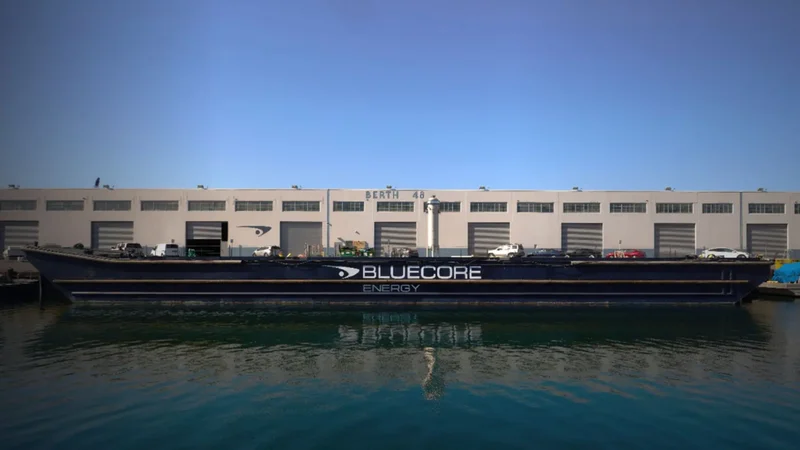
- Bluecore's floating reactor could power about 15,000 homes near the port
- California has banned new nuclear reactor construction since 1976
- The reactor would sit on a barge leased at Berth 48
The Port of Long Beach is exploring small modular reactors that could eventually supply electricity for port operations and ships.
Bluecore Energy, a startup building compact nuclear reactors meant to operate from floating barges, is leading the proposal.
This marks a potential return of nuclear power development in California after nearly five decades under state restrictions.
A startup's barge-based reactor plan
Bluecore has leased space at Berth 48 within the Port of Long Beach, where it intends to develop and test its floating reactor system.
The company's initial system is rated at 10 MWe, a capacity the startup says can scale through pairing multiple units together, an approach which suits continuous port operations partly because individual reactors are designed to run for years on a single fueling cycle.
The port has also signed a cooperation agreement with the US Maritime Administration to help establish safety standards for maritime nuclear power use.
"The company has taken nuclear reactor technology used in power generation and developed a smaller system designed to operate from a barge," said Kofi Asante, founder and CEO of Bluecore.
Asante told CBS News that a single reactor could generate enough electricity to power roughly 15,000 homes.
The proposed system is water-cooled and would generate heat through nuclear fission, similar to conventional nuclear plants on land.
Port officials say nuclear power could eventually supply around-the-clock electricity as cargo operations become increasingly electrified across Long Beach's terminals.
The technology could also extend to ships, data centers, and other coastal facilities located near water access points.
Regulatory hurdles still unresolved
California has maintained a moratorium on new nuclear fission reactor construction since 1976, tied to unresolved questions about high-level radioactive waste disposal.
It remains unclear how this long-standing state restriction would apply to Bluecore's proposed floating reactor design.
At the federal level, Bluecore has not yet filed a formal application with the Nuclear Regulatory Commission (NRC) for deployment approval.
The company was scheduled to meet with the NRC this week to present its reactor design and regulatory plans.
An NRC report reportedly raised questions about how maritime nuclear deployments would address hazards such as sinking, capsizing, and severe weather extremes.
The Port of Long Beach, the Maritime Administration, and federal agencies including the Coast Guard and Department of Energy are jointly developing operational and safety protocols.
The Maritime Administration also began seeking industry input earlier this year on scalable, US-built small modular reactors for the marine transportation sector.
For now, the Long Beach initiative remains firmly in the development and regulatory-planning stage, with no construction timeline confirmed.
If the project eventually advances past these early hurdles, Long Beach could become an early American test case for maritime small modular reactors serving port infrastructure.
Whether the state's decades-old nuclear moratorium ultimately blocks or accommodates this barge-based approach remains an open and unresolved question — one that regulators, port officials, and Bluecore itself have yet to answer.
Efosa has been writing about technology for over 7 years, initially driven by curiosity but now fueled by a strong passion for the field. He holds both a Master's and a PhD in sciences, which provided him with a solid foundation in analytical thinking.