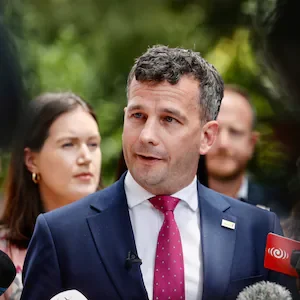
Act is revealing the next evolution of the reform it sought to achieve through the failed Treaty Principles Bill as it announces its “one law for all” policy.
The party will campaign on amending several laws to reinforce Parliament’s authority over the courts, increase the prominence of property rights and require Cabinet to explicitly articulate Treaty of Waitangi obligations before bills are drafted.
It is also proposing that Parliament pass a law to address the Supreme Court having “widely expanded the use of tikanga in the law” in the Peter Ellis case.
Among the various proposed changes to legislation was to add three principles to the Constitution Act 1986:
- Parliament is sovereign;
- The rule of law is fundamental;
- All New Zealanders are equal before the law.
It’s not clear whether adding the principles would result in any change or consequence, but party leader David Seymour argued that aside from the Treaty, no document outlined the country’s core principles.
“These principles are the foundation of a free society and deserve a clear place in New Zealand law in their own right.”
The next proposal was to add a property rights clause to the Bill of Rights Act 1990, which the party said would be “modelled on similar clauses from other jurisdictions” which the Herald understands includes some states in Australia and some European countries.
While Act’s policy did not propose a clause, the party said it would include “the peaceful enjoyment of property” and no deprivation except in the public interest, on just terms, and in accordance with law.
Act said it would lead to governments facing greater scrutiny and require clearer justification of why the Government was interfering with private property.
The party also raised concerns about recent Supreme Court decisions, citing the Smith vs Fonterra and the Marine and Coastal Area Act cases as having “pushed the line further than Parliament ever legislated”.
It referenced the Supreme Court allowing the successful appeal of Peter Ellis’ historical sexual offending convictions to continue after Ellis’ death due to considerations of tikanga (Māori custom).
Act intended to pass a law that would clarify how the courts could consider tikanga, saying it should only apply when “directly relevant to the case” such as a dispute between iwi or where Parliament had “expressly provided for it”.
“We cannot allow tikanga to become a separate source of law applying to broad areas of unrelated law without Parliament ever deciding that it should,” Seymour said.
Building on the actions of the current Government removing or altering references to the Treaty in legislation, Act would also campaign on changes to Cabinet’s processes, either through the Cabinet Manual, a Cabinet circular or in legislation, to require Cabinet to outline what Treaty interests are engaged or obligations created in a new law.
Other legislative changes in the policy included amending the Legislation Act 2019 to ensure statutes mean what Parliament enacted and defining the “rule of law” in the Senior Courts Act 2016.
A party spokesman told the Herald that legal experts were consulted in the development of the policy, but he couldn’t disclose who they were without first seeking permission.
The policy is an evolution of Act’s Treaty Principles Bill which it attempted to pass this term and in doing so re-define principles of the Treaty. The bill sparked significant outrage in Māori communities, leading to one of the biggest protests in Parliament’s history.
In its coalition agreement with National, Act was only afforded support from coalition parties to pass the bill at its first reading. It was later voted down at its second reading with National leader Christopher Luxon later saying he would not support another iteration of the bill.
Seymour, when asked if he would campaign on another Treaty Principles Bill, had said on several occasions the reform the party hoped to achieve could be done in different ways, such as through changes to the Bill of Rights.
Adam Pearse is the Deputy Political Editor and part of the NZ Herald’s Press Gallery team based at Parliament in Wellington. He has worked for NZME since 2018, reporting for the Northern Advocate in Whangārei and the Herald in Auckland.