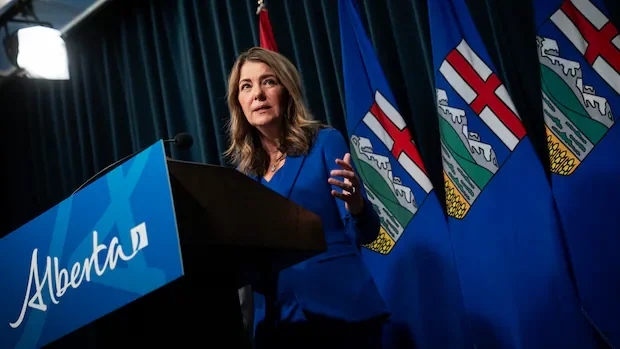
Alberta premier urges return to trade talks, calls U.S. terms 'untenable'
Smith calls for both sides to reach 'fair' deal as cabinet prepares to meet on Tuesday.
Alberta Premier Danielle Smith hopes federal negotiators will return to the table after the collapse of trade talks in Washington triggered a 50 per cent tariff on Canadian exports.
About $1.5 billion of Alberta’s $188 billion trade volume with the U.S. faces disruption, Smith said on her radio show Your Province, Your Premier Saturday morning. But she also said that the last minute demands from American negotiators were “untenable” and “too painful” for Canada to accept.
“I hope that they can get back to the table to negotiate something that’s more fair,” she said. “I’m really hopeful that some constructive conversations begin because, boy, the tariff war is painful.”
Smith spoke moments after Prime Minister Mark Carney announced Canada is imposing dollar-for-dollar retaliatory tariffs on the United States starting Sept. 8. She said she hopes negotiations will resume, and a deal can be signed before that date.
Carney said during a press conference in Ottawa that American negotiators wanted to restrict Canada’s ability to sign trade deals with other countries. He also said the Canadian automotive industry would have suffered under the deal, and that there were objections to Canadian subsidies for French cultural programs.
"We cannot accept what they've offered, and we will not give what they've asked," Carney said, adding that the United States “asked too much and offered too little.”
Smith said she was surprised to hear about the proposed trade restrictions and said Alberta has been trying to double exports to countries outside the U.S.
However, she was cautious on retaliatory tariffs towards American goods, adding she has no interest in banning imports of U.S. alcohol. Alberta and Saskatchewan are the only provinces without a ban.
She also worried about the impact a trade war would have on farmers and agricultural equipment, and warned Alberta’s furniture makers and honey producers are particularly exposed.
- American tariffs on Canadian goods take effect after trade talks fall apart
- Carney says he doesn't 'see the value' in using energy as leverage in U.S. trade talks
“I know emotionally it feels good to retaliate, I get that. But…when retaliation happens, it means that everybody who is buying products from the United States are now going to face upwards of 50 per cent tariffs,” she said.
Smith will meet with her cabinet Tuesday to review the scope of the new trade measures, review federal relief proposals and discuss next steps.
Impacts to small businesses 'significant'
Alberta’s major exports of natural gas and oil won’t be impacted too severely by these latest tariffs, said Smith.
Kayode Southwood, a senior policy analyst for the Canadian Federation of Independent Business (CFIB), told CBC News on Saturday that small businesses across Canada and the province will still suffer “immediate and significant effects.”
Roughly 40 per cent of Alberta’s small businesses export to the U.S. and half import American goods, he noted.
“This round of tariffs is going to be much more impactful than previous rounds,” he said. “Any retaliatory tariffs that are applied by the Canadian government will hit those Alberta businesses hard.”
WATCH | Tariffs on Alberta businesses kick in after trade talks collapse:Calgary Chamber of Commerce president Deborah Yedlin told CBC News she supports Carney’s decision to end negotiations, but warned up to 100,000 jobs across Canada are vulnerable without a resolution.
She said she hopes both sides return to negotiations soon, but also framed the trade breakdown as an opportunity for Canada to re-evaluate its interprovincial commerce and expand its international trade relationships.
“We know that we have free trade agreements with 51 countries covering 60 per cent of the global GDP, but yet 33 per cent is what we’ve been exporting,” said Yedlin.
“We need to make sure that we make the most of those trade agreements, but at the same time it means that we have to really focus on building the infrastructure to get our goods to those new markets.”
With files from Jo Horwood