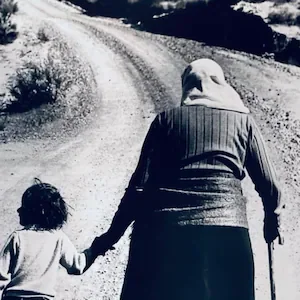
Dame Whina Cooper walking hand-in-hand with a moko during the 1975 Māori Land March. Photo / Michael Tubberty
Freedom of expression in New Zealand is guaranteed only in principle. It survives only if New Zealanders exercise it.
Few metaphors are as pointed as the scene that unfolded one winter evening in July 2024, in a newsroom on Auckland’s North Shore. After 35 years of bulletins, the lights wentout at Newshub. There was no censor’s order pinned to the door; the money had simply run out. Within months, the state television broadcaster’s current-affairs programmes were axed and regional papers thinned to pamphlets. Nobody silenced these voices. They just stopped, and the country largely shrugged.
New Zealand likes to tell itself that its freedoms are as natural as the tide or as Kiwi as jandals in summer. But anything that persists in a nation’s life does so only through fortune and choice.
Our freedom of expression is written down – section 14 of the New Zealand Bill of Rights Act 1990 declares that everyone has the right to freedom of expression, including the freedom to seek, receive, and impart information and opinions of any kind and in any form. Those words are strikingly generous – broader in some respects than America’s First Amendment – and they protect the listener as well as the speaker.
But the guarantee is thinner than it looks. The Bill of Rights Act is an ordinary statute, not supreme law. Section 4 of the same act tells our courts they cannot strike down legislation that tramples the rights it lists. Parliament, with a bare majority on a single night under urgency, can legislate straight through section 14. Since Attorney-General v Taylor, courts can declare an inconsistency, and Parliament must respond – but respond is all it must do. In the end, the only real entrenchment our freedom of expression has is us: a citizenry that notices, objects, and insists.
That should make us impatient with the misconceptions about free expression that fill our public conversation.
Too many people assume freedom of expression means freedom from consequences – reputational, social, professional. It does not, and never has.
Others treat the moderation decisions of private platforms as state censorship. They are not: the act binds the Government, not private companies, which have expressive rights of their own. Still others believe section 14 is absolute. It is not.
Section 5 permits limits that can be demonstrably justified in a free and democratic society – which is why we have defamation law, suppression orders, and the classification regime that banned the Christchurch terrorist’s livestream.
Reasonable people argue about where those lines sit – the abandoned hate-speech reforms after March 15 showed how hard that is. But justified limits are not tyranny. Pretending every limit is tyranny, and every consequence is censorship, cheapens the currency we will need when the real thing comes.
And here is the misconception that matters most: far too many behave as though freedom of the press belongs to professional journalists. It does not. Journalists occupy no special constitutional category in this country. The right to seek, receive, and impart information belongs to every New Zealander who chooses to exercise it. Freedom of the press is not about the press; it is about the freedom.
So when someone cheers for the “mainstream media” to be defunded or shut out of the room, they are cheering the diminishment of their own right to know what is done in their name.
And if you are the one furious at the media’s failings – and there are failings – consider not just complaining but competing. The barriers to publishing have never been lower. Start the newsletter. Sit through the council meeting nobody covers any more. File the Official Information Act (OIA) request yourself; the act belongs to you, not to the press gallery.
Power doesn’t like to be checked – it never has, anywhere. Watch how our politicians increasingly route around scrutiny: the interview declined in favour of the friendly podcast, the announcement livestreamed where no one can ask a question, the OIA response that arrives late and redacted like Swiss cheese.
Watch ministers dismiss legitimate questions as “gotcha journalism”, as if evading an answer were a victory for anyone but the politician. None of this is illegal. All of it is corrosive. The test of a Government’s commitment to section 14 is not whether it tolerates praise; it is whether it submits to questioning.
Journalists, for their part, bear an awesome responsibility, and no one is entitled to be believed – that must be earned. The collapse of trust in our media is real, and journalists are not without blame.
But notice the difference between how a reputable outlet handles error – the correction published, the Media Council or Broadcasting Standards Authority ruling accepted – and how the powerful respond to being caught out. Accountability is the tell.
If you doubt that our freedoms were fought for rather than found, our own history is instruction enough.
In 1863, the Kīngitanga’s printing press was seized at Te Awamutu – expression answered with confiscation, on the road to invasion.
In 1951, emergency regulations made it an offence to publish material supporting the locked-out waterfront workers, and people were prosecuted for handing out pamphlets.
As late as 2006, a man was convicted of sedition, a spectacle so embarrassing that Parliament abolished the offence the next year.
In 2011, it took the Supreme Court, in Morse v Police, to confirm that burning a flag at an Anzac Day service could not be criminalised merely for causing offence.
In 2015, the High Court ruled the police raid on the journalist Nicky Hager’s home unlawful. Each was a choice someone made to insist on the freedom, at a cost, so the rest of us could inherit it casually.
That inheritance includes voices who used the freedom before the statute existed to name it. Kate Sheppard and the suffragists pamphleteered a Parliament of men into the first universal franchise on Earth.
Whina Cooper walked the length of an island so a grievance could not be ignored. Māori-language newspapers argued for rangatiratanga in print when the Government would not listen.
None of them waited for permission. That is the whole point.
Every person in this country deserves the freedom section 14 describes. But freedom is not promised to any of us, and in New Zealand it is not even entrenched. It is a continual achievement, secured by those willing to defend it: the reader who subscribes, the citizen who publishes, the neighbour who asks the question everyone else is too polite to ask.
It is a choice we must make, again and again – knowing that the forces arrayed against the pursuit of truth are, always and everywhere, working against the cause of liberty too.
Catch up on the debates that dominated the week by signing up to our Opinion newsletter – a weekly round-up of our best commentary.