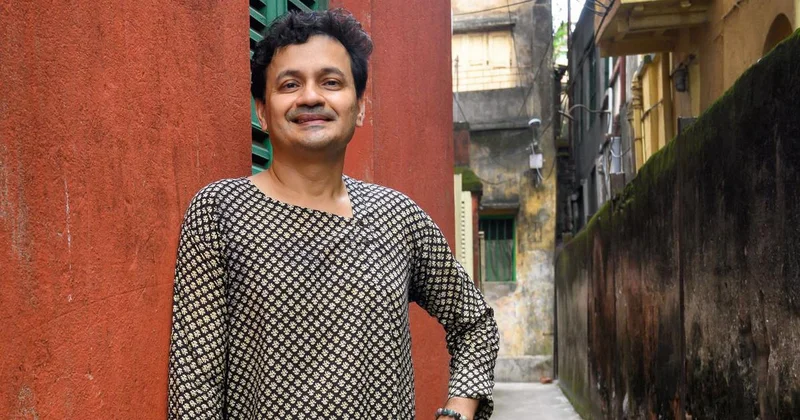
Having read several of Saikat Majumdar’s novels and a couple of his non-fiction books, I consider him one of those rare contemporary writers who move seamlessly across fiction, nonfiction, and academia – embodying the spirit of a true literary polymath. What I find particularly compelling about his writing is the way it inhabits both intimacy and ideas with equal ease. His novels delve into love, desire, friendship, memory, cities, and the shifting textures of modern life with emotional acuity, while his nonfiction carries the same depth through sharp insight and elegant prose. Across genres, his writing has consistently challenged and moved me, often leaving me with unexpected reflections long after I’ve finished reading.
In a conversation with Scroll, Majumdar talked about his latest book Open Intelligence: Education Between Art and Artificial, the value of narrative intelligence, why we urgently need to re-evaluate our intellect, and more. Excerpts from the interview:
Let me begin by saying that I’ve long admired your fiction – you are among my favourite contemporary Indian writers. So, I’m especially curious to know what prompted Saikat Majumdar, the novelist, to write Open Intelligence: Education Between Art and Artificial?
Fair question. Writing through the years, the technical difference between genres feels less important than certain overarching preoccupations that are now finally taking shape for me. One such concern is a certain ability of language to shock and surprise, to evoke a sensory, atmospheric reality. Likewise, the fundamental question of how we take shape as the characters we eventually become – our making and education, but one that is not limited to institutions: school, college, university, though obviously they are significant too. The Bildungsroman, also called the novel of education or the coming-of-age story, has been important to me, particularly through the question of sexuality and the self-making of the artist or the intellectual, as you might sense in novels like
The Firebird,
The Scent of God, or
The Middle Finger. But this is also the defining question in a critical book such as
The Amateur.
Many of these questions – education, creativity, imagination, and most importantly, our sense of who we are and who we like to relate to – came together in this book situated in the already-present future of artificial intelligence. The style in which it came out is also one that has some personal significance. It is what I might define as public thought in a private mode, where emotions, personal experience and narrative seek to pry open subjects of research and public debate. This style has helped me bridge the different worlds I inhabit and has shaped the newspaper articles and op-eds that I’ve written over the years.
Indeed, while reading Open Intelligence, I was struck by how different its language and style felt from much of the nonfiction in this genre – it often reads like a work of storytelling. Was that a deliberate choice, especially given that the book explores how artificial intelligence might shape education and our creative lives?
I’m glad the book has come across in this way to an avid fiction
reader like you. But this wasn’t just the writing style of this book – it was the fundamental way I imagined it. Storytelling is the very worldview of
Open Intelligence, which foregrounds narrative intelligence as a key mark of human uniqueness in the AI age. The idea here is that humanity is not just connected to each other through objective data (by that, too, definitely), but also about intersubjective feelings, common emotions, anxieties, and fears. These intersubjective feelings form our common reality no less than quantifiable data. Fears of irrelevance, unemployment, and obsolescence are now widespread among many people, including teenagers asking questions about studies and careers. These anxieties are what got the book started.
A book about education, imagination, and artificial intelligence has a strong emotional life of its own. There is, as you know, much research, data, and news reports in this book, as well as historical accounts of academic disciplines and human intelligence, but the moral and emotional force in this book is that which connects human beings not only to one another, but also to the non-human and the planetary. I know there are many books and articles on these subjects – be it education or AI – that are very technical, and I have learned a lot from reading many of them. But the book I was going to write couldn’t quite be like them. The spray of stories, from Aesop’s fables to the eccentricities of my own children, as such, do not only give shape to the writing style – they embody the fundamental ethos of this book, as well as the human future I envision in an AI-shaped world.
Your writing in Open Intelligence also feels very welcoming – it draws readers in rather than trying to impress or intimidate them. Unlike many intellectual writers, you don’t seem to weaponise your intellect. Did you always envision the book speaking to readers in this open and accessible way, and how do you think about accessibility when discussing complex ideas?
I think writing to dazzle can be one of the fatal mistakes of the preoccupation with writerly craft. Writing is not meant to display brilliance; it should move and shift something within the reader. Brilliance will never work unless it is also truly touching. This is true of all books, but more urgently for a book like this one. I was very happy to hear from many students, teachers, and counsellors that my previous book on higher education,
College: Pathways of Possibility, helped answer some education and career questions, and the book was also lucky enough to play a small role in educational policymaking.
Open Intelligence, as the sequel to
Collegein the AI Age, was driven by the same impulses – to seek some answers to questions about knowledge, education and career with which we’re all grappling now.
AI has brought up some questions that are unsettling both practically and philosophically, and before this massive transformation of our world, there is no space or time to weaponise our intellect. Rather, we need to re-evaluate our intellect and question whether our existing educational priorities will at all suffice anymore. As I’ve tried to elaborate in this book, our fetish for symbolic systems (language and numbers) as the cornerstone of all academic subjects and standardised tests may need to change so that we can celebrate a more holistic human potential that will remain relevant for longer in an AI-driven world. The impulse to weaponise one’s intellect comes from our current fetish for what we value as intelligence, whereas the world before us is going to need qualities that are a lot more humane and ethically and politically sensitive. This is no longer idealism but a question of survival, and in the book, I’ve tried to explain why.
You spoke about accessibility and how uniquely human, holistic potential may remain valuable in an AI-driven world. That makes me want to ask a slightly provocative question: when people use AI tools to produce polished, intellectually sophisticated writing that may not reflect how they naturally communicate, do you see that primarily as empowerment and accessibility, or does it risk becoming a form of intellectual misrepresentation?
This is a tough one. My simple answer is yes – this levels the playing field in many ways. The real goal of education, the Marxist theorist Terry Eagleton had argued, is to socialise people into a kind of discourse, basically to teach them to talk in a certain way. It leaves out many people who have valuable things to say and do but cannot articulate them in the language that is acceptable to the power structure. Of course, this goes far beyond merely verbal language – it includes the entire way of presentation of ideas, individuals and communities. But even if we limit ourselves to verbal language right now, many more people have access to something resembling this polished discourse than before, thanks to AI writing tools.
The deeper problem is that language is not fully separable from ideas, and a lack of training in language may go hand in hand with lacunae in concepts and even the ability to do things. So, while some of the linguistic empowerment with AI is real and necessary, some of it is also false. I think given where the Large Language Models are right now (significantly improved since the launch of ChatGPT in 2022), sensitive readers of language are able to identify AI-generated material – flawless, articulate, but without distinctive character. For everyday functional communication, I think this is fine as more people can participate in it – though I agree that it may also involve a certain misrepresentation, particularly if they also cannot think/express themselves in situations without AI, such as in spontaneous conversations. As I explain in the book, our definition of essential knowledge changes with time – now no one considers it a misrepresentation of one’s ability if people use calculators for large-scale numerical calculations.
But on higher levels of communication – be it the speech of a truly persuasive politician, the statement of a visionary industry leader, or unique or idiosyncratic artistic language – there is no levelling of the playing field, as only the distinctive will work here. But we cannot say how long it will be before AI reaches these places too.
Near the end of the gratitude section of Open Intelligence, you write that the flaws in the book “remain stubbornly human.” I loved that line! So perhaps another final, slightly controversial question: what do you make of literary creativity and the debate around Nobel laureate Olga Tokarczuk’s admission that she used AI tools while writing her novel?
Honestly, the way AI is going, it is impossible to predict where all of this is headed. I’ve tried to explain in this book how elements like personalised subjectivity and originality, so far held as essential to the making of art, must be drastically reconfigured in the age of AI. These elements have not always been essential to the making of art, and the world of myths, legends and oral performance has thrived without these notions. I’ve always said that the postmodern is the return of the premodern in a digitised form. Even though AI has pushed the virtual into unexplored terrain, it’s important that we see the big picture through a lens of history.
The part of me that wants art and thought to be “stubbornly human” believes that AI is capable of meeting or perhaps even exceeding the human capacity for literary craft. But craft is the body of art that must contain something wilder and more unpredictable – its soul. Without making too much of the separation of the body and soul (which must melt with good art), it is possible to come across perfectly formed writing that is soulless, as well as poorly crafted writing that has a wild and throbbing soul in it. As someone who teaches creative writing, I see this daily. It is possible to produce writing of great technique that remains brilliant in a distant way, and it’s also possible to say something that is truly moving while somehow faltering in language and technique.
In the end, this is more about the reader than the writer. Is the reader happy with craft that is mechanically perfect, or do they long for that ineffable quality that only the mist of human breath can leave on writing? I believe AI will quickly master forms of writing, such as genre fiction, which are governed by discernible rules. This has already started to happen with popular music on the internet. But if the reader is not happy with just perfect adherence to form and longs for the felt nature of lived life behind writing, AI won’t be able to do everything for them. At least not for a while.
What has happened recently shows how deeply our focus has shifted, from the soul to the body of art – from its humanity to its technique. When it comes to technique, even great writers have something to learn from AI, as Tokarczuk’s example shows. But if AI truly takes over writing, I believe, it will happen through the will of readers as much as through the work of writers. It’s really another version of the question whether we want deep and intimate relationships with chatbots or whether we still need human beings for them. Art and literature make up a great medium through which to ask this very question.
Diya Sengupta works across artificial intelligence, business strategy, and consulting. She is the founder and co-curator of Juhu Reads and the co-curator of Pint of View Mumbai.
We welcome your comments at letters@scroll.in.