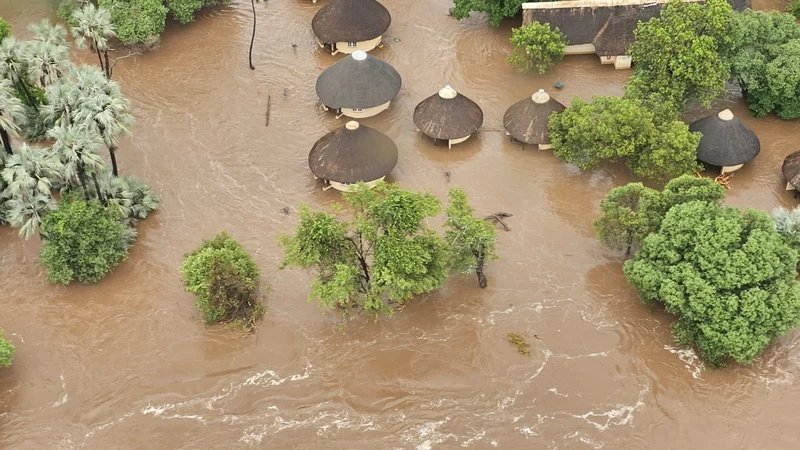
It began in early January with a low-pressure zone over Mozambique drawing moisture-laden air from the warming Indian Ocean. The saturated air was pulled towards the escarpment west of the Kruger National Park and forced upwards.
As it cooled and condensed, huge cloud systems began building. A disaster was on its way. By 9 January, torrential rain was pummelling the catchments of the Krugerâs rivers and the park itself. The South African Weather Service issued a level 6 warning.
When the saturated earth could absorb no more water, drainage lines fed streams that sluiced into rapidly filling tributaries and then the parkâs major rivers.
The Kruger began evacuating tourists as the Sabie, Olifants, Letaba, Sand, Luvuvhu and other rivers burst their banks. Roads vanished beneath brown water, bridges and causeways were overwhelmed and camps were cut off. Debris massed against culverts and the rising water pressure simply blasted them away, taking roads with them. The Pafuri area received its average annual rainfall in just two days.
On 16 January, a red-level warning went out. By then, one of Africaâs best-known protected areas had become a landscape of flooded rivers, broken infrastructure and isolated pockets of high ground. By the time the weather relented, the storms had caused nearly R1-billion in damage.
The park had endured major floods before, notably in 2000 and 2023. But this event was different: several river systems flooded almost simultaneously, and the Letaba River rose beyond its level in 2000. With extreme weather expected to become more frequent, the Kruger needed a major rethink: how to expect the unexpected and build for it.
Under massive siege, its infrastructure could have fallen apart. It didnât. The park happened to be conducting an infrastructure vulnerability assessment based on earlier floods when the waters began rising. Managing executive Oscar Mthimkhulu therefore had the basis on which to assemble a disaster management team.
Park management rapidly established detour routes and moved people out. More than 500 guests were evacuated from camps including Letaba, Balule, Talamati, Shimuwini and Sirheni, and Pafuri tented camp in the far north was cleared. As low-level bridges washed out, several gates into the park had to close.
Remarkably, the park worked around failing structures to keep large sectors operating. The interconnections needed to run this vast place, and staff with in some cases a lifetimeâs experience, held it together. Information was shared quickly. Infrastructure was hammered, but the system held. A complete shutdown was avoided and visitor numbers remained resilient.
Rethinking the strategy
Around the table are Mthimkhulu, head of conservation management Danie Pienaar and large-mammal ecologist Sam Ferreira â the core of the team thinking through the Krugerâs recovery.
âDanie was on holiday when the floods hit,â says Mthimkhulu. âBig problem. Heâs my go-to guy in a situation like this. Iâm fairly new and heâs been here most of his life. Fortunately, he cut short his holiday.â
What they had not bargained on was how long the floods would last. âThey took us by surprise when they flowed over high-level bridges,â says Mthimkhulu. âItâs amazing when you consider that we evacuated more than 500 people. Nobody lost their life.â
âYou have to remember that these floods came on the back of the 2023 floods,â Pienaar adds. âInfrastructure damage from then had not yet been fixed, so it was damage on damage. The dual impact amounted to a hell of a lot of destruction.â
As the crisis eased, the team began planning the clean-up and reconstruction. Its vulnerability assessment identified four key threats: floods, fire, drought and heatwaves. Consultants conducted a detailed analysis of every section of the park. It was clear that the Kruger would have to rebuild for a new normal â and that the costs would be huge.
âWe realised we couldnât just build back like before,â says Mthimkhulu. âThis is going to happen again, and probably more frequently. We had to build back better.â
That has become the mantra of the Krugerâs reconstruction.
The park receives about two million visitors a year and its revenue supports not only the park, but many other SANParks properties. Repairing roads and accommodation quickly was vital.
The floods isolated large areas, bringing down bridges and culverts and severing the road connection between the north and south. Many gravel roads were impassable. Reconnecting the network was a priority.
The park has its own road teams as well as road and bridge contractors, but frustration mounted as insurance claims dragged on and environmental authorisations were required wherever rebuilding enlarged the original footprint.
âOur big problem is our road infrastructure,â says Pienaar. âThat is something tourists donât necessarily see, especially our management roads. Of the R1-billion we need, more than half is for management roads, which nobody sees or drives on â but we feel it.â
These unseen roads are the Krugerâs Âoperational arteries, carrying rangers on anti-poaching and fire-control efforts, alien plant removal and other conservation work.
Starting the rebuild
Much of the practical rebuilding rests on the shoulders of Bharat Gulab, programme manager responsible for infrastructure and technical services. A civil engineer, he was already overseeing repairs after earlier floods when the latest disaster struck.
Weâre standing in an almost dry riverbed on the road to Lower Sabie, surveying the remains of a culvert system now reduced to tangled corrugated iron and mangled concrete downstream.
âYou have no idea what water can do until you see this,â Gulab says.
The wreckage is framed by its replacement: a concrete structure embedded with rocks, vaguely resembling part of a medieval castle, but designed to let the flood through. Two ceiling-high openings beneath the road look capable of swallowing flood-driven trees whole.
âIâve now seen three floods. I wouldnât say itâs regular, but itâs happening all over the park,â Gulab says. âOur infrastructure has to be resilient to the changes weâre seeing in weather patterns. If we simply rebuild what was there before, it will go in the next flood.â
The culvert has been completely reÂÂdesigned with larger openings, stone pitching and stabilised embankments.
âPreviously there was no stabilisation and the water flooded over the bridge,â he says. âIt scoured beneath the structure and ate the material backwards. In the end it took away the road and sent everything downstream. When I saw the whole deck at Letaba under water, it was scary â a really scary sight.â
Repairs after the earlier floods were delayed by insurance claims and environmental approvals. In one case, Gulab says, the insurance payout took six to eight months, by which time the emergency environmental authorisation had lapsed.
With areas isolated and tourists returning, the roads department built temporary routes around destroyed infrastructure. The network mattered, and engineers were key to restoring it. Gulab estimates that rebuilding after the 2026 floods could take about five years, depending on funding.
âHow much does a culvert like this cost?â I ask.
âI reckon about R1-million,â he says.
Cost of the fix and partnerships
A detailed engineering assessment presented in Parliament put the cost of repairing the Krugerâs flood-damaged roads, bridges and other infrastructure at R949.86-million, excluding VAT. Almost R699-million is uninsured. The breakdown is:
- Roads: R640.19-million
- Bridges and culverts: R196.26-million
- Structural damage: R113.41-million
On 26 May, R36.4-million was allocated through the Department of Tourism for the parkâs rehabilitation. On 4 August, Deputy Minister of Forestry, Fisheries and the Environment Narend ÂSingh said the National Treasury had approved R288-million for flood damage. That was still substantially below the parkâs needs.
Around the table, Mthimkhulu, Pienaar and Ferreira are looking even further ahead. One proposal is for a Kruger Conservation Fund. The park is renowned around the world, heavily Âvisited and much loved. On that basis, an international fundraising campaign could succeed.
âThere are people with the means and resources to help us,â says Mthimkhulu. âWeâre asking them to reach out and provide a service or product. It isnât only about giving us funds. A company could adopt a bridge, a culvert, a road or a camp structure and build it on our behalf. That would go much quicker.â
Pienaar is thinking not just about culverts and roads, but also the floodâs ecological effects. âThings that are bad for humans can often be good for nature,â he says. âWhen the flood happened, I donât think the public were thinking about the infrastructure. They were asking, what about the poor animals?
âBut floods are good for river systems. They wash out alien plants and accumulated gunk. Animals have coped with changing systems for millions of years. Theyâre far better at it than we are.â
Despite fears that the rain would bring more mosquitoes and malaria, Pienaar says the Kruger recorded remarkably few insects after the floods. Insect eggs get drowned in the saturated soil or washed away. Stink bugs largely vanished and Ferreira encountered far fewer ticks than expected. âItâs an exciting time to see the dynamics playing out,â he says.
âThese animals evolved over many millennia to deal with floods. In previous floods, crocodiles simply moved out of the main stream and hippos did the same.â
When the Sabie River came down, Pienaar says, a whole pod of hippos gathered beside the bridge, out of the main current. Elephants presented no problem: they love water.
Taking lessons into the future
Everything is green. Heavy rain produces grass and, in time, more rodents â good for raptors and small predators.
âThe important question isnât what the Kruger or its rivers should look like,â Ferreira says. âIt is which ecological processes we should sustain, or allow to play out, to maintain the Krugerâs dynamics.
âThese are some of our biggest lessons. Whenever a drought or flood comes around, those processes are accentuated and we understand them better.â
Mthimkhulu adds: âThe Kruger is a national park and thatâs about conservation. But itâs also a tourism destination. Sometimes those things conflict. That is where you have to strike a balance.â
Without a sound environment and ecological system, he reflects, there is no tourism product. One depends on the other.
âWe have experienced this crisis,â he says. âThis park means a great deal to many people. Iâve met people who have travelled all over the world and they tell me the Kruger is something else. Thereâs nothing like what we have here.
âSo weâre building something intended to withstand these floods. It may not fit the exact place or footprint of what was there before. But we canât let a good crisis go to waste. We have to build back better â and we are.â DM
This story first appeared in our weekly DM168 newspaper, available countrywide for R35.