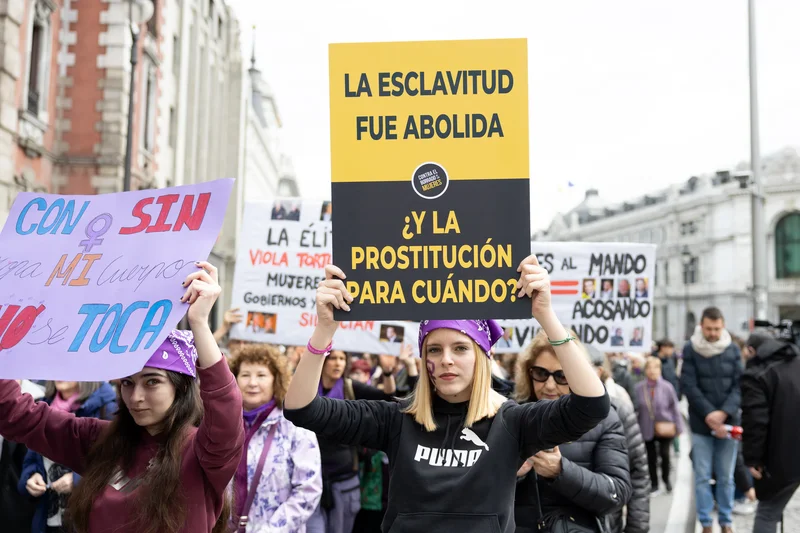
Few issues in feminism are as politically charged as the debate over sex work. Back in the 1980s, the ideas of Andrea Dworkin and legal scholar Catharine MacKinnon helped lay the foundations of what became known as radical feminism, then associated with its uncompromising opposition to prostitution and pornography. Dworkin’s determination to eradicate both led her to ally with conservative groups, forging a connection between abolitionism and the political right. Today, however, political debate is resurfacing in several European countries, and in some cases that alliance — perhaps one that lasted too many years — is beginning to fracture.
In Spain, the publisher Debate has reissued Andrea Dworkin’s Right-Wing Women (2026), originally published in 1981, bringing the issue back to the fore and reopening debates at the heart of the feminist movement. Poet and writer Noemí Trujillo’s Hambre de abolición (A Hunger for Abolition), a manifesto against what she sees as a profound structural injustice, will be published on October 7. The questions raised by second-wave feminism are back, albeit reshaped by years of legislation that have put different approaches to the test: is sex work simply another form of labor, or is it a manifestation of women’s subjugation? Does it make sense to seek its abolition, or is regulation the better path? And where it has been regulated, what have the results been?
Alice Schwarzer, 83, a leading figure in abolitionist feminism and founder of the magazine Emma, responded by email. Her assessment of the sex industry, which she has campaigned against for four decades, is unequivocal, and she sees no mitigating factors in its newer digital forms: “Prostitution is prostitution. Whether it is soft or hard, it is equally destructive for women because it penetrates to the deepest level of their being: it turns them into objects, commodities, people who can be bought.”
This theoretical argument is reinforced by an empirical one focused on the harm experienced by women engaged in sex work. For Rosa Cobo, professor of gender sociology, sex work “represents the absolute triumph of capitalism.” She believes that feminism is incompatible with support for prostitution: “Feminism has fought for women’s sexuality to be based on desire. Prostitution is founded on male desire and denies women’s desire.”
It is difficult to prove a causal link between sexism and sex work, although that is one of the main arguments advanced by abolitionists. In the meticulous study Is Sex Work Inherently Gendered?, British researcher Natasha McKeever challenges some of the most common claims, such as the idea that men pay for sex because they cannot find partners or that there is necessarily a socioeconomic imbalance between buyers and sellers. The available evidence does not support those assumptions. Perhaps the most striking finding is that, in the United Kingdom, during a period of significant progress in gender equality (1990-2010), the proportion of men reporting that they had paid for sex rose by two percentage points. McKeever argues that choice also plays a role and that many people enter sex work for reasons that go beyond poverty, particularly since the rise of the internet. “Students, for example. It’s a better way to make money,” she says by phone. “Some people genuinely want to do sex work.”
And this is where the strongest arguments for regulation emerge: individual choice and the idea that the body should not be treated as sacred. According to Martha Nussbaum, all workers are paid for the use of their bodies. The fact that prostitution involves particular body parts and is socially stigmatized is, in her view, a matter of prejudice. The problem arises when women in poverty have no alternatives. As she argues in one essay, legalizing prostitution improves conditions for women who have very few options.
Supporters of regulation also argue that coercion and exploitation can occur in any line of work. Erin O’Brien, a political scientist who identifies as both a feminist and a supporter of regulation, argues that recognizing sex work as work allows those who perform it to seek legal protection without fear of stigma, she said in an email. She rejects so-called neo-abolitionist laws, which target clients and seek to eliminate demand for sexual services. In her view, such measures are ineffective and “amount more to symbolic politics than to laws that genuinely protect health, improve safety [for sex workers], and guarantee their human rights.”
Having moved through virtually every position in the debate, Mabel Lozano, 58, is now firmly aligned with the abolitionist camp. She has directed short films and documentaries on the subject and argues, in a phone interview, that the truly radical position today is not to regulate sex work but to ban it. “There is nothing more conservative, more outdated, than thinking prostitution can be a job. That is what pimps have always wanted,” she says. “I once worked with a pimp who told me: ‘When I hear those [pro-regulation] voices, I think there’s no need to bribe them. They already think the same way I do.’”
In Europe’s current political climate, the debate has resurfaced, albeit in different forms across the continent. In Spain, the Socialist Party (PSOE) has spent the past eight years trying to pass legislation abolishing sex work. In the wake of the Koldo scandal, which exposed a network of influence peddling and allegations involving paid sexual services, Equality Minister Ana Redondo has said that even if the bill fails, it will at least spark a public debate and possibly a parliamentary one. The left-wing group Sumar, which governs in coalition with PSOE, has yet to see the draft legislation, but the party’s general position is to repeal the so-called gag law, which penalizes women engaged in sex work, and to reform immigration legislation, which it says “condemns thousands of women to irregular status and exclusion.” Beyond these goals, and a commitment to listening to women in the sector, opinion within the party remains divided.
From the other side of Europe, in Germany, regret over two decades of regulation is growing. The Christian Democratic Union (CDU) wants to repeal the law, arguing that it has turned the country into “Europe’s brothel.” And, to a lesser extent, and in a more unexpected way, the issue is also resurfacing in France. A lawmaker from the far-right National Rally party has proposed reopening brothels and having them managed by sex workers “as cooperatives.” The proposal is framed as a response to criticism from sex workers of the 2016 law that penalizes clients and, they argue, has made their working conditions more dangerous.
As the situation in France illustrates, sex workers have interests of their own and tend to favor regulation. For Cobo, women’s autonomy is essential to the advancement of feminism, but she sees sex work as one of the cases where choice reaches its ethical limits: “Extracting sexual surplus value from our bodies is ethically unacceptable. Nor would it be acceptable for someone to decree their own enslavement.” Once again, the debate exposes a gap between ethics and politics.