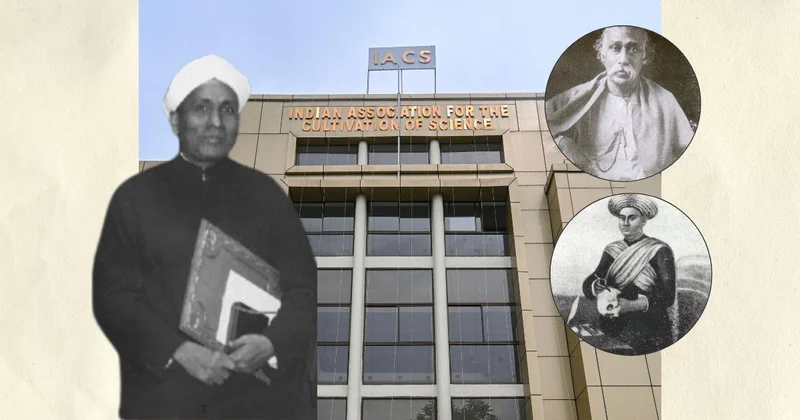
One afternoon in 1907, a young accountant named Chandrasekhar Venkata Raman walked into the laboratory of the Indian Association for the Cultivation of Science at 210 Bowbazar Street in Calcutta.
Though he had a passion for the sciences, colonial India offered no stable careers in the field, so Raman had joined the Indian Finance Service.
But after work, Raman started a series of pathbreaking experiments – first in sound, then in optics – at the laboratory of the IACS, an institution that had been established just over three decades earlier specifically to popularise science and encourage Indians to conduct research at a time when such opportunities were scarce.
Soon, Raman (who would go on to become the secretary of the IACS) along with his associate KS Krishnan started experiments related to light. The phenomenon he recorded, where light changes its wavelength when scattered by molecules of a liquid, is called Raman Effect.
In 1930, this work earned Raman the Nobel Prize in Science, making him the first person from Asia to win this award.
Raman’s illustrious career was the fulfillment of the dream of Dr Mahendralal Sircar, who had started the Indian Association for the Cultivation of Science on July 29, 1876, with an express ambition: “to invite, encourage and enable the natives of India to cultivate science in all its departs”.
The story of the Indian Association for the Cultivation of Science offers a snapshot of the tireless efforts of Sircar and others in 19th-century India to create a self-reliant scientific culture that would allow the subcontinent to stand shoulder-to-shoulder with the rest of the world.
When Sircar died in Calcutta on February 23, 1904, the obituaries were effusive.
“It is no exaggeration to say that he was the father of whatever scientific spirit we find in New India,” wrote Banwarilal Chaudhury in New India on April 27, 1904. “Here was a Caesar. When comes such another?”
A medical doctor by profession, Sircar firmly believed that God’s great gift to humankind was the power of observation and reasoning, to be applied to the material world.
On Sunday afternoons, he would invite friends over to his home in North Calcutta, for discussions on science at which he would conduct demonstrations about heat, electricity and magnetism.
Sircar strongly felt that ordinary Indians should have a space for experimentation that should be indigenously managed, free of the control of the colonial government.
“We want an institution where lectures in scientific subjects will be systematically delivered and not only illustrative experiments performed by the lecturers, but the audience should be invited and taught to perform themselves,” he wrote in 1869. “And we wish that this institution be entirely under native management and control.”
Concepts of western science had begun to circulate in Bengal through popular journals from the beginning of the 19th century. As early as 1818, the Bengali periodical Digdarshan, published by the Serampore Mission Press, carried news of scientific discoveries made in Europe.
The journal Pashavali, established in 1822, carried illustrated articles on nature and the workings of the human body. In the magazine Jnanodaya, the editor Krishnadhan Mitra published articles on natural science to challenge deep-rooted superstition.
As writings on science in Bengali journals were slowly picking up, Akshay Kumar Dutt appeared in the scene. In 1840, he joined the Tattwabodhini Sabha or Truth-Propagating Society that had been started by reformer Devendranath Tagore, the father of writer Rabindranath Tagore.
In 1843, Dutt became the editor of the Sabha’s journal Tattwabodhini Patrika. Through his sustained advocacy, the journal became a powerful vehicle to propagate scientific ideas.
Dutt promoted evidence-based scientific rationalism, arguing that understanding nature and physical laws was just as important as spiritual contemplation.
Dutt’s essays helped the Bengali reading public, for the first time, to gain an understanding of the diurnal movement of the sun and the rhythms of season change. He developed a modern scientific vocabulary in the Bengali language to make complex scientific concepts understandable to the lay reader.
Already, Indians were advocating for the study of science in the country.
Among them was the reformer Raja Rammohun Roy, who contended that India’s path to modernity lay through the study of science.
In 1823, he wrote to the governor general, Lord Amherst, expressing the hope that European teachers would be employed to teach Indians about subjects such as mathematics, natural philosophy, chemistry and anatomy. These disciplines, he said, had carried Europe “to a degree of perfection that has raised them above the inhabitants of other parts of the world”.
But Roy’s appeal went largely unheeded. When the University of Calcutta was established in 1857, it did not have any science facilities. In Bengal, only the Calcutta Medical College, established in 1835, had a chemistry laboratory and a dissection room.
When Madhusudan Gupta, a student in the first batch of the Medical College, dissected a human corpse in 1836, the event was lauded with a 50-gun salute. An Indian had at last overcome the age-old superstition against touching human remains.
It was a turning point in the study of medicine in India. Gupta silenced his detractors by citing passages from the Sanskrit medical text Sushrut Samhita, to prove that anatomical examination had existed in ancient India.
Mahendralal Sircar as a student of the medical college dissected human cadavers too. He took advantage of the laboratory facilities of the Medical College to carry out scientific experiments.
But the Indian Association for the Cultivation of Science was the country’s first indigenous research institute for modern science.
Instruments were purchased with generous donations from “native” science enthusiasts. To maintain the laboratory and to fund the salaries of laboratory assistants, several people paid monthly subscriptions of Rs 25.
Though Sircar had a thriving medical practice, he found time to make sure that the instruments in the association’s laboratory were in perfect working order.
He hoped that young Indians would walk into the laboratory and unlock the mysteries of nature through experiments.
The novelist Bankim Chandra Chattopadhyay was an enthusiastic supporter of the campaign to spread modern science. After the Association was established in 1876, he introduced a regular column called “Vigyan Rahasya” in his journal, Bangadarshan. Chattopadhyay himself wrote articles on physics, chemistry, and astronomy to demystify advanced concepts for ordinary people.
At the IACS, lecture-demonstrations were held regularly to acquaint laypeople with the latest developments in science. Starting from 1885, Fr Eugene Lafont, the rector of St. Xavier’s College and vice president of the IACS, gave lectures on topics of fundamental science such as the “Properties of Gases”, “Velocity of Light and Means of Measuring it”. At one session in 1891, he elaborated on technological developments such as Edison’s phonograph. In 1898-’99, he spoke of experiments with colour photography.
In July, 1900, Sircar gave a lecture-demonstrations on wireless telegraphy and pointed out the similarities and differences in Jagadish Bose’s experimental set up and those of the Italian engineer Guglielmo Marconi. He also gave an elaborate talk on X-rays and called it “new photography”.
The day after Mahendralal Sircar died in 1904, the Hindu Patriot wrote: “Dr Sircar’s one view, one aim, one ambition was to instill into his lagging countrymen’s minds, a genuine desire for scientific research.”
One hundred and fifty years after he set up the Indian Association for the Cultivation of Science, the institution has flourished. It has grown into a deemed university located in Jadavpur with more than 400 research students and 67 faculty members who specialise in the physical sciences, chemical sciences, biological sciences, material sciences, mathematical and computational sciences and applied and interdisciplinary sciences.
“The present times are vibrant and filled with enormous possibilities,” said Kalobaran Maiti, the institute’s director. “It puts the new generation in a unique position to invent and innovate.”
Subha Das Mollick is a documentary filmmaker working in Kolkata. She also teaches media studies and film studies.
We welcome your comments at letters@scroll.in.