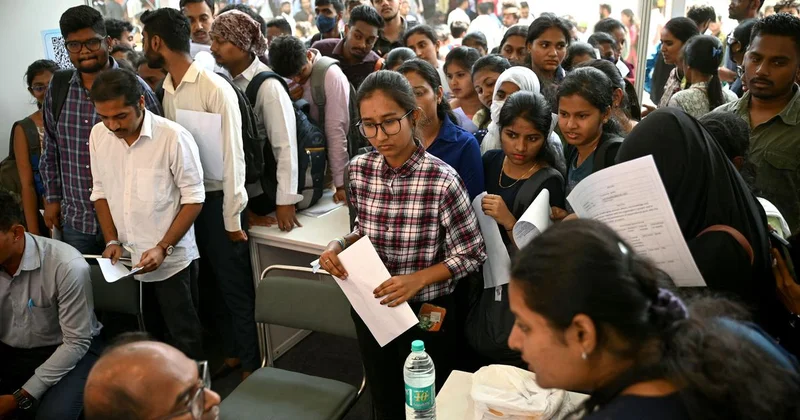
An estimated 8.7 crore Indians aged 15 to 29 are not studying, working or undergoing training, said a report by the NITI Aayog, the main public policy think tank of the Union government.
The report, titled Reimagining Skilling for Viksit Bharat@2047, is based on data from the 78th round of the National Sample Survey conducted in 2021. It classifies India’s workforce and learners into five categories: those attending school, going for tertiary education, involved in formal and informal work, women and those not in education, employment and training, or the NEET youth.
“NEET youth are constrained by the absence of income and the sunk cost of prior education,” said the report. “Students often cannot layer paid skilling onto existing financial commitments.”
This group, along with women, needs affordable or subsidised training and financial support, underlined the NITI Aayog. It also said that skilling programmes should be linked to the demand of emerging sectors and self-employment opportunities.
“Across segments, the ability to combine learning with earning remains a central requirement,” it said.
The report further pointed out that only 8.25% of persons who have graduated from college are employed in roles aligned with their qualifications.
“Limited exposure to practical learning and industry-aligned training continues to constrain employability, even among formally educated youth,” it said.
It added that students from low-income households often cannot afford to pay for additional skilling alongside college expenses. It is because of this that many take up whatever work provides a stable income after graduation, even when it is low-paying, said the NITI Aayog.
Those who are unable to do so struggle to enter the workforce and become NEET, said the report.
To address this, skill development programmes should be introduced in schools, rather than treating it as an option after formal education, said the NITI Aayog. It added that Universal General Employability and Entrepreneurship Skills should be taught from Class 6 to Class 12, along with structured vocational pathways from Class 9.
Edited by Sneha.
We welcome your comments at letters@scroll.in.