- See more This is Money on Google - save us as a Preferred Source
Britain's cement industry is facing extinction if the Government does not act within the next few months to prevent the sector being buried by cheap imports, business leaders have warned.
The firms, which employ 89,000 people and are part of a UK mineral sector worth £6.7billion a year, want ministers to level the playing field by taxing imported cement at the same levels as that produced domestically.
The Government is consulting on doing this under a system known as the Carbon Border Adjustment Mechanism (CBAM) – but details are still under discussion despite a pledge to bring it in by January 1, 2027.
At present, British firms are subject to green taxes as they use large amounts of energy.
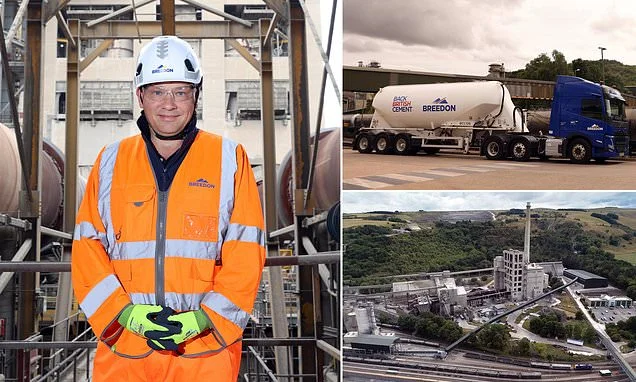
Breedon's CEO Rob Wood, pictured at Hope Cement Works, warns the industry faces extinction if the government does not act within months
Foreign producers face no such levies, leaving UK cement firms at a disadvantage as they also battle soaring energy costs and other taxes.
As a result, imported cement soared to 32 per cent of the market last year against just 12 per cent in 2008.
Meanwhile, domestic production has fallen to 7.3 million tons a year, its lowest since 1950 and down from a peak of 20 million tons in the 1970s.
Bosses have called on the Government to reverse this decline, arguing a reliable supply is crucial to Labour’s plan to build 1.5 million houses and projects such as the HS2 rail line.
They added that relying on foreign imports puts this at risk because cement is bulky and difficult to transport across the sea.
Last week, industry chiefs said they had received a ‘supportive’ letter from Business Secretary Jonathan Reynolds, but added it contained no firm commitment on when the Government would implement CBAM levies on imports.
Rob Wood, head of Breedon, which runs Britain’s biggest cement works at Hope, Derbyshire, said: ‘We need the CBAM at the start of next year. The EU has one, we don’t. Without that level playing field, there won’t be a domestic industry.’
Reynolds recognised the industry was ‘crucial to delivering new homes and nationally significant infrastructure projects’.
£150m has been spent on improvements at Hope, Britain's largest cement works, in the last decade but the industry is being undercut by imports which currently don't pay green taxes
Breedon's James Brotherton, CFO, Rob Wood CEO, Steve Groves, works manager and Ed Cavanagh, innovations manager (l-r) with branded 'Back British Cement' lorry at Hope
He confirmed a timescale for how the CBAM would be implemented on imports – with details to be ‘set out in the autumn’, adding: ‘In addition, secondary legislation confirming details on monitoring, reporting and verification of emissions will follow in due course, with comprehensive guidance for businesses to be published later in the year.’
He said the Government also plans a review of ‘eligibility criteria’ for the Energy-Intensive Industries Compensation Scheme to help UK firms cover the cost of reducing emissions.
But Wood said: ‘The industry is on its knees. The Government has committed to a CBAM by the end of the year and now needs to deliver on its commitment.’
Tory MP John Cooper said: ‘It seems crazy to shoot ourselves in the foot allowing cement production to be outsourced. The CBAM is complex, but solutions are what government is for.’
Cement bosses are also calling for a new ‘stimulus’ to boost business – such as large-scale public construction projects.
Wood said cement had also been hit by high energy costs, as well as National Insurance hikes brought in by the previous Chancellor Rachel Reeves.
He added: ‘Without a strong domestic cement business, building anything would be compromised.’
James Brotherton, Breedon’s chief financial officer, said: ‘If the last couple of years have taught us anything, overreliance on imports can be a big mistake.’
Wood contrasted investment by his firm with inaction by Whitehall. Breedon has spent £150million at Hope since taking over in 2016, – £26.5million to handle alternative fuels such as shredded tyres and waste, reducing the coal burnt in its two kilns, where 29-metre flames heat raw materials to 1,450C.
‘We’ve put our money where our mouth is,’ Wood said, pointing to civil service dithering.
The cement sector’s issues are similar to those facing steel.
The Government said: ‘We recognise the challenges, which is why our Supercharger scheme is cutting electricity costs for hundreds of our most electricity-intensive businesses, including Breedon.
'CBAM will ensure highly traded, carbon-intensive imported goods face a comparable carbon price to that paid by British companies producing the same goods, and we are focused on ensuring it is in place for January 2027.’
DIY INVESTING PLATFORMS
Compare the best investing account for you