By the time I reached the middle of the sunflower field, my face had taken on an alarming shade of red.
The sunflowers I’d come to see in Kiyose, some towering as much as 2 meters above me, were magnificent. Distinctly less magnificent was the fact I’d inadvertently chosen to visit them on Tokyo’s hottest day of the year so far.
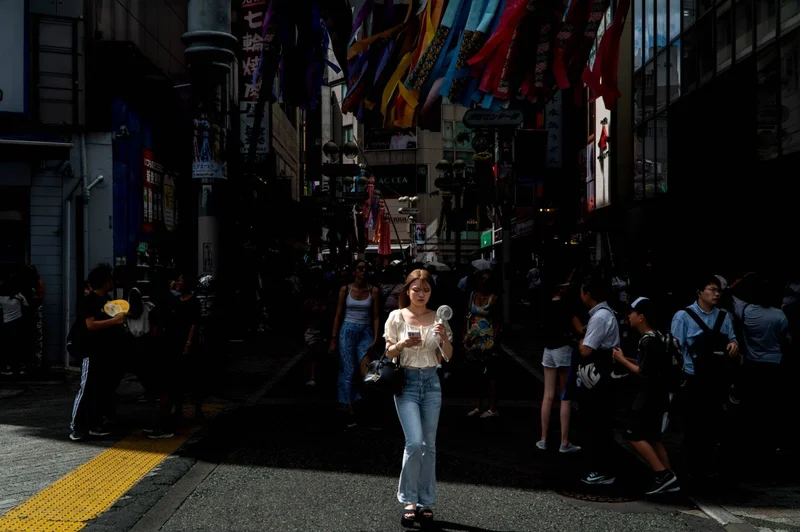
The mercury had climbed to 38 degrees Celsius. I was dripping with sweat, darting between islands of shade and clutching an increasingly futile handheld fan, wondering how I’d managed to overheat while doing little more than standing in a field and admiring the view.
Somehow, though, the people around me appeared to be having an entirely different experience.
An older woman ambled past in long trousers and sleeves that covered her wrists. Another couple posed for photos. An elderly gentleman tended to a vegetable patch nearby.
They weren’t exactly impervious to the heat — people clustered in the shade, covered up against the sun and waved electric fans in front of their faces — but nobody looked even remotely as close to melting as I felt.
I had lived in Tokyo as a child, at a time when I could spend summer days running around outside without giving much thought to the heat. But returning 25 years later, I was beginning to wonder whether Tokyo’s summers had changed — or I had.
As it turns out, both may be true.
According to Kazutaka Oka, head of the Climate Change Impacts Monitoring Research Section at the National Institute for Environmental Studies (NIES), Tokyo’s average temperature has risen by about 3 C over the past century.
One of those degrees can be attributed to climate change, with the other two linked to the urban heat island effect, he says.
Concrete and asphalt absorb the sun’s heat during the day and release it slowly, while buildings, traffic and air-conditioning systems pump more warmth into the surrounding air.
It’s an irony that isn’t lost on Oka. As temperatures rise, we retreat indoors and turn on the air conditioning, which in turn releases heat outside: “It’s a negative spiral,” he says.
Where once temperatures above 40 degrees were rare in Japan, they’re becoming increasingly common.
So common, in fact, the Japan Meteorological Agency has even introduced the term kokushobi, or “cruelly hot day,” for days when the temperature exceeds 40 C.
It sounds almost comically dramatic, until you consider why a new phrase was needed in the first place. Suddenly, my sunflower-field meltdown seemed a little less like a personal failure.
But the problem with measuring heat solely by the temperature on the dial is that a single number rarely tells the whole story, Oka says.
Cue Tokyo’s characteristically high humidity, which seems to settle on your skin the moment you step outside and leaves you wondering whether you’ve accidentally been for a swim after walking for 10 minutes.
The humidity also makes it harder for sweat to evaporate, disabling one of the body’s key mechanisms for cooling itself, Oka says.
For someone arriving from a milder climate like me, that combination of heat and humidity can be particularly difficult to adjust to, he says.
The older you get, the harder it can be to acclimatize to as well. At the ripe age of 29, I can’t help but agree. It is, after all, the oldest I’ve ever been.
But instead of pretending the heat and humidity aren’t a problem, Japan has seemingly built an entire way of living around it.
Back home in New Zealand, surviving summer mostly means finding a beach, applying factor 50 sunscreen and praying for the best.
Here in Tokyo, an entire ecosystem has evolved around keeping cool. Portable fans hang from bags, parasols bloom along pavements and konbini become temporary refuges from the heat.
Armed with a basket and an open mind, I’ve raided Don Quijote to form my own personal arsenal, trying everything from cooling body wipes and frozen neck rings to UV parasols, portable electric fans, cooling sprays and every other gadget promising any semblance of relief.
Some products genuinely transformed my day-to-day life (God forbid I forget to charge my fan), while others have felt suspiciously close to expensive optimism.
But while today’s summer gadgets and gizmos might be more technically sophisticated, Japan actually has a long history of adapting to summer heat, according to Midori Nemoto, climate change adaptation coordinator at NIES.
Traditional adaptations included uchiwa (handheld fans), bamboo screens and uchimizu, or sprinkling water outside to cool the streets.
But it isn’t just about buying something to make the heat more comfortable, Nemoto says, it’s also about changing the way we live around it.
Human mobility data shows people reduce daytime outings as temperatures rise, shifting activities into the evening, she says.
“Sometimes adaptation is very simple: change the time, change the route, take a break, or even change your plans.” Learning the art of gradual acclimatization is important too, Nemoto says.
For example, before a big outdoor event, it can be useful to start getting your body used to the heat around two weeks in advance, perhaps even taking long hot baths to adjust.
That said, learning to adapt to the extreme heat shouldn’t mean just accepting it as the new norm, Nemoto warns.
“If extreme heat changes when people can safely work, travel, play outside or hold festivals, it could gradually change the way we live and experience the seasons in Japan,” she says. This year, Nemoto says she has been struck not only by the intensity of the heat but by how early the warmer days began and how long the heat can linger.
“We were already feeling very warm days quite early in spring, and the heat doesn’t necessarily end when the sun goes down either,” she says.
A longer hot season has its own risks — it can affect mental well-being as people stay indoors for longer periods of time, hamper food production, and disturb seasonal customs and traditions.
At its most devastating, the heat can even kill.
More than 1,500 people die from heatstroke in Japan each year — roughly 10 times the number of annual deaths from natural disasters such as earthquakes and typhoons.
Unlike an earthquake or typhoon, heatstroke rarely arrives as one singular event. Rather, it happens quietly, day after day, as people become accustomed to conditions that are actually very dangerous.
And then there’s the question of what happens in an even hotter world.
Oka expects Tokyo’s average temperature to continue rising, but says the increase in extreme temperatures may be more significant than the change in the average alone.
As was the case after the earthquake in Kumamoto Prefecture last month, a heat wave combined with another natural disaster becomes significantly more dangerous due to power outages that reduce access to AC.
But it’s important not to write a Tokyo summer off quite yet.
From Nemoto’s perspective, it’s worth remembering that adaptation doesn’t have to be a grand, global undertaking.
It can begin much closer to home: in the buildings we live in, the way we move through our neighborhoods and the choices we make about how and when we spend time outside.
Perhaps that’s the lesson I’ve taken from my Tokyo summer too.
I arrived thinking I needed to find a way to beat the heat. Instead, I’ve learned to work around it — to seek shade, carry water, change my plans and, occasionally, admit defeat and retreat into the nearest air-conditioned shop.
It isn’t much in the face of a warming planet, but adaptation, Nemoto reminds me, has to start somewhere.
And besides, it would be a shame to give up on a Tokyo summer altogether. When the worst of the heat finally begins to loosen its grip, the city changes.
The lanterns come out, neighborhood festivals fill parks and temple grounds. Children emerge in yukata, food stalls pop up and Bon odori dancers circle beneath strings of lights as fireworks bloom above. It’s truly magical.