Defying the UK's oppressive terrorism laws is an honourable use of white privilege
There is a video I cannot stop thinking about. A retired academic, sitting in an ordinary room, in front of an ordinary bookshelf, speaking in the unhurried speech of a man who has spent his life explaining things to 19-year-olds.
He gives his name. He then says words he knows will not only break the law but may also result in his imprisonment.
The words he says are simple enough, but they constitute a terrorist offence: "I oppose genocide, I support Palestine Action."
He is not the only one. According to Defend Our Juries, the organisation coordinating these mass acts of civil disobedience, more than 60 people have now filmed themselves in this way - an escalation from the paper signs of Parliament Square, which carry a sentence of up to six months, into the territory of section 12 of the Terrorism Act 2000, which carries up to 14 years.
Counter-terrorism officers have raided a handful of homes in the Midlands. Devices have been seized and doors broken through during raids. The rest are still waiting.
And what stands out, before anything else, is that almost all of them are white.
For 25 years, the Terrorism Act 2000 has pervaded every corner of ordinary life in my community.
It is the Schedule 7 stop at Heathrow where you are held without suspicion and asked to explain a book. It is the Prevent referral for a child who mispronounced a word.
It is the bank account that closes without explanation. It is the friend who spends nine months in Belmarsh prison before the charges quietly evaporate, at which point nobody who ran the headline runs the correction.
The disproportionality figures have been in front of us for years - my organisation, Cage International, has long pointed to Schedule 7 stop ratios in the order of 150 to 1 against people of Muslim backgrounds. Nobody in power was troubled by that.
The machinery worked precisely as it was built to work, on precisely the bodies it was built for, and the country carried on queuing.
Today it grinds on unabated, but what has changed is who is standing in front of it.
Presumption of innocence
Let us be exact about what white privilege actually is in a counter-terrorism state. It is not a life without pain. It is not wealth, and it is not comfort.
It is something much more specific and much more useful: it is the presumption of innocence surviving contact with the police. It is the ability to be interpreted outside of a pathology that exists in your skin, belief and behaviours.
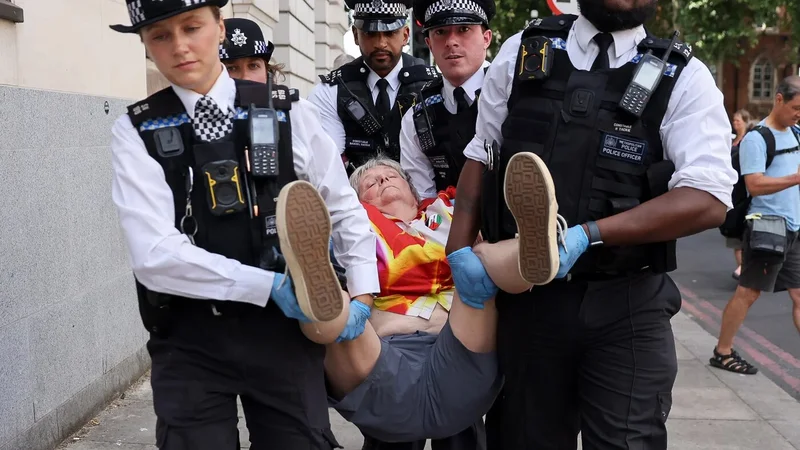
When a white pensioner is carried away from Parliament Square with a cardboard sign, the country reads the scene as an image of the state's absurdity. When a Muslim is arrested under the same section, the country reads the scene as an image of the Muslim.
When a white pensioner is carried away from Parliament Square with a cardboard sign, the country reads the scene as an image of the state's absurdity
It is the same act, the same law, the same handcuffs - and two entirely different national imaginations.
That gap is the privilege.
And here is the thing that ought to keep us honest: that gap is the very thing making this campaign effective. The privilege is being spent in this circumstance for honourable reasons.
When a man who taught telecoms theory for 30 years stares into a camera and dares the state to come for him, he is converting his own credibility - his accent, his skin, his blamelessness, his grandchildren - into a demonstration that the law is obscene, that genocide is obscene.
He is doing what a Muslim cannot do, because a Muslim doing the same thing would not generate a scandal - it would generate confirmation.
This is the honourable use of privilege, not a display, not an academic theorising, but an expending of it. To place it, deliberately, where it will be reckoned with, and to use the noise of that reckoning to shed light on the ongoing genocide in Gaza and our government's ongoing complicity with it.
'Usual suspects'
Privilege spent badly is worse than privilege hoarded, so let me say what I think dishonours it.
It is dishonourable to launder the machinery while defying it. A framing that has become popular in the press is that these are not the usual suspects; they are vicars, retired doctors, grandmothers and even military veterans.
I understand why the movement leans on it - it works. But if one reads it slowly, you can hear what it concedes. If these are not the usual suspects, then somewhere there are usual suspects, and the implication is that when the same law fell on them, it fell more or less where it belonged.
Every time that line is used without being interrogated, the acquittal of the white protester is purchased with the conviction of the Muslim one. If you are going to walk into this machinery, do not let them use your respectability as a certificate of the machinery's ordinary good sense.
It is dishonourable to accept the deal that will be offered. The state has always preferred to split a movement into the reasonable and the dangerous, the protester and the terrorist, the sign-holder and the man who cut the fence at Filton.
When the offer comes - and it will come dressed as pragmatism, as strategy, as let's not muddy the waters - the answer must be that we do not accept a hierarchy of who gets persecuted by terrorism laws.
Already we have seen the leaders of professed human rights and civil liberties organisations, such as Amnesty International and Liberty, confine the call of the larger movement to making terrorism laws less onerous, rather than pushing for complete abolition.
It is precisely here that a dissonance exists between the privileged terrorism suspect and an entire community of Muslims who continue to live with the architecture of surveillance.
In some ways, the theatre of the arrest at the sign-holding protests is the easy part. I know this because I have spent my working life with people for whom the arrest was year one of 30.
The terrorism label does not end at the magistrates' court. It follows you to the border, or into the school's assessment of your children. Some of the people now filming themselves are about to discover, at 69, what it is to be permanently classified.
If solidarity evaporates at the point where the cameras do, then what happened in Parliament Square was theatre, and the participants were extras in a story about their own goodness.
The same cells
In February 2026, the High Court found the proscription of Palestine Action unlawful. The Court of Appeal restored it in June. The Supreme Court has agreed to hear a final appeal in the autumn.
Through every stage of that legal battle, the arrests have continued.
This is what it looks like when a state discovers that a power it built for one population is being used by another, and cannot bring itself to admit that the power was always wrong.
So I do not think the question before the thousands who have been arrested is whether they were brave. They were.
The question is what happens when they finally face the prospect of prosecution and conviction? To what extent was their action performative, and are they willing to stand between Palestine Action and the unconscionable wielding of proscription laws?
Behind them, in the same cells, under the same act, are people who have been there for 20 years, and who were never carried out to applause.
The honour is not in the arrest.
The honour is in refusing to leave the building until everyone is out. It is to keep escalating until there is no genocide in occupied Palestine, to keep escalating until apartheid ends, and to keep escalating until the settler colonial machinery has been entirely dismantled.
The views expressed in this article belong to the author and do not necessarily reflect the editorial policy of Middle East Eye.