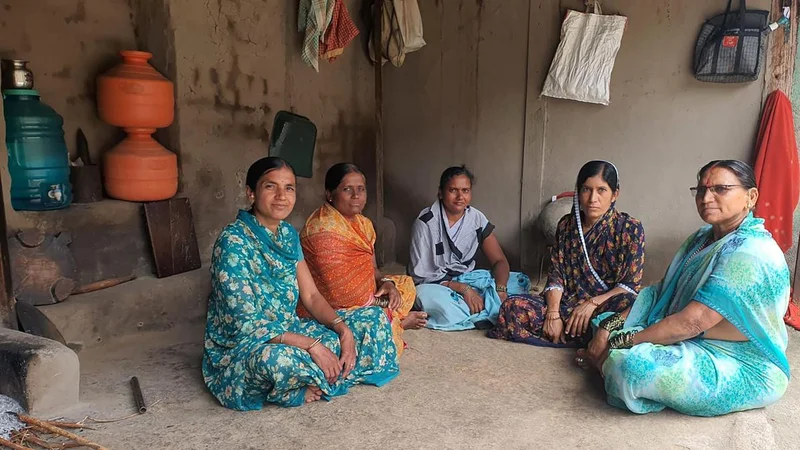
In Kherda village of Maharashtra’s Dharashiv district in the Marathwada region, Manisha Jadhav limps into a low-ceiling meeting hall that can barely accommodate 20 people. She favours the leg she injured while working in her soya bean field a few days earlier.
Her eyes drift towards the banyan tree near the entrance. Its trunk is wrapped in layers of white threads tied by married women during the Vat Savitri (Vat Pournima) festival, seeking blessings for an enduring marriage across seven lifetimes. Before joining the other women waiting on the veranda, Manisha walks to the tree and gently runs her fingers over one of the threads.
“Baghat hote ajun dhage rahilet ki nahi. Sann sampun pandhra-vis divas zalet (I was just checking whether the thread is still intact. It has been nearly 15-20 days since the festival),” she says with a faint smile.
For Manisha, certainty and permanence have become precious commodities. She was pursuing her graduation when she married Chandrasen, a farmer cultivating the family’s rain-fed land. She began building a life with him and their two daughters. But years of crop failures and mounting debt pushed Chandrasen to end his life. Suddenly widowed, Manisha found herself fighting another battle when her in-laws threw her and her young daughters out of the house.
She survived by working as a farm labourer, simultaneously fighting for her legal right over the family land. Rumours spread that she wanted to grab the land, abandon her daughters, and elope with someone. When she approached villagers for help, some demanded money while others offered sympathy in the hope of sex, she says.
Today, as Manisha sits among a group of four other farm widows in the village, the other women listen to her with quiet respect.
Over the past two decades, they say, she has battled every uncertainty with remarkable resilience. She married off her older daughter after she completed higher secondary education while her younger daughter is now pursuing graduation. They have gathered to discuss the Mukhyamantri Majhi Ladki Bahin Yojana, which translates as the Chief Minister’s My Favourite Sister Scheme. It provides direct benefit transfer of ₹1,500 per month to vulnerable women in the State, but is now surrounded by doubt.
After providing short-lived relief to women, the State government has been deleting the names of beneficiaries based on certain categories that are excluded: government employees, taxpayers, and existing beneficiaries of welfare schemes. According to local activists, the State government has removed more than 92 lakh women from the beneficiary list so far.
This has reduced the original beneficiary base of 2.4 crore women by nearly 38%, raising critical questions about the scheme’s future.
Manisha had never availed herself of any pension or welfare scheme for women or farm widows until the then Chief Minister Eknath Shinde announced the monthly aid scheme for women on June 28, 2024.
For her and many other farm widows across Marathwada, the ₹1,500 monthly assistance is not merely a welfare payment, but an essential lifeline. “Many women here have a monthly household budget of hardly ₹3,000 to ₹4,000. If this ₹1,500 stops, managing the household will become extremely difficult,” she says.
Working on a farm and a budget
Manisha now cultivates soya bean on the two acres of dry land that she secured after a prolonged struggle with her in-laws. Although the fight for land is over, her battle with nature and the market continues relentlessly. “When there are good rains, prices crash. When the rains fail, market prices rise but there is hardly any crop to sell,” she says, summing up the paradox that defines dryland farming in Marathwada.
Manisha’s story mirrors that of thousands of farming families across the mostly rain-starved region. Despite lying largely in the Godavari basin, the region has few perennial rivers.
The Godavari itself skirts much of the region while tributaries such as the Purna, Sindphana, Bindusara, and Shivna often shrink to a trickle or run dry for much of the year, leaving farmers heavily dependent on an increasingly erratic monsoon. Long accustomed to drought, Marathwada is now facing another layer of climate uncertainty as unseasonal rains damage standing crops and disrupt farm incomes.
The consequences are reflected in the continuing agrarian crisis. Marathwada recorded 465 farmer suicides between January and June 2026, after 1,131 such deaths across its eight districts in 2025. Together with neighbouring Vidarbha, the region continues to account for a large share of Maharashtra’s farmer suicides.
Whenever a crisis deepens, men migrate, kill themselves or find rescue in dry wells, leaving women behind to fight the battles of life, say the farm widows as the conversation turns to their children. Manisha, who also works as an assistant at the anganwadi in the village, shares a fierce hope for her younger daughter.
She wants her to complete her graduation, achieve financial independence, and never have to depend on anyone for survival. “In this region, where climate uncertainty has become permanent and farmer suicides have spread like a pandemic, girls must earn their own living. Otherwise they will end up like many of us – waiting for government instalments whose arrival is as uncertain as the government itself,” she says.
For women who have spent years stitching together fragile lives from repeated personal, climatic, and economic crises, that monthly payment is another thread of security – one they fear will not remain intact for long.
Anxiety and the question of now what
The Ladki Bahin scheme was modelled on a similar scheme already in place in Madhya Pradesh. Manisha, Dhondabai Mingule, and several other farm widows from the village enrolled in the scheme, relieved that vulnerable women like them had finally received pension-like aid.
This proved a game changer for the Bharatiya Janata Party-led Mahayuti alliance that came to power. In the 2019 Assembly poll, out of the 4.28 crore registered women voters, 2.53 crore cast their ballots, resulting in a turnout of 59.26%. By 2024, the registered base grew by roughly 10% to 4.70 crore women, but the number of voters shot up by over 21% to reach 3.06 crore, driving the turnout to 65.21%.
This clear 5.95% jump shows that active participation grew twice as fast as new registrations. An additional 52.5 lakh women turned out to vote compared with the previous election, proving that this surge went far beyond simple voter registration growth. It highlighted a powerful behavioural shift, which political analysts say was sparked by the Ladki Bahin scheme.
“The scheme came as a surprise, but it was a truly vital blessing for us. We immediately registered. When elections were approaching, nobody scrutinised our documents. After the government returned to power with massive support from women, it started applying new criteria and deleting names,” says Dhondabai, who also works at the anganwadi while cultivating her marginal farmland to survive.
Widowed after her husband’s death by suicide, she single-handedly raised her daughter, got her into a nursing college, and is now happy to see her married in Pune. “But now there is news that more women will lose the aid and I am worried. Farm widows walk on a razor’s edge while managing household budgets. We think about every single rupee and save wherever we can, even by avoiding buying vegetables and eating whatever grows in our fields,” she says.
Manisha says she once did not receive her ₹1,500 monthly instalment under the scheme and had to run from one government office to another before being asked to submit her documents again. Only then was the instalment credited to her bank account. That experience, along with the government’s decision to remove lakhs of women from the scheme, has heightened her anxiety about losing the benefit.
The uncertainty surrounding the scheme has prompted Manisha, Dhondabai, and many other farm widows to consider shifting to older welfare programmes such as the Sanjay Gandhi Niradhar Anudan Yojana, introduced in the State in 1980, which provides monthly aid of ₹1,500 to widows, the destitute, those with disabilities, and other vulnerable groups.
Some are also considering the Indira Gandhi National Widow Pension Scheme, which offers the same monthly assistance. “These schemes have been running for years and are not linked to elections or poll promises. More and more farm widows are now asking how they can withdraw their names from the Ladki Bahin scheme and enrol in these older schemes. Every day, women come to me with these questions and I don’t know what to tell them,” says an ASHA (Accredited Social Health Activist) worker from Kalamb, 4 km from Khera, in Dharashiv district, requesting anonymity for fear of losing her job if she speaks against the government scheme.
She herself had left an abusive marriage and chose to enrol in the Sanjay Gandhi scheme instead of Ladki Bahin. She says she receives the ₹1,500 instalment regularly every month. “This one feels permanent. Ladki Bahin may disappear anytime as politicians do after polls,” she says.
Anita Kharate used to receive ₹1,500 monthly under the State’s widow pension scheme after her husband died by suicide. When the Ladki Bahin scheme was launched, she did not even think of applying for it because she had firm faith in her existing government benefits. But all of a sudden in 2024, her pension stopped for reasons she is still completely unaware of. Today, she is desperately trying to resume her pension under the old scheme, refusing to even think about applying for the Ladki Bahin scheme despite promises that the monthly aid will be increased.
Addressing a campaign rally for the zilla parishad elections in the Marathwada region in February this year, Shinde, who is now the Deputy Chief Minister, said the monthly aid will be increased from ₹1,500 to ₹2,100 at the right time.
“An amount of ₹45,000 crore is disbursed through the Ladki Bahin scheme. Earlier, I saw reports about the CAG (Comptroller and Auditor General) censuring this scheme. However, the scheme will continue as it has been helping women immensely. It has spawned several stories of women entrepreneurship,” he said.
Beyond pensions and pity
Widows in Hasegaon village, located just a few kilometres from Kherda, do not agree with Shinde’s claim. A majority of these women, much like those in the neighbouring villages, manage their own farms while also doubling as farm labourers. They toil from 10 a.m. to 6 p.m. for a daily wage of ₹300, work that is never guaranteed, though during the soya bean harvest, they spend longer hours in the fields to earn ₹400.
Komal Dhumal, who lost her husband to kidney failure and hypertension, builds a striking analogy. A woman, she explains, is always viewed as a seeker: as a child, she seeks support from her father; as she grows, from her brother; once married, her husband is added to the list of givers. Now, the government has joined that list, wanting to give women pensions and cash aid without helping them stand on their own feet. “The government is also a patriarch,” she says, prompting the other women gathered in her household to burst into a gloom-tinged laughter.
“Even though we are not highly educated, we would still like to be independent,” Komal says.
“Any cottage industry would help us. We are also ready to take any training that the government provides.” She currently receives no benefits under government schemes but plans to apply for widow pension as she finds it increasingly difficult to run the household alone while supporting her school-going daughter and son.
In the meantime, she continues to grow soya bean on her two-acre land.
“Like the Ladki Bahin instalment, even the market is not in our hands. In fact, nothing is in our hands,” says Raziya Sayyed, a farm labourer.
Following her husband’s death, Raziya began receiving the Sanjay Gandhi Niradhar Anudan Yojana pension, which automatically made her ineligible for the Ladki Bahin scheme.
“There is no guarantee of Ladki Bahin; actually, there is no guarantee of anything these days,” she says as the other women console her.
Raziya lives with her son, who is currently pursuing his graduation in Kalamb town, and says it is time farmer suicides are not seen just as a male tragedy. In Kalamb, activist Sunanda Kharate of Paryay, a non-profit organisation, is flooded with complaints regarding arbitrary deletions from the Ladki Bahin scheme.
Her three decades of work reveal that even when funds are deposited, widespread illiteracy allows male relatives to control accounts and withdraw the money without the women’s knowledge. She notes that many who complained about missing instalments were unaware that the cash had already been taken by their husbands.
As the meeting in Kherda ends, Manisha stands up, ready to head back to the fields on her limping leg. With below average rainfall this season across the Marathwada region, the seeds sown have failed to sprout.
If the dry spell persists, she fears another looming drought and the deep financial distress that accompanies it. She has survived multiple droughts and seen unseasonal rains wash away her crops before, yet she has always managed to stay afloat.
“This season looks like another challenge. We must be prepared for it,” she says.
(Those in distress can contact Tele MANAS at 14416 to seek help)
Published - July 24, 2026 03:49 am IST