- 1936: The Year Of Three Kings Sian Evans (Hodder & Stoughton £28, 416pp)
'God damn you!’ were the last words of King George V, spoken to a nurse attempting to administer an injection. It was a crotchety end for the 70-year-old pheasant-shooting, stamp-collecting king, who’d worked hard to uphold rigid Edwardian standards throughout his reign. With a fatal overdose of morphine and cocaine injected into his jugular vein by his physician, timed so the death would be announced in The Times rather than the more downmarket evening papers, the king died in the night of January 20, 1936.
George the Duke of Kent (right) alongside his brother Edward Prince of Wales, later King Edward VIII
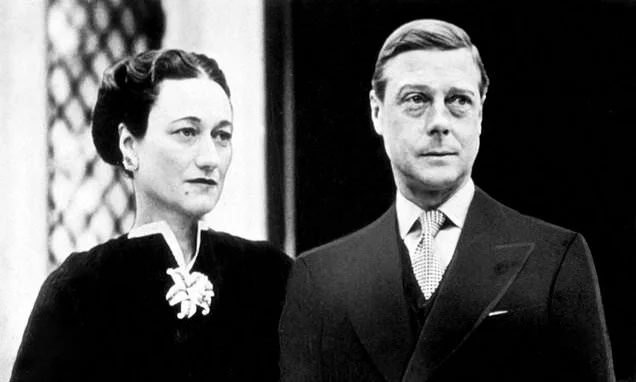
Thus began the momentous ‘Year of Three Kings’, of which this is the 90th anniversary. The initial reaction of his eldest son, the new king Edward VIII, was to howl with grief. He was ‘hysterically upset’, ‘frantic and unreasonable’. This was surprising, as he’d never got on with his crusty old father, who, over a deadly-dull Christmas at Sandringham, had (along with his wife Queen Mary) avoided any mention of Edward’s lover, the divorced and married American Wallis Simpson.
But Edward’s histrionic reaction is in character with the over-emotional, attention-seeking, love-sick basket-case Sian Evans portrays in her fascinating book, which takes us through that dramatic year month by month. Quick to anger, petulant, selfish to the point of narcissism, and obsessed with Wallis, he was impossible to deal with. ‘He had all the charm of the world,’ remarked Noel Coward, ‘without anything to back it up.’
Perhaps another reason for his howl was his knowledge that, from that moment on, pressure would be put on him to renounce the love of his life. As Supreme Governor of the Church of England, he was required to uphold its laws, which stated that one former spouse could only remarry following the death of the other.
While this was impossible – as Wallis Simpson’s ex-husband, Win Spencer, was still very much living – Edward was hell-bent on getting his way.
What he could do was at least try to engineer her divorce from her second husband, Ernest Simpson – and in such a way that he would not be accused of collusion.
This he managed to achieve. The divorce hearing ‘Simpson v Simpson’ took place at Ipswich Assizes in October and lasted just 19 minutes. The decree absolute would come through six months later – just in time for the Coronation in May 1937, or so Edward hoped.
The British public were kept in the dark about the King’s illicit love affair for most of the year. Newspapers maintained a decorous silence, despite editors being desperate to publish what they knew to be true. Along with political tensions – civil war in Spain, threats of Nazi triumphalism, and (more locally) marches on London from the depressed North (1936 was the year of the Jarrow March) you get an overwhelming sense of a dam about to burst.
Edward had been adored as the dapper Prince of Wales, and was now revered as the new king, but he himself couldn’t abide the tedium of ‘kinging’, as he called it – the daily trawling through red boxes, and being kept in check by boring, bossy courtiers. He shunned Buckingham Palace, preferring his hideaway, Fort Belvedere in Windsor Great Park.
Edward VIII during his short reign as King
He had one all-consuming plan: to marry Wallis. ‘WE must hold each other so tight,’ he wrote to her – ‘WE’ being their initials and his soppy nickname for their union. With the skill of a novelist, Evans brings out the characters and moods of the three main protagonists in this psychodrama: Edward, Wallis, and prime minister Stanley Baldwin, who cannily made it his business to ensure that this stubborn, unreliable Nazi sympathiser must go, for the sake of the institution of the monarchy – without anyone being able to guess his (Baldwin’s) hand in making it happen. He was confident that waiting in the wings as alternative monarch was Edward’s more malleable and steady (if stammering) younger brother, ‘Bertie’, Duke of York, with his exemplary wife and their two charming young daughters.
Wallis comes across as miserable throughout; almost ill with the stress of being the target of the King’s obsession. As early as February, she was suffering from gastric ulcers from the strain of being bombarded by the King’s love notes during a country house visit. She had no desire to cause a national crisis. ‘I’m sure you and I would only create disaster together,’ she wrote to Edward – on reading which he threatened to slit his throat if she left him.
Her marriage to Ernest seemed just fine, before Edward (or ‘David’ as he was known in the family) came along to wreck it. One of the most moving moments in the book is when Wallis – hiding away with friends in France in early December, to escape the pandemonium and sheer physical danger to her life after news of the love affair broke in the press on December 3 – wrote to her now ex-husband Ernest, ‘None of this is my making, it’s the new “Peter Pan plan”. I miss you and worry about you. Oh dear, wasn’t life lovely, sweet and simple?’
Her reference to ‘Peter Pan’ suggests she considered Edward a perpetual child. Baldwin was of the same view: ‘There are patches in the King’s brain that are those of a child aged 13.’
An intriguing facet to the story is that when Edward visited depressed towns in Wales in November – his last-ever royal tour – he made a point of visiting the town of Dowlais, where unemployment was particularly high. Baldwin disapproved of this visit, seeing it as the King meddling in politics and shining a bad light on his government. The situation was made worse for Baldwin, Evans tells us, because it was Baldwin’s own family firm (which had recently merged with another company) that had decided to shut down the Dowlais ironworks and asset-strip them.
‘Did the King know that the Prime Minister’s family fortune was tied up with economic decisions that had cut Dowlais and the locals adrift?’ Evans wonders.
It took just a week from the news breaking in the papers on December 3 for Edward to abdicate, on the 10th – at which moment the reign of the year’s third king, George VI, began.
Shortly before his death, George V had predicted about Edward, ‘After I am gone, the boy will ruin himself in 12 months.’
He was proved right. It was not ruin, exactly, but by his actions, Edward had consigned himself and Wallis to a lifetime of futility and exile.