Sign in. It’s quick, free and it’s up to you.
An account is an optional way to support the work we do. Find out more.
In Calling 353, a new series for The Journal, bestselling Motherfoclóir author and podcaster Darach Ó Séaghdha casts a linguistic eye on how we talk about what it means to be Irish, the signs we post to each other about Irishness – and what really lies beneath it all.
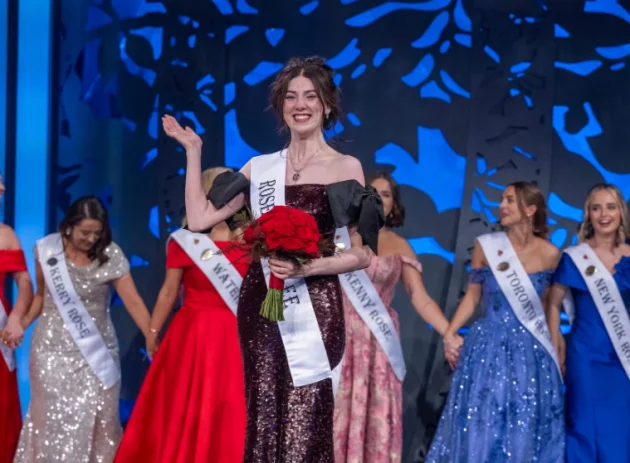
I RECEIVED A cranky text earlier this week while the Rose of Tralee was on television.
“You told me that that name Caoilfhionn was pronounced Keelin”, I was told, “and I told everyone in the house that, and now this wan is on telly and saying it’s pronounced Kale-finn. You made me look like an utter flute. I think she knows how to pronounce her own name, like. Irish language expert my hole”.
I replied that the young woman in question (the eventual winner) spelled her name Caoilfhinn, so I was off the hook.
Those dots that you see when someone is typing a long message were bubbling away for ages, so I was surprised when the reply I eventually received was actually quite short:“Is an FH silent or not?”
I was about to reply with something about the subtle differences between silent letters and un-aspirated consonants and the significance of diphthongs, but felt that this would lead to further questions.
Nonetheless, the interaction turned my mind to mutterings and mumblings I had been hearing a lot lately about Irish names. Two subcategories of Irish names in particular: the SIPE name and the extra-shot name.
An example of SIPE (Spelled Irish, Pronounced English) would be the Gallagher brothers in Oasis or Barry Keoghan saying the gh in their name like a G.
Tyrone country singer Cliona Hagan pronounces her first name with a longer O than would be the norm as Gaeilge.
A hospital near where my wife is from is called The Dalriada; she told me that nobody would know what I was talking about if I called it the dohl ree-ah-dah.
However, I’m not worried about offending a hospital. I would be far more reluctant to tell a person that they are saying their own name wrong.
In defence of Ms Hagan and Messrs Gallagher and Keoghan, the SIPE phenomenon is nothing new.
Consider the name Niall. The NIA in this name should be pronounced just like the NIA in Niamh. But how often does that happen?
It’s far more likely to be pronounced like the river in Egypt. And then there’s Emer.
Historically, this would have had a ponc séimhithe over the M – the little dot indicating lenition, which is recreated in modern Irish with a H after the consonant.
So it would have been Emher and pronounced “Ever” were it not for various popular retellings of the Cuchulainn story in English during the Celtic Revival which normalised pronouncing the M.
At some point the “wrong” version is out there, being used and enjoyed, and complaining about it only draws attention to your inability to do anything about it. I
t’s a bit like how the word “irregardless” is now in the dictionary (there was no perforated red line under it when I typed it just there), but it has a little “nonstandard” warning next to it followed by a paragraph from some disgruntled lexicographer on how it really isn’t a proper word but they can’t not include it and still be a dictionary.
Similarly, whelmed used to have the meaning we now give to overwhelmed, the over- prefix was superfluous, unnecessary and added nothing to the original meaning.
Thorny
A further point in defence of our talented friends above (see, I really don’t want to upset anyone): is spelling it Irish and pronouncing it English so much worse than TISEPE: taking Irish, spelling it English and pronouncing it English?
Is a Caitríona calling herself Cat-ree-oh-nah so much worse than Sive or Oona? Lady Gregory spelled Gráinne as Grania, are you going to go back in time and tell her she’s wrong?
The matter is particularly thorny because on the one hand, there are often several accepted ways to spell a particular name and on the other hand there are some renderings which don’t make sense or may even mean something else.
You may not like Shaun or Shawn, but Sean without a fada on a A means old, so is it really any better?
The most notorious of these is Órla without a fada, which ceases to mean golden princess and starts to mean vomit.
Regarding our newly-crowned Rose above, this name means slender and fair (call + fionn), and with fhionn and fhinn both being grammatical forms of fionn, so I don’t see an issue here.
Much as with the different spellings of Finola/Fionnuala/Fionnghuala, it comes down to a matter of personal preference.
An Extra Shot
“But Darach”, I hear you say, “there’s no point singing kumbaya and saying that all names are beautiful and equal if I end up accidentally giving my kid an incorrect name for all to see and looking like a big eejit”.
And in fairness, nobody wants to look like an eejit. It’s easy enough to defend an anglicised spelling even if you think that’s terribly déclassé, and an English pronunciation of an Irish spelling probably has a story behind it.
The real danger zone is where a name flaunts certain Irish language features (like fadas or gh/dh/bh/th/fh or certain vowel combinations) but does not obey the norms of Irish spelling and pronunciation.
Saoirse with a fada. Rónán with a dh tucked in there. Sinéad with a H. Éamon with a double M. Aoife with a second F.
I once had the pleasure of speaking to an English woman called Chivonne on the phone; I may have winced at the spelling, but I cannot say that it is so much worse than Siobhan with an extra H stuck in, especially if it works for her.
But before we get too smug, we should remind ourselves that rules are made to be broken.
One of the names for baby boys that has risen every year this decade is Ógie.
If you’re unfamiliar with this one, it’s Óg (young) with an affectionate -ie suffix. It is an Irish name that flouts the caol le caol rule among other things, but it is a name that is particularly popular in Gaeltacht areas (Rose of Tralee host Daithí Ó Sé is the father of one such Ógie).
Are you going to correct Daithí on his Irish? I certainly wouldn’t.
In the end, no good comes from sticking your noses other people’s business and it’s better to take a minute to stop and smell the roses.
Darach will be back next Sunday with more thoughts on the words and Irish cultural phenomena that unite us.
To embed this post, copy the code below on your site