6 Android phones with microSD card slots you can still buy in 2026
Aug 23, 2026 — 5:00 AM ET
The smartphone industry is finally feeling the full effect of RAMageddon in 2026, as prices have shot up across the board due to rising memory costs. Brands are no longer able (or unwilling) to absorb the higher cost of components, so this is now passed on to us, the consumers. Smartphones with higher RAM and storage now command a steep premium, even more so than before.
Thankfully, a small segment of smartphones still exists that has a solution for the storage crisis — the microSD card slot. It’s mostly entry-level and a few mid-range Android phones that still support the microSD card, but there are some good models to choose from. Flagship Android phones have largely done away with this feature, except for a few specialized models that aren’t widely available in the US.
If you need more local storage and don’t want to spend an exorbitant amount on flagships, here are six of the best Android phones with microSD card support, in no particular order. This isn’t an exhaustive list, as there are more, but I’ve only picked the ones that I felt are worth buying in 2026.
What do you think is the best Android phone with a microSD card slot in 2026?
Samsung Galaxy A55 5G
Samsung didn’t officially launch the Galaxy A55 5G in the US, but you can easily find the 128GB variant on Amazon for around $430. It has a hybrid SIM tray, where the second SIM slot can accommodate a microSD card of up to 1TB. The A55 5G offers quite a few premium features like a slick aluminum frame, Gorilla Glass back panel, and Gorilla Glass Victus Plus over the display. It’s quite slim at 8.2mm, but a bit on the heavier side at 213 grams. The phone is also IP67 rated for dust and water resistance.
The Galaxy A55 5G launched in 2024 with One UI 6.1, based on Android 14. In our review, we found that the Exynos 1480 SoC in the A55 5G delivered solid sustained performance, handling gaming and multitasking effortlessly.
The 5,000mAh battery had good endurance, and the 50MP main camera captured detailed photos in daylight. The FHD AMOLED display offered crisp visuals and smooth motion thanks to the 120Hz refresh rate. The only real downsides were low-light camera performance, weak auxiliary cameras, the absence of Galaxy AI features, and a fair bit of bloatware.
For casual use, the Galaxy A55 5G is a solid option with a premium design, great battery life, and room to expand local storage.
Moto G Power (2025)
The Moto G Power (2025) from Motorola is one of the best value-for-money phones with a microSD card slot. Now retailing for just $200 with 8GB RAM and 128GB of storage, you get an IP68/ IP69 rating, MIL-STD-810H certification, wireless charging, and Android 15 with two guaranteed OS upgrades. Battery life is also solid thanks to the 5,000mAh capacity, and charging is relatively quick. There is a 2026 Moto G Power as well, but I’d advise against it as it’s practically the same phone at $400.
Motorola has had to cut some corners, though, and ironically, it’s the power. The MediaTek Dimensity 6300 is not a very powerful chip for anything beyond handling the bare minimum, like the OS and casual apps. The main 50MP camera is decent, but don’t expect much from the other sensors.
Overall, I’d say the Moto G Power (2025) is a solid phone if you’re prioritizing ruggedness and durability. If you need more horsepower, though, there are better options on this list.
Moto G Stylus (2026)
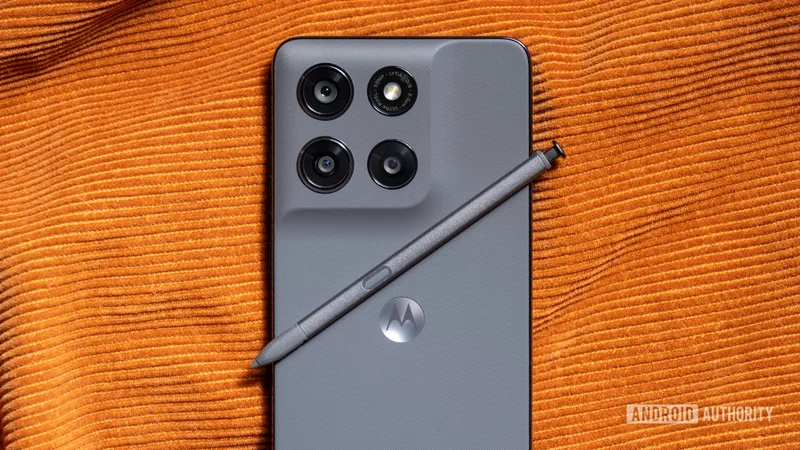
For all the stylus lovers out there, the Moto G Stylus (2026) offers an S Pen-like active stylus at a mid-range price and expandable storage. This is easily the biggest upgrade over the 2025 model, as the new stylus can detect pressure and tilt and features palm rejection. This is highly useful when taking notes or sketching. You can start taking notes the moment you pop the stylus out, without opening any apps. The button on the stylus is also configurable to various shortcuts, and Circle to Search can be activated via the stylus.
Other positives include snappy performance thanks to the Qualcomm Snapdragon 6 Gen 3 SoC, IP68/ IP69 rating, clean Android 16 UI, a big battery with 68W wired charging, wireless charging, and an incredibly bright AMOLED display. The 2026 Moto G Stylus costs $500 for 8GB RAM and 128GB of storage, which is on the higher side. The price might be worth it if you absolutely need the features of the active stylus; otherwise, the 2025 Moto G Stylus is a better value pick. Aside from a few features and a passive stylus, it’s practically the same phone at $350.
TCL NXTPAPER 70 Pro
If you’re looking for an affordable Android phone that supports microSD cards greater than 1TB, the TCL NXTPAPER 70 Pro is a solid choice. You can expand local storage to up to 2TB, which is simply incredible given its $300 starting price. TCL offers three storage tiers, up to 512GB, but you can get double that storage by simply using a high-capacity microSD card for less.
What really makes this phone unique is TCL’s proprietary NXTPAPER 4.0 display tech, which now promises improved sharpness, clarity, and color accuracy, compared to the older version. This essentially gives you a paper-like display similar to E Ink screens, and helps reduce eye strain and screen glare.
The specs are solid too, as you get an expansive 6.9-inch IPS display with 120Hz, an IP68 rating, Android 16, compatibility with TCL’s T-Pen stylus, and a decently powerful MediaTek Dimensity 7300 SoC. The NXTPAPER 70 Pro also features a large 5,200mAh battery with 33W charging. The rear cameras include a main 50MP sensor and an 8MP ultrawide sensor. There’s a 32MP selfie camera upfront.
Samsung Galaxy A17 5G
The Samsung Galaxy A17 5G is one of the cheapest phones with expandable storage, and with the longest software update commitment of six years. For just $200, that’s incredible value in terms of how long you can practically keep using this phone. Launched in 2025, the Galaxy A17 5G is just 7.5mm thick and weighs only 192 grams. It has a 6.7-inch AMOLED screen with a 90Hz refresh rate, 50MP main camera, IP54 rating, and a 5,000mAh battery.
The Galaxy A17 will get six generations of OS upgrades, and costs just $200.
The one thing holding the Galaxy A17 5G back is performance. The Exynos 1330 is the same chip from the Galaxy A16 5G, and it’s not the best. We’ve noticed that even light workloads can bog down the phone, making the user experience laggy. Playing simple games is possible, but anything more challenging, like Pokémon Go, the A17 begs you to stop. Consider this phone only for absolute basic use like checking email, making calls, and occasional photography. But for the price, that’s a fair compromise.
Sony Xperia 10 VII
If you’re looking for something totally unconventional, the Sony Xperia 10 VII from 2025 is worth considering. It’s not officially sold in the US, but you can find it on Amazon for $550. For this money, you get an incredibly slim and light (only 168 grams) Android 15 smartphone, front-firing stereo speakers, a dedicated camera shutter button, and microSD card support going up to 2TB.
The phone comes in playful shades and packs a 5,000mAh battery into its compact body. You get 50MP and 8MP rear cameras, and an 8MP front camera. Sony also promises up to four OS version upgrades and six years of security updates for the Xperia 10 VII. Unlike the flagship Xperia 1 series, the Xperia 10 VII’s display has a more familiar 19.5:9 aspect ratio, rather than the tall 21:9 ratio. To round things off, there are Google Gemini and Circle to Search features present, making this a capable option to consider.