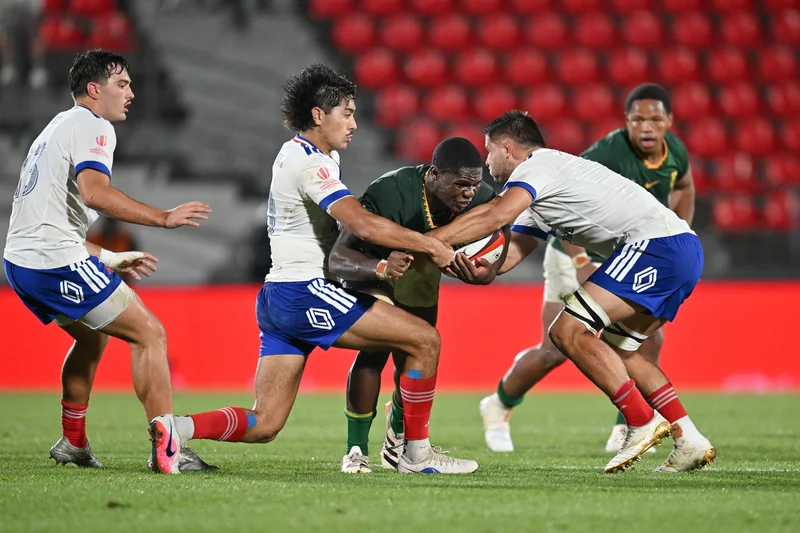
In July, the Junior Springboks made history when they claimed back-to-back Junior World Championship titles, beating France in a nervy final. A month later, in the Under-18 International Series, both South African teams (SA U18 and SA U18 âAâ) completed their campaigns unbeaten, the first time in the competitionâs history that both teams had done so in the same campaign.
These results, amid the dominance of the senior Springbok structures, reinforced what many in the game already believe â that South Africaâs school rugby system appears sounder than ever.
Lwazi Zangqa, the head coach of the SA U18s, credited the schoolboy system after his sideâs dominant campaign, which included victories over France (52-7), Ireland (51-15) and England (68-40).
âWe as selectors and coaches probably have the easiest job in just identifying the talent, but this is bred through many years of school pre-seasons, off-seasons and in-seasons,â said Zangqa. âIt would be an injustice not to acknowledge how much South African schoolsâ rugby programmes contribute towards the pathway of what South African rugby can produce.â
School rugby has evolved into one of the countryâs most influential sporting ecosystems, producing elite talent and serving as a critical pathway. It also attracts significant investment and draws crowds that many professional competitions would envy.
âRugby is part of the South African DNA,â said Jeppe first team coach Drickus Venter. âIn my opinion, South Africa has the best schoolboy rugby system in the world. The competition is fierce and there are some quality schoolboy coaches and some serious rugby programmes around.â
Deeper talent pool than ever before
The quality and depth of schoolboy rugby is remarkable, and with more than half a million registered players, according to SA Rugbyâs 2024 annual report, it is only going to get better.
The country has always had a proud tradition of powerful schoolboy rugby and the pool of competitive first teams has grown in recent years. Paarl Boysâ High, Paarl Gimnasium (Gim), Grey College, Paul Roos, Affies and Oakdale have been the top teams for some time.
Rondebosch Boysâ High, Jeppe Boys, KES, Sacs, Waterkloof, Durban High School, Grey High, Boland Landbou and others also regularly produce good teams and quality players.
In 2025, Stellenberg were marked as an up-and-coming side. And yet, few could have predicted that they would win 16 of their 18 games in 2026, beating Gim (20-19), Grey College (26-21), Paul Roos (20-10) and Oakdale (15-13) to get a top-four national ranking.
âOur talent pool is deeper than we think,â said Venter. âTalent isnât just at the prominent rugby powerhouses in our country any more. The top-tier schools will always be very competitive and have bigger budgets and greater resources, but the gap has closed. Schools and coaching have improved across the board and right now I feel that on a Saturday anyone can win.â
This yearâs crop in Paul Roos flyhalf Travis Pheiffer, Grey College fullback Lamla Mgedezi and Monument flyhalf Jaydon Viljoen (who recently grabbed headlines with a monster near-60m drop goal against Grey College) are just some of the players who secured opportunities with professional unions.
Behind this vast talent pool sits an increasingly professionalised and well-funded school rugby ecosystem.
The business of schoolboy rugby
These days, big schoolboy rugby matches attract far more fans than Currie Cup games. The annual interschool derby between Paarl Gim and Paarl Boysâ High alone attracts 20,000 spectators.
âThereâs a deep tradition that comes with interschools and itâs a tradition that lives on through the old boys,â said Ronnie Cooke, a former professional rugby player and now head of the South African office of The Team, a talent agency.
âI donât think anywhere in the world youâll get a school game where thereâs more than 20,000 spectators. That shows just how highly regarded schoolboy rugby is in this country,â Cooke told Daily Maverick.
This popularity has fuelled significant investment and an entire business revolving around schoolboy rugby. Collectively, South Africaâs top 200 rugby schools spend well over R1-billion a year on their rugby programmes, Cooke previously wrote on LinkedIn, and coaching salaries at elite institutions can exceed R1-million.
âThe game has evolved tremendously,â added Venter. âBack in the day there was a forward and backline coach, we trained twice a week and just played on Saturday. Now it has become much more professional. Coaches have sharpened up and try to stay ahead of the curve. You have defence coaches, attack and skills coaches, strength and conditioning, nutritionists, medical staff, mental preparation, the list goes on.â
Coupled with the investment, the broadcasting, specifically on SuperSport Schools, has increased visibility, boosting the commercial appeal of school sports and attracting further sponsors and advertisers.
Welfare concerns
However, in talking about the health of schoolboy rugby, the concern of rapid professionalisation and increasing pressure on schoolchildren runs parallel.
By transforming school sports into a widely consumed product, it introduces a new level of scrutiny and expectation. Students become exposed to pressures typically associated with professional superstars while still balancing rugby with academics and the normal challenges of adolescence.
South African Institute for Drug-Free Sport CEO Khalid Galant recently told News24 that the increasing commercialisation of schoolboy rugby may be contributing to a more pressured environment for young athletes, with far too many cases popping up of children copping multiyear bans for testing positive for prohibited substances.
Venter agreed, saying there was âhuge pressureâ on young athletes. âOur primary role is to educate, guide and improve the skills and lives of these young people. They are still children. We must create an environment that allows players to develop and improve, to never kill the passion and desire but allow them to grow safely, carefree and to enjoy our great game.â
A bottleneck after school means not all these talented players will play professionally. So long as schools put systems in place to encourage a balance between sport and academics, the situation is a healthy one for the countryâs rugby ecosystem.
âDonât get me wrong, winning matters and we all want to win, but winning isnât everything,â said Venter.
âWe must create an environment that allows players who want to make a career out of rugby to grow and develop, but that environment must also be nurturing, guided, safe and a space where children can make mistakes.â DM
This story first appeared in our weekly DM168 newspaper, available countrywide for R35.