Reaching into the body bag, and gently cradling her face, a family member places a mobile phone next to Mariam Abu Dagga's ear.
It is a devastating moment. Mariam, a journalist for Independent Arabia, has just been killed in an Israeli double-tap strike on the last functioning hospital in southern Gaza. She is surrounded by mourners in a tableau of grief.
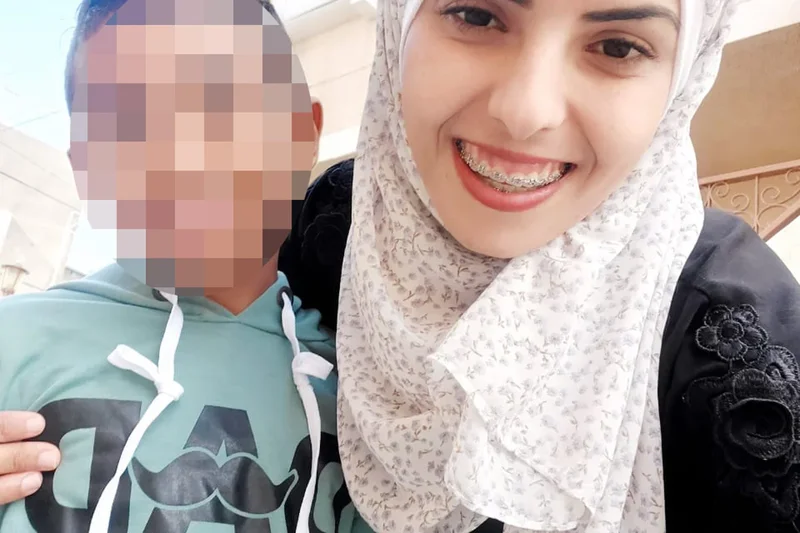
On the phone is her only child, 14-year-old Ghaith. And he is saying goodbye.
He is more than 1,000 miles away, after his mother fought hard for him to be evacuated to safety in the UAE a year earlier.
And so - amid Israel's unprecedented siege and bombardment of Gaza - this is the only way for the distraught young boy to say goodbye.
“Honestly… I was against my son being away from me, because he is quite literally my life itself,” Mariam had said about Ghaith, in tears, during one of the last interviews she gave shortly before she was killed.
“But every day, I was filming the martyrs - children, just children - to the point where one day I imagined Ghaith among them.”
Over a year had passed since he left, she explains in the interview to Palestinian organisation Filastiniyat, struggling to speak.
“He still follows the news… Whenever there were reports of journalists being targeted and I am not online, he would call me. ‘Mum, are you okay? Please tell me you're safe. Reassure me’.
“It gave me the feeling that there was someone… who truly cared about me.”
And now with his worst fears realised, this is the last phone call Ghaith will make to his mother. This time it is to say goodbye, in the hope that somewhere her soul would hear it.
Israel killed 33-year-old Mariam on 25 August 2025, while she was covering the bombing of her colleague, Reuters cameraman Hussam al-Masri. Israel had killed Hussam around eight minutes earlier, while he tended to his camera which was broadcasting the Reuters livestream from Nasser Hospital, a building protected under international law. She had rushed to the scene to find out what had happened.
This meant her killing was live-streamed to the world. A friend of Mariam's, Ghad TV correspondent Ibrahim Qannan, was filming it all from his live position just a few metres away in the aftermath of the first tank projectile which blew up Hussam.
In Ibrahim's footage, you can see Mariam there in a white headscarf and black abaya. Any journalist who covers conflict will instantly recognise that intense concentration: she is entirely focused, intently filming the rescue mission on her mobile. No time to think, to process her own grief or the enormity of the situation around her. In that moment she is her job.
As the crowd of journalists, first responders, medics and civilians grows on the stairwell, there is a second deafening boom, and Mariam is swallowed up in a fury of exploded shrapnel, concrete, wood and dust forever. Killed that day at the same hospital she was born in.
Israeli prime minister Benjamin Netanyahu dismissed the killings of around 22 people as a "tragic mishap". The Israeli military claimed the target was a camera "positioned by Hamas… to observe the activity of IDF troops" and later identified six people it called Hamas militants. Reuters soon confirmed the camera as their live feed.
A year-long investigation and reconstruction by The Independent, published today, paints a very different story to Israel’s claims, uncovering what international law experts have said is evidence of violations of international law and likely war crimes. The Independent shared these findings with the military who declined to respond to them but added “the review is still ongoing under the General Staff Fact-Finding and Assessment Mechanism”. In the past the military has in multiple statement to The Independent repeatedly denied targeting journalists or committing any war crimes in Gaza.
Mariam was beloved by those she lived and worked alongside. That is not kindly editorialising, applied posthumously because people can't speak ill of the dead.
Her family, a dozen different journalists and people who lived and worked around Nasser were unanimous in their praise. She was a "blessing", "remarkable", "selfless", "kind", "determined", "dedicated", "a sister among us".
"She was deeply, genuinely human, not just a journalist," says Baraa Lafi, 30, her best friend, flatmate and fellow journalist, also injured in the hospital attack.
"Every story Mariam went to film, she felt the pain of people living it," the Swedish-Palestinian journalist continues, finding it hard to go back to that day.
In the footage of Mariam's body laid out on the ground, Baraa is seen kneeling next to Mariam, her head back, leaning on a wall beside her, lost in an obliterating, incomprehensible grief.
Mariam started working as a photographer in 2016 after graduating with a degree in Journalism and Media Studies. But in her own words, she played with toy cameras as a child and pretended to take photos as if they were real.
She had covered multiple wars and crises: it was around the 2021 conflict in Gaza that she started working with Independent Arabia, alongside the Associated Press and Médecins Sans Frontières.
When Israel unleashed its heaviest ever bombardment of Gaza in the wake of Hamas militants' deadly 7 October 2023 attacks, she decided to stay and keep reporting on Israel’s retaliation, which has been so intense that a UN Commission of Enquiry has concluded it is a genocide. She kept working despite the fact that the Committee for the Protection of Journalists (CPJ) warned that Gaza was one of the most dangerous places on earth for journalists and that Israel has killed more media workers than any other nation on record. (Israel denies targeting journalists and has rejected the accusations of genocide).
She worked closely with her brother Siddiq who would accompany her, often filming her for her reports.
"Anything that happened, you'd find her there first. With her energy and drive she would be there before the event even started, no one could beat her to it, you know?" he says.
Through that Mariam was very active on social media; many posts focused on children and their inconsolable mothers going through the many stages of grief. She also added her own voice as she too lived through displacement, hunger and bombing.
"The days have become indistinguishable from one another. This is the reality we are living," she says in one reel posted to Facebook as she walks through a destroyed street.
Mariam could have found a way out of Gaza with her son but also chose to remain to support her parents.
She nursed her beloved mother, who had cancer and died in May 2024 in the middle of multiple displacements and unprecedented bombing, because there was little treatment or medicine.
In 2015 Mariam had given her kidney to her sick father Riyad Abu Dagga. In his grief, he says his one small consolation is that she quite literally "remains with me always".
Mohamed Abu Shahma, another Palestinian journalist who, like Mariam, was from Khan Younis, says one of the reasons she stayed in Gaza was to try to find her father food and water during the famine, because he needed special care and nutrition.
Mariam always put others and her work first, Baraa adds.
There were multiple times when Mariam shared her last piece of bread to stop Baraa going hungry. Once Mariam tried, at midnight and on her own, to rescue Baraa and her family when they were trapped under siege and intense bombing in the southern city of Rafah.
"She would often step away from filming to comfort the children," Baraa says.
But such misery took its toll.
"Losing my mother was the hardest thing. My life changed completely after that, there was no life left as I knew it," Mariam says in her interview with Filastiniyat, dressed in her blue press body armour, sitting on rubble and wiping away a tear.
"Because of this war, I had to send my son to the UAE, which was also incredibly difficult.
"These were the two hardest events of my life, not just of the war, but of my entire life, because my existence was anchored to those two people: my son and my mother."
Three days before she was killed, she sent a desperate message to Hadi Torfi, assistant editor-in-chief at Independent Arabia, saying she feared she would be displaced again. Following a well-documented pattern of Israel encircling, bombing and laying siege to large medical centres they claimed were being used by militants, there were concerns Nasser Hospital would be next.
As she speaks, it is clear she is sick: the voice note is perforated by deep, chest-wracking coughs.
"We've been told to evacuate," she says, asking Hadi if they are still tracking her for her safety.
"If I find a place in Al-Mawasi, I will let you know, because until now I don't know where to go… I have nowhere to go."
But she never stopped working. Around the same time she also sent a message to Mohamad Ghandour, one of the other editors at Independent Arabia, who bonded with Mariam because, as a Lebanese citizen, his family home in south Lebanon had also been destroyed by Israel.
"She was born with a camera in her hands," he continues, adding that she struggled to juggle being a reporter, mother and victim.
Towards the end, Mariam felt "surrounded by death", her friends said. Prominent Palestinian journalist Anas al-Sharif, who worked for Al Jazeera, had been killed just a few weeks before in an Israeli targeted assassination on his tent in Al-Shifa Hospital in Gaza City.
Like so many Palestinian journalists, she wrote several wills in case the worst happened, including one for her son, in which she urged him to flourish, become a businessman and not cry if the worst happened. Her last posthumous request to her beloved boy was that, if he has a daughter, she be called Mariam.
She left these testaments with Baraa, who had the horrific task of delivering them.
Mariam had moments of feeling inconsolably bleak, and admitted more than once to wanting to "throw the camera away". She felt they were documenting a genocide in real time and the world shrugged in return.
But as always, she never gave up.
"The difficulties and the targeting we faced actually made us more attached to the profession, despite the danger and the harsh conditions we were living through," she says in her final interview - defiant in her press jacket amid the ashen rubble.
"We are continuing with our press coverage to convey the message to the outside world. We held on even tighter to this profession, our love for it grew."
*With additional reporting by Nedal Hamdouna and Ezzedine Abu Aisha in Gaza