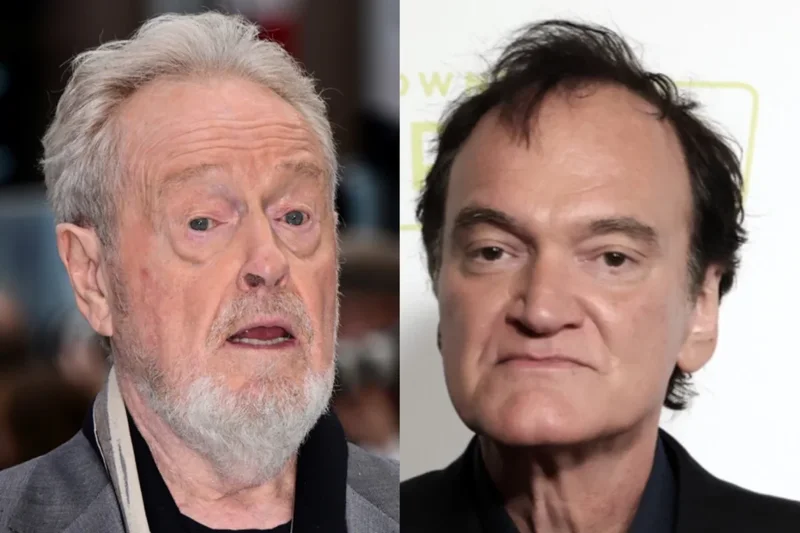
Ridley Scott has responded to Quentin Tarantino naming Black Hawk Down the best film of the 21st century.
The 2001 war drama, directed by Scott, topped a list of the century’s best films selected by Tarantino during an appearance on Bret Easton Ellis’s podcast last year.
The Pulp Fiction filmmaker selected the film ahead of others including Pixar animation Toy Story 3, Tokyo-set romance Lost in Translation, and historical drama There Will Be Blood.
Scott was asked about Tarantino’s choice during a new interview with The Times.
“I wonder what he was on, because whatever it is, I want some,” he remarked. Asked if he considered it the best film of the century, Scott replied: “No!”
He added that he had not spoken to Tarantino about the interview, but his brother, the late filmmaker Tony Scott, “knew him well”.
“Tony adored Quentin and, I think, Quentin adored Tony,” he said.
Elsewhere in the interview, Scott railed against the uniformity of storytelling in modern cinema, claiming that crime dramas and superhero films had oversatured the market.
“Look, everything now is about a murdered girl in the woods, or an FBI agent who is better than anyone else – or a superhero,” he said. “F*** me! There have to be other stories to tell.”
Scott, 88, has directed more than 30 films across his career, including modern classics such as Alien, Blade Runner, Thelma & Louise, and Gladiator.
His latest film, The Dog Stars, is out in cinemas next week, and sees Jacob Elordi (Euphoria; Wuthering Heights) play a civilian pilot drawn into action after humanity has been ravaged by a deadly flu pandemic.
The film also stars Josh Brolin, Margaret Qualley, Allison Janney, Guy Pierce, and Benedict Wong.
Scott’s previous effort was the 2024 sequel Gladiator II, a follow-up to the Russell Crowe-starring sword-and-sandals epic.
In a four-star review for The Independent, critic Clarisse Loughrey wrote: “Gladiator II is equal in scale and spectacle [to the original] and weighted with metaphor, but it’s also shot through with the kind of wry, absurdist slant that’s come to dominate Scott’s work of the last decade and a half, from Napoleon to Alien: Covenant.
“At times, Gladiator II is pure camp. To insist that it shouldn’t be is to hold on too tightly to the dour expectations of the 21st-century blockbuster.”