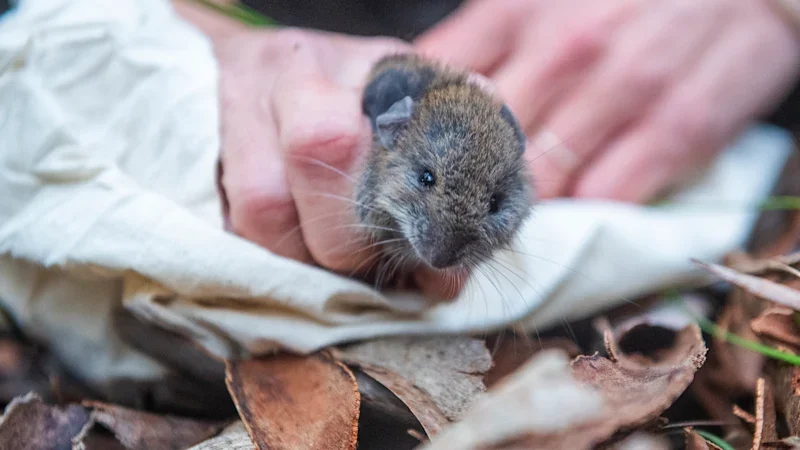
Mareshell Wauchope, a khaki-clad conservation ecologist, bush-bashes out of a tangle of bloodwood branches, acacia and sedge grass carrying a silver container the size of a champagne gift box: “We’ve got an animal!”
She sets the box down and begins to blow, hard, into one of its edges. She’s trying to coax its occupant into a small canvas bag, but the captive clings doggedly to the coconut husk lining the metal trap.
“I’m dying,” Wauchope gasps after a minute, red-cheeked and blinking stars. “Thank god I play the trumpet.”
Finally, her target tumbles into the sack: a native bush rat, called a bogul in Dharug. It’s the latest potential conscript in a globally significant rewilding effort aimed at repelling destructive and disease-carrying invasive black rats from Sydney’s bushland.
The fresh recruits Wauchope is gathering near Cowan, north of Sydney, are part of a 15-year series of experiments dashing the stereotype of native species as vulnerable victims and challenging the idea cities can’t be wild.
Reintroductions of boguls into North Head Reserve, only 11 kilometres from the CBD, between 2014 and 2016 transformed the area into an invasive rat-free zone. Marsupial mice and pygmy possums followed – species which now pollinate the area’s critically endangered banksia scrub – and the bush rat’s supremacy has ended black rat attacks on native bird nests.
Now the commanders of the Sydney rat war are seeking new lands to liberate. And they’ve updated their tactics.
But first: a whiff. Wauchope offers the trap like a cigar, waving it under my nose, and indeed the remnant bush rat musk offers an aroma of tobacco and hay, a note of vanilla with a bite of whisky. Compare that with invasive house mice, Wauchope says, which have a cheesy reek like stale Twisties.
From the bag she carefully extracts the bush rat itself. It has the curved Roman nose of a bull terrier and regards us with big, black eyes, glossy as drops of sap. Where black rats have big, pointed ears and a long scaly tail, boguls sport small, rounded, mouse-like ears, and unlike their invasive counterparts have tails shorter than their bodies.
This bogul, a male, is weighed and assessed. Wauchope runs her fingers down its spine, feeling for the layers of subcutaneous fat over its vertebrae and hips. She rates the rat’s condition a healthy three out of five, with one being skinny and five being fat. Recruits must be healthy and weigh at least 90 grams.
There are about 200 traps laid across bush rat territory to be checked in this conscription drive. To lure the rats, researchers make fatty balls of peanut butter, oats and honey so irresistible to a raft of creatures it’s called “universal bait”. (Humans are not exempt; after hours traipsing through thick bush they look utterly tantalising.) Sometimes the traps yield native New Holland mice, but mostly it’s bush rats.
This one is too small for war. Wauchope, a PhD candidate at the University of Sydney, notes its data and takes it back into the bush. As soon as her fingers relax, the bogul bounds forth, sprints along a mossy log, leaps into a grassy knot and melds into the undergrowth, backdropped by an orange sunrise flaming the horizon beyond the bloodwoods.
From battle arenas to the bush
This war began with the death of dogma. A sticky stereotype has cast native animals as feeble sitting ducks compared with voracious and virile invaders. But when the University of Sydney’s Professor Peter Banks and ecologist Dr Vicki Stokes scrutinised the idea in 2009, the hypothesis fell over.
When black rats were removed from patches of coastal forest, bush rats reclaimed the territory. Even when the black rat control stopped, the boguls prevailed, staunchly defending their reclaimed lands.
Perhaps bush rats weren’t driven from urban bushland by black rats, the researchers thought, but by human persecution. During a plague breakout in 1900, Banks says, the NSW government offered sixpence for every rat tossed into a purpose-built furnace in Bathurst Street.
That led to the indiscriminate killing of 100,000 animals, including black rats, bush rats, and rakalis (native water rats), according to historical records and photographic evidence. The last bush rat in Sydney was seen in 1901.
Banks believes this killing, and other human forces, caused bush rats to disappear from urban bushland, which black rats were in a better position to repopulate. Given the chance, he thought, bush rats could stage an uprising.
To see how the rats fared head-to-head, a 2011 study put bush and black rats into experimental “battle arenas”. A bush rat or black rat would be introduced to an enclosure first, and then an intruder. The rats brawled, bit, kicked, reared up on hind legs, postured, lunged and snatched food from each other’s mouths.
The statistics revealed something crucial. One species was not stronger or fiercer than the other. But 88 per cent of the time, whichever rat was placed in the enclosure first – the “resident” – won the fight. The experimenters proved a maxim immortalised 2500 years ago in The Art of War: “Whoever is first in the field … will be fresh for the fight.”
Around the same time, black rats were replaced with bush rats in patches around Sydney Harbour in proof-of-concept rewilding trials. A release in Mosman made Banks nervous: “I always joke that we released rats into the highest concentration of lawyers in the country.”
One cranky resident wrote a “please explain” to the government and compared the released rats to cane toads. The rest of the public reaction, and the trial results, were overwhelmingly positive. Despite being about 10 per cent bigger, black rats did not prove to be unbeatable bullies and avoided areas active with bush rats. When challenged, like the French, they seemed thirsty for retreat.
The Australian Wildlife Conservancy became interested and released about 170 bush rats into North Head Reserve between 2014 and 2016, while trapping and euthanising black rats. In 2019, a survey captured 112 invasive rats in the 250-hectare nature refuge. In 2020, there were 29. The next year, there were nine. “It’s turned things around completely,” Banks says. “We don’t want the introduced ones there for all sorts of reasons.”
His research has shown black rats are worse pollinators than bush rats, which help seed banksia and grevillea, and spread beneficial fungal spores. The invasive rats, meanwhile, eat eggs, skinks, small bats and spiders, warping the make-up of wildlife from birds to bugs.
Boguls also stick to wild spaces, but black rats scurry between the bush and backyards, ferrying diseases such as deadly rat lungworm, puppy-killing leptospirosis and ticks into people’s homes. Bush rats are largely free from maladies that infect humans.
In this rodent guerilla war, the brave and battle-hardened bush rat has proved our greatest ally.
Air, water and ground support
If bush rats make perfect ground soldiers, research last year added an amphibious assault vehicle to the mix: the rakali.
Footage captured on the shores of Sydney Harbour, not far from the North Head bush rat stronghold, showed a hulking one-kilo native water rat leaping out of the scrub to ambush a black rat.
It was the first documented rakali attack against a black rat, Banks reported, adding evidence to the idea native rodents fight back against – and even hunt – their invasive counterparts and serve as natural pest control.
Now other candidates for reintroduction to city bushland are being considered to bolster the barracks, including echidnas (tanks), feathertail gliders (paratroopers) and phascogales (fuzzy-tailed flagbearers). Reintroduced antechinuses in North Head have already proved themselves the ultimate kamikaze fighters: the male mice-like marsupials copulate so fiercely they die by sex, so by the end of the mating season their bodies litter the breeding grounds, martyred in the name of sirehood.
Wauchope is investigating new strategies to make bush rats more successful. She’s testing whether boguls released in intact social groups survive better; perhaps clan loyalty makes braver fighters. “They’re a super-social species,” she says. “They’re constantly scent-marking to communicate who’s who in terms of their hierarchy and breeding status, and they have communal nesting.”
Wauchope is also testing if adding bush rat scent to urban bushland might encourage reintroduced rats to reclaim that territory. The two release sites are Allenby Park in Allambie Heights and Twin Creeks Reserve in Turramurra.
The results of the experiment will be crucial. Patrick Finnerty, a postdoctoral research fellow with the Sydney Rewilding Intuitive, analysed nearly 3000 scientific papers and found only 1 per cent of rewilding efforts worldwide involved the reintroduction of terrestrial animals into cities.
“On a global stage, this is one of the first urban rewilding initiatives where we’re reintroducing species back into an ecosystem where they have invasive predators,” he says. The boguls’ success would prove that, with the right design and management, native animals can reclaim feral spaces and become biological assets that boost ecological and human health. Natural control of invasive rats would mean reduced use of poison too, which kills native predators including owls, eagles and rakalis.
The researchers envisage volunteers releasing boguls just as bush regeneration groups plant saplings: “Not just replanting, but refaunaing,” Finnerty says. Involving people in the bush rat rebellion would also help arrest a key indirect driver of global biodiversity loss: lack of connection to nature, also called “the extinction of experience”.
“We’ve treated cities as places where nature’s been lost,” Finnerty says. “I hope these projects ask whether cities can be places where both native species and humans can coexist.”
The Examine newsletter explains and analyses science with a rigorous focus on the evidence. Sign up to get it each week.