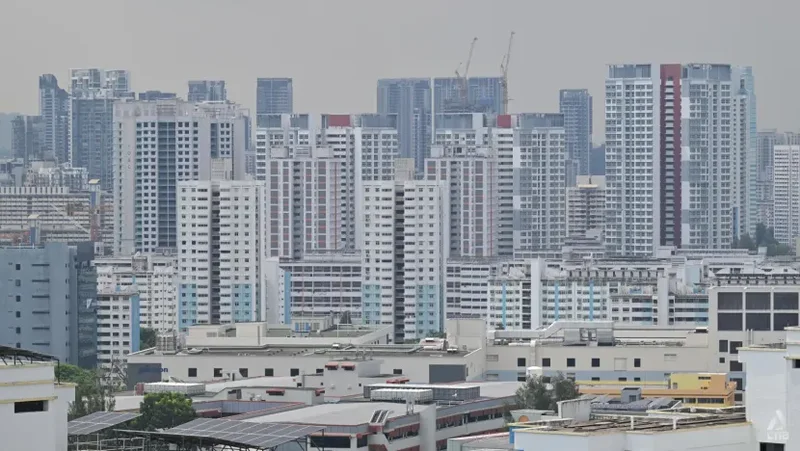
NDR 2026: Income ceilings for BTO flats, executive condos raised; first-time buyers to get extra ballot per child
To give potential flat buyers sufficient time to review their housing plans under the revised ceilings, the next Build-to-Order (BTO) exercise will be moved from October to November.
SINGAPORE: The income ceilings for buying new Housing and Development Board (HDB) flats will be raised to ensure that the vast majority of Singaporeans can continue to access subsidised public housing, Prime Minister Lawrence Wong said on Sunday (Aug 23).
Starting February next year, there will also be an additional ballot chance per Singaporean child for first-timer families with or expecting children, Mr Wong said in the National Day Rally.
For Build-to-Order (BTO) flats, the ceiling will rise from S$14,000 (US$11,000) to S$16,000. For executive condominiums (ECs), the income ceiling will go up from S$16,000 to S$18,000.
“Over the years, we have steadily increased housing supply. Today we see encouraging results. Success rates for booking BTO flats are higher, waiting times are shorter. And the resale market has stabilised. These improvements give us confidence to do more,” said Mr Wong.
Mr Wong noted that Singaporeans are marrying later these days, with many further along in their careers and earning more by the time they settle down, leading to many young couples crossing the current income ceilings.
The changes are among the measures to keep public housing and ECs affordable and accessible for Singaporeans and to provide greater support for families with children, as part of broader efforts to encourage marriage and parenthood, the Ministry of National Development (MND) and HDB said in a joint press release on Sunday.
The revised ceiling will kick in for eligible families who apply for an HDB Flat Eligibility (HFE) letter from Monday. This lets them buy a new subsidised HDB flat, a resale HDB flat on the open market with the CPF Housing Grant, or get an HDB housing loan.
Correspondingly, the income ceiling for eligible single HDB home buyers aged 35 and above, will also be raised from S$7,000 to S$8,000.
The revised ceiling for ECs will apply to new units in projects with land sale tender closing dates on or after Aug 24, and will not apply to balance units in existing ECs or new units in ECs with land sale tenders awarded before that, said MND and HDB.
To give potential flat buyers sufficient time to review their housing plans and apply for an HFE letter under the revised ceilings, the next Build-to-Order (BTO) sales exercise will be held in November this year, instead of October.
“We would like to encourage all flat buyers who wish to participate in the BTO sales exercise to apply for an HFE letter early and submit all required documents by Sep 25, 2026,” MND and HDB said.
In November’s exercise, about 7,960 flats in Bedok, Geylang, Sembawang, Tengah, Toa Payoh and Yishun will be launched, along with community care apartments in Toa Payoh.
More details on the projects, including their classification, will be shared during the launch.
“The income ceiling ensures that the limited supply of new subsidised HDB flats, which are priced with significant market discounts, and housing grants are prioritised for lower to upper-middle income families,” said MND and HDB.
They said the income ceilings are reviewed periodically to ensure that they keep pace with income growth.
Since they were last adjusted in 2019, incomes have risen, leading to more aspiring buyers exceeding the ceilings, said HDB and MND.
The median monthly household income in Singapore rose to S$12,446 last year, up from S$11,558 the year before, an increase of 6.8 per cent after adjusting for inflation.
After accounting for household size, the median monthly household income per household member rose by 7.5 per cent in real terms, from S$3,837 in 2024 to S$4,160 last year.
MORE BALLOT CHANCES PER CHILD
Another change announced on Sunday was for first-timer families with or expecting children to get additional ballot chances from February next year.
This move will “significantly improve” their chances of getting a flat, said Mr Wong.
“Today we already give priority to couples who are engaged as well as married couples. But once you have children, I believe you should receive even greater priority,” said Mr Wong.
“So the more children you have, the more ballot chances you will receive – because we want to help growing families secure a home sooner.”
HDB and MND said first-timer families will receive one additional ballot chance for each Singaporean child aged 18 and below, for all BTO and SBF flat applications.
First-timer families refer to those where no member has previously received any government housing subsidy or owned a subsidised flat.
Currently, they are given greater priority in the ballot in BTO and Sale of Balance Flats (SBF) exercises.
They receive two ballot chances, compared to one for second-timers.
Those eligible under the First-Timer (Parents & Married Couples), or FT(PMC), category receive three ballot chances. They are also prioritised under the Family and Parenthood Priority Scheme when applying for a four-room or smaller BTO flat in Standard projects.
The FT(PMC) category includes married couples aged 40 and below, and families with at least one Singaporean child aged 18 and below, including married couples who are expecting and have a doctor’s certification of the pregnancy.
They must also never have owned or sold a residential property before, nor had a chance to book a BTO or SBF flat in the past five years prior to their application.
All first-timer families who have failed in two or more BTO applications for Standard flats, receive an additional ballot chance for each subsequent application, capped at five ballot chances in total.
Mr Wong also said that larger families would automatically receive more financial support under the new approach.
This includes an additional MediSave top-up and more help with transport needs.
“Larger families often want bigger homes, which cost more. So I have asked Chee Hong Tat to consider additional housing support for larger families,” he added.