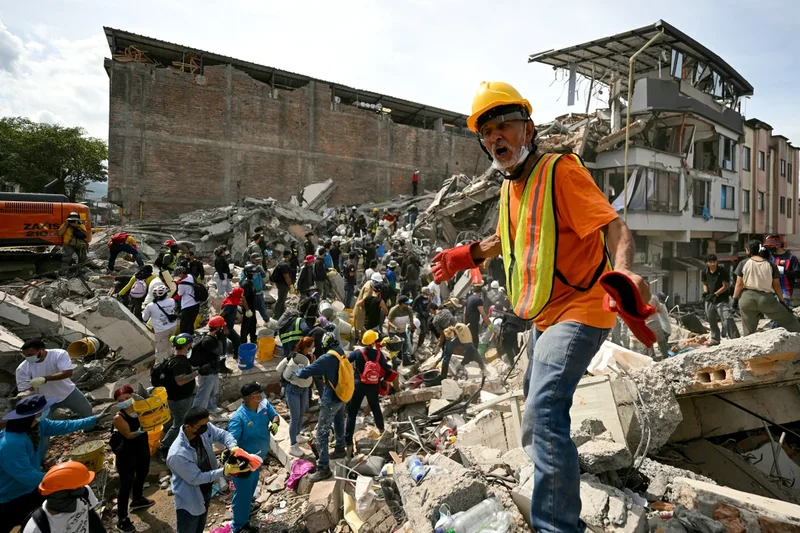
Major earthquakes have caused devastation around the world this summer.
A 7.7 magnitude earthquake hit the Philippines in June, triggering a tsunami. Twin quakes with magnitudes over 7.0 struck Venezuela back to back the same month, killing thousands. In July, a 6.8-magnitude tremor rattled Japan, and a 7.3 hit off the coast of southern Mexico.
Earlier this month, a 7.4-magnitude earthquake shocked Colombia, one of the largest there in years, and a 7.7 displaced some 40,000 people in Indonesia. This week, a 4.9 quake led to evacuations of hundreds in Spain.
The number of major earthquakes in such a short span of time may seem shocking but experts tell The Independent this is par for the course on a shifting planet.
“There’s nothing I’m seeing here that is unusual, this is all within the typical variations in earthquake rates that we see,” Zachary Ross, a professor of geophysics at Caltech, said.
Earthquakes happen when pieces of the Earth underground known as tectonic plates rub up against each other, creating the shaking sensation we feel on the surface. The quakes help release heat from the planet’s core.
Over 7.0 - the second-highest level on the Richter scale that measures earthquake strength - is considered to be “major” and can cause serious damage over larger areas.
There have been 11 of those earthquakes this year but that’s just below the annual average of 15-18, said Maureen Long, the Bruce D. Alexander professor and Chair of Yale University’s Department of Earth and Planetary Sciences.
“It feels like a pattern because unfortunately, several of these events have occurred in populated areas and caused significant damage, so we have all seen a lot of headlines,” she told The Independent.
This year, 17 or 18 quakes are expected, Dr. Allen Husker, a research professor of geophysics at Caltech, said. That’s based on the track for a typical active year, which sees 20.
“If we reach that number, it would be a little high, but not unusual,” he said.
There is also no indication that the quakes this summer are connected - and are “almost certainly a coincidence,” John Emilio Vidale, a seismologist at the University of Washington, said.
“All of the large earthquakes that have recently occurred have happened in different plate boundary zones and in different plate boundary environments,” William Barnhart, the assistant coordinator of the U.S. Geological Survey’s Earthquake Hazards program, added.
“While they seem close to each other in space and time, seismologically, they are not.”
Large earthquakes can trigger other smaller quakes in distant locations and aftershocks, which is what happened in Venezuela.
“But there is no evidence for large earthquakes triggering other large earthquakes at global scales,” Eric Dunham, a professor of geophysics at Stanford University, said.
So a large earthquake elsewhere in the world has no impact on whether a damaging earthquake will happen in the U.S., Long and Husker said.
But, that doesn’t mean a major event is off the table - and Southern California’s San Andreas fault is one area being closely monitored. So is the Pacific Northwest Cascadia subduction zone, which runs along the coasts of Oregon and Washington.
These West Coast faults could trigger each other, possibly leading to double the disaster, researchers at Oregon State University warned last October.
“The forecast for the San Andreas Fault is that the fault is overdue for a large earthquake,” Folarin Kolawole, an assistant professor at Columbia University’s Department of Earth and Environmental Sciences, said.
“However, I would also mention that there are many critically stressed faults across the U.S. that can rupture an earthquake if there is significant disturbance around them.”
Earthquakes cannot be predicted, so be prepared. As goes for other major disasters like hurricanes and winter blizzards, having an evacuation plan and emergency supply kit is a good idea.
For earthquakes specifically, the early warning apps ShakeAlert and MyShake can give up to a minute’s notice.
During an earthquake, people should drop to the floor, crawl under a protected space away from windows and hold on, the American Red Cross says. People outside should make their way to an open area that is away from buildings and power lines, the USGS advises.
“Large, infrequent earthquakes can be devastating, but so can smaller earthquakes that occur more frequently. Being prepared for how to respond to an earthquake is the best way to handle one when it arrives,” Barnhart said.