Rock art: Tiny Sasanian bird motif discovered in southern Iran
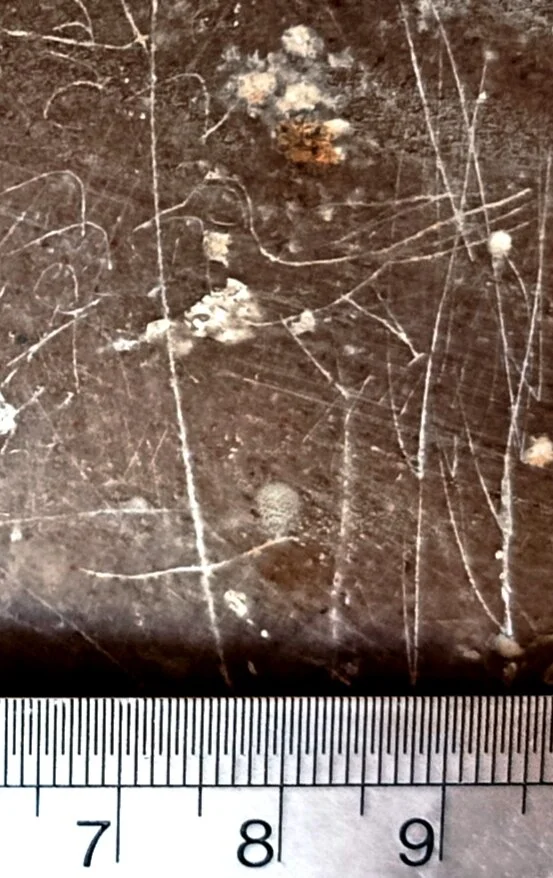
TEHRAN – Archaeologist Abolhasan Atabaki has reported the discovery of what he describes as the smallest known bird motif from the Sasanian period, measuring just 3 by 2 centimeters and engraved on the rocks of the Marvdasht Plain in Fars province, southern Iran.
The tiny image was executed using a pecked or incised technique and is located beside a Middle Persian (Pahlavi) inscription dating to the late Sasanian period. According to Atabaki, the bird appears to be related to the concepts expressed in the inscription, particularly the idea of the soul’s salvation, Jamaran news website reported.
Atabaki said birds in ancient Iranian culture were often associated with auspiciousness, the carrying of messages, the ascent of the soul, and the connection between the earthly and celestial realms.
“This visual tradition did not disappear after the fall of the Sasanian Empire,” he said, adding that it continued, with changes, during the Islamic period and reached a high point in Persian miniature painting.
Birds perched on branches became recurring elements in the art of various Persian miniature schools, particularly during the Ilkhanid, Timurid and Safavid periods. Atabaki said such birds were not merely decorative motifs but also contributed to the poetic and spiritual atmosphere of paintings.
He said the roots of this visual tradition could be traced to Sasanian art, in which animals and plants were arranged according to symbolic and geometric principles.
The bird’s ability to fly between earth and sky also made it a fitting symbol of the relationship between the material and spiritual worlds, Atabaki explained. A bird perched on a branch could reinforce this symbolism, with the tree or branch representing life, growth and continuity, while the bird evoked the celestial realm.
In that regard, historian Najmeh Ebrahimi said the motif could also be interpreted in relation to death and beliefs about the soul.
“In Iranian traditions, death was not regarded as the end of existence, but as a transition of the soul from the material world to the spiritual realm,” she said. The bird perched on a branch, positioned between earth and sky, could therefore be understood as a metaphor for the soul’s passage and the connection between earthly and afterlife existence.
Ebrahimi said examination of the engraving showed that the bird had been rendered in a highly linear manner, using narrow and shallow grooves cut into the rock. The artist appears to have defined the small image mainly through its outlines with a pointed tool.
The nearby Pahlavi inscription, with its references to salvation and the fate of the soul, provides a basis for a possible symbolic interpretation of the bird, she added.
According to Ebrahimi, birds in Iranian religious and epic traditions often carried meanings beyond their natural existence and were sometimes regarded as intermediaries between the material and spiritual worlds or as bearers of divine messages. Some birds in the Avesta and Middle Persian texts were also associated with concepts including divine glory, guidance, protection and the spiritual realm.
The location of the engraving and inscription further adds to their significance. The Marvdasht Plain remained an important political and religious landscape of Iran from the first millennium BC through the Sasanian period. Its proximity to major archaeological sites such as Persepolis, Naqsh-e Rostam and Naqsh-e Rajab suggests that the area continued to form part of an important ritual and cultural landscape during the Sasanian era.
Ebrahimi added that the combination of a religious inscription with a symbolic natural motif on the rock was consistent with traditions in which natural elements were used to convey religious concepts.
She described the small engraving, together with the Pahlavi inscription, as a rare example of the interaction between image and text in late Sasanian art. She also noted that full publication and study of the find, including a complete reading of the inscription and comparison with similar examples, could contribute to a better understanding of the role of bird symbolism and religious concepts in Sasanian art and culture.
AM