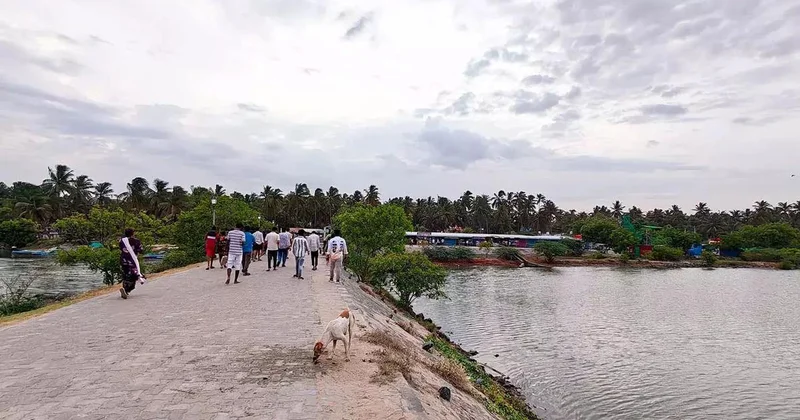
On the evening of February 19, 58-year-old Anbukarasi sat alone in the usually bustling marketplace at the coconut grove in Puducherry’s Eden beach. Until a couple of days earlier, local residents were running temporary stalls selling fried fish, boiled corn, cucumbers, mangoes, toys and hats to tourists visiting the beach.
But on Sunday, February 15, the commissioner of the Ariyankuppam Commune Panchayat issued an eviction notice demanding that the stall owners vacate the area by Monday. On Tuesday, the police came and started pulling the tarpaulins off the 50-odd stalls. “They took about a hundred of us to the police station at Ariyankuppam,” said Anbukarasi, “We asked them to not remove the shops and that this is our only livelihood and we need our beach.”
After some negotiation and the involvement of a local legislator, the stall owners were given an extension till the 19th. While most stall owners left by then, Anbukarasi stayed put, urging every visitor to buy the cucumbers and boiled corn that she was selling. “I’m making the most of the three days that I am allowed to run my shop,” she said. “This is my only source of income other than the Rs 2,500 [a month] I get from the government as a widow’s pension.”
The eviction has impacted the livelihoods of all the stall owners in the village. Half of them managed to get stalls near the parking area, while the other half, like Anbukarasi, have no alternative. And all of them say they are facing severe financial loss.
This eviction was part of the beach’s compliance under the “Blue Flag” certification, based on 33 criteria that focus on environment education, water quality, beach management and safety. In 2019, the Indian government had selected 13 beaches for “development of facilities and infrastructure” to prepare them for the certification.
ISignal visited three Blue Flag-certified beaches – Eden in Puducherry, Kappad in Kerala and Padubidri in Karnataka – between February and July 2026, and found that these projects are leading to violation of coastal regulations, some of which are later legitimised through post-facto orders, and has also led to alienation of local communities from public beaches, disrupting their livelihood.
Experts warn that these activities are leading to irreversible changes to the sensitive systems.
ISignal has reached out to the governments of Tamil Nadu, Karnataka and Puducherry, and the Union government, for comment. We will update this report when we receive responses.
What are Blue-Flag beaches?
The Union government developed Eden Beach as an eco-tourism project. It is managed by a Beach Management Committee that includes an official from the tourism department, the district collector and a local body representative. Day-to-day operations are overseen by a beach manager who reports to the tourism department. In 2021, it received the “Blue Flag” certification from the Denmark-based nonprofit called the Foundation for Environment Education.
The Society of Integrated Coastal Management, an environment ministry agency, issued tenders for infrastructure development with funding from World Bank’s Integrated Coastal Zone Management Project. The government launched a programme called the Beach Environment & Aesthetics Management Services to facilitate the development of these beaches.
The prime objective of the Beach Environment & Aesthetics Management Services programme, as stated by the government, was to “protect and conserve the pristine coastal and marine ecosystems through holistic management of the resources”. The government’s push to get more beaches this certification is also to boost local economies, in line with its “blue economy” policies that aim to sustainably extract the most economic value from ocean resources.
One of the criteria for Blue Flag certification is that the local authority or the beach operator must comply with all laws and regulations affecting the location and operation of the beach. India’s coasts are governed by the Coastal Zone Regulation notification of the Environment Protection Act 1986.
Since the notification was introduced in 1991, it has been amended over two dozen times, steadily diluting the level of protection given to the coast. The latest notification, passed in 2019 opened up the coast for eco-tourism projects on beaches and “temporary facilities” in no-development zones.
It divides the land upto 500 metres from the High Tide Line into seven different categories and lists the activities that are prohibited in these areas. They are implemented using Coastal Zone Management Plans which demarcate these areas and define where the High Tide Line falls.
Based on the ecosensitivity of the area and other features like population density, level of urbanisation and infrastructure facilities, different kinds of activities are permitted on different beaches.
For example, Eden beach is in an environmentally critical and eco-sensitive area, so fewer activities are permitted there. Padubidri beach is in a “relatively undisturbed” area and hence is comparatively less protected. Kappad falls under a developed land area that is close to the shoreline, receiving the least amount of protection.
However, irrespective of categories, the notification only allows “temporary facilities” for tourism purposes. And even that is dependent on being marked as such in the tourism plan of the Coastal Zone Management Plans, and needs to be at least 10 metres from the High Tide Line.
Environmental violations
Until March 2018, the southern end of Padubidri beach looked like a lush green forested patch sandwiched between the Kamini river and the Arabian Sea.
By November, most of the green cover in the area had disappeared and by March 2020, a portion of the river had been reclaimed to set up a parking lot, solar panel, solid waste management plant and a grey water treatment plant.
Such concretised reclamation is a violation of the Coastal Zone Regulation notification. No one used to visit the end-point beach, as it is called, said Vijaya Shetty, the beach manager. “Only fishing communities used to visit it, there was not even a road,” he added. Infrastructure development began in 2018, he said, with funding from the Union government under the supervision of the Society of Integrated Coastal Management.
“Initially we faced some issues with CRZ [Coastal Zone Regulation] norms, especially with construction of concrete pillars but that was later resolved by the central government by giving relaxations to all Blue Flag beaches,” said Shetty.
The relaxation that Shetty refers to is a July 2019 order by the environment ministry allowing 12 types of structures and facilities within 10 metres of the High Tide Line in the selected beaches. But the reclamation at Padubidri violates this relaxation order as well by overshooting the HTL and encroaching the Kamini river and the inter-tidal area.
“The protective provisions of the notification are seldom applied. Relaxing, diluting provisions are always applied, and violations are seldom questioned,” said Nityanand Jayaraman, an independent journalist and social activist.
In January 2020, the Union government issued another order superseding the July 2019 one. This order broadened the scope of permitted activities by listing 17 facilities and any “Other associated facilities or infrastructure, as per requirements of Blue Flag Certification”. It also removed the specifications mentioned in the 2019 order on what each of these facilities should be composed of.
For example, the 2019 order said that the pathway to the bathing zone has to be made of interlinking paver blocks, while the 2020 order changed it to just “Beach access pathways”. In 2021, the Bombay High Court, while hearing a Public Interest Litigation against this order with reference to Miramar beach, had called the phrasing of “other associated facilities or infrastructure” open-ended.
It also commented on how the 2020 order “quite consciously omits reference to temporary structures”, in reference to treatment plants for grey water and solid waste.
This lack of specification and ambiguity in the notice is one of the reasons why violations happen, said an official from Puducherry Coastal Zone Management Authority who did not wish to be named. “Most of the inferencing happens on the ground and if you look at permanent or temporary, there is no definition,” they said.
To illustrate, they said, “If I am laying the ground in concrete but using thatched roof and green materials for the rest of the structure, can that be treated as temporary or permanent?”
In 2017, when the Eden beach project received Coastal Zone Regulation clearance, the conditions were that the structures have to be made of eco-friendly materials that are resilient to natural disasters like cyclones, without disturbing sand dunes or any other eco-sensitive areas and in conformity with the provisions of the Coastal Zone Regulation notification 2011, that was applicable then.
The residents from Chinna Veerampattinam village, where Eden Beach is located, approached the National Green Tribunal alleging that the beach construction violated Coastal Zone Regulation norms after a private company started constructing a resto-bar.
Based on the tribunal’s order, the Regional Coastal Zone Management Committee, Puducherry conducted an inspection in December 2025 and found that three sets of permanent structures including the entry archway were constructed before 2019. It also found construction on a part of the sand dunes – which receive maximum level of protection under Coastal Zone Regulation . The Puducherry Coastal Zone Management Authority directive was issued based on this inspection report.
In March 2026, the Puducherry Coastal Zone Management Authority issued a directive to remove unauthorised construction at Eden Beach, including on sand dunes.
The directive ordered removal of the tile work laid down for opening the restaurant and removing unauthorised buildings on sand dunes and restoration of the area. In July, when ISignal visited the beach, the walls of the restaurant collapsed from erosion while the tile work remained. The National Green Tribunal is still hearing the case.
“Because of the vagueness in the CRZ, municipalities and local governments that want to implement these projects can just go ahead and do it and then the violation will have to be questioned later,” said Nityanand.
“A dune that is gone is gone. Often when they demolish such construction, they leave the debris there. The quality of the dune has been destroyed already,” said Nityanand.
Public beaches behind paywalls
India’s beaches are generally very dynamic ecosystems, said Naveen Namboothri, Programme Head at Dakshin, a non-governmental organisation that works extensively on coastal conservation and community wellbeing.
“Coasts always need some buffer space. When there is a strong monsoon, a lot of the beaches can get eroded, and then they come back also if there's sufficient sediment supply,” he said, adding how most beaches constantly work on this cycle of erosion and accretion.
And any construction disrupting this cycle not just has ecological impacts but also economic ones, he said, “Because those constructions have to be constantly maintained and constantly repaired.”
In both Kappad and Eden, concrete platforms that were constructed as the base of the beach pathways had broken off and were visibly eroded.
“This had fallen the last time there were strong winds and it was replaced. It will fall again and will have to be replaced. This cycle has repeated at least 14-15 times already,” said 64-year-old Nasar Kappad while pointing at a tin roof above a resting area in Kappad Blue Flag beach.
Over the next 20 minutes, Nasar pointed at each piece of infrastructure that has either corroded or become defunct. “None of the lights work, the metal structure propping up the solar panels corroded and fell. Those are now lying in a corner as scrap metal,” he said, adding how none of the permanent infrastructure was made to last.
“Two-three years ago, the beach was really good. But now everything has fallen apart,” said one of the women workers responsible for cleaning the beach. The workers showed the now-defunct solid waste management machine. “The waste here is often mixed with heavy wet sand. The machine helped dry all the waste and segregate it from the sand. But it has been defunct for a while now,” another worker said.
When asked what is the most challenging part of managing the beach, Padubidri beach manager Shetty said maintaining the infrastructure. “Because of the salt water, iron corrodes easily, so all the infrastructure requires frequent replacement and maintenance,” he said.
Kappad beach was completely off-grid, relying on solar panels for electricity. Since the collapse of the solar panels, the beach has started having power cuts, which has impacted the functioning of toilets and showers, said beach manager Gireesh Babu. “The water tank is at the ground level and works with a power motor. So when there is no electricity, there is no water supply. We are in the process of building an overhead water tank.”
Blue flag is not a project but a standard, said Shriji Kurup, the National Operator of Blue Flag India and Programme Director at the Centre for Environment Education. “The Blue Flag idea is to make the beach as simple as possible and pristine, not infrastructure-heavy.”
He said that the initial batch of beaches which include all the ones ISignal visited were developed as part of the Beach Environment & Aesthetics Management Services programme and have a similar model of infrastructure development, adding that newer projects such as the one in Silver beach in Tamil Nadu’s Cuddalore and Chal beach in Kerala’s Kannur are much simpler.
The programme has been discontinued, it was last mentioned in the 2021-22 annual report of the environment ministry. The initial World Bank ICZM project that supported these beach development projects ended in 2020.
In 2018, the bank announced the Enhancing Coastal and Ocean Resource Efficiency, or ENCORE, project with a total cost of $360 million. Between December 2019 and January 2020, SICOM issued notices seeking bids to develop a total of 24 beaches – four each in Karnataka, Kerala, Andhra Pradesh, Odisha, Gujarat and Tamil Nadu.
By the time that project ended, Society of Integrated Coastal Management was de-registered and was merged with the National Centre for Sustainable Coastal Management. The next round of World Bank funding for these blue flag projects came through the Strengthening Coastal Resilience and the Economy Project (SHORE) programme. Announced in 2023, with a total project cost of $240 million, the programme is being piloted in Karnataka and Tamil Nadu as K-SHORE and TN-SHORE respectively.
While Karnataka and Tamil Nadu have announced plans to develop 11 and six beaches respectively as part of this programme, there is no clarity on what kind of infrastructure would be installed at these beaches.
Besides infrastructure, a key expense for these beach projects is waste management. Cleanliness and waste management are some of the most important criteria for Blue Flag. Most of the staff hired at Kappad and Padubidri are cleaning staff. Moreover, handling the waste is cost-intensive, said Babu from Kappad.
“We have to pay the panchayat Rs 100 per kilogram to handle the plastic waste. A bigger expense is handling the needles that fall from the Casuarina trees. For handling one load of the needles, accumulated in a few days, we have to pay Rs 2,000,” he said.
The only way to pay the salaries and generate revenue for the recurring costs is to charge an entry fee, said the beach managers of both Kappad and Padubidri. “We are able to self-sustain only because of the fees that we charge. This is the only beach that is able to manage its costs with the revenue it generates,” said Shetty from Padubidri.
But the entry fees and restricted access to these once open beaches have changed people’s relationship with the coast.
Local communities sidelined
In November 2020, when the Kappad beach was being reopened after the Covid-19 lockdown, the District Tourism Promotion Council announced an entry fee of Rs 50. Immediately, a group of local residents rallied and protested against the move.
“I grew up running around on this beach. I refuse to pay to access it,” said 54-year-old Noushad (he uses one name), a fisherman from Kappad. The protests led to slashing of the fee to Rs 25 for the general public and Rs 10 for residents of the Chemanchery Panchayat. Moreover, in practice, residents of the nearby villages are able to access the beach for free.
This was not the only contention local residents had with the Blue Flag beach project in Kappad. Earlier, the project was planned on another beach, around a kilometre north. But local fishing communities protested and moved the beach to its current location. “That is an important area for small fishers like us. We park our boats there, so we did not want to lose that,” said Noushad.
India’s beaches are important common spaces for coastal communities and are collectively managed by the communities. Blue-flag beach development projects warp this management of commons, said Nityanand, adding how the beach is entrusted to a Beach Management Committee that has elected local body representatives, members of the government and district administrators.
“So all of a sudden, the space that people have been using for their livelihood, for storing your gear, children playing gets transferred to a committee in which they don't have a voice. Their voice will have to be mediated through an elected representative who can have a variety of interests and might not be from the fishing community,” said Nityanand.
At the Kappad blue flag beach, a small section at the northern end of the beach remains outside the purview of the project. As the sun started setting, the Blue Flag beach became deserted and people started trickling into this open stretch. “The reason we can sit here freely is because these children fought for it,” said Abdul Khader, a resident pointing at boys who were playing football on the beach, “They did not want to lose their playground.”
The blue flag certification is a system that works in countries where ample unclaimed beach spaces are available and there’s not much contestation over coastal commons, said Naveen from Dakshin, “Bringing similar models to coastline of India absolutely makes no sense. The Indian government is building alternative certification models that take local contexts into account. On such committees, we have always pushed for beach management committees that’s run and operated by local fishing communities, where their interests are also taken care of and benefits of tourism go back to the communities.”
While the Coastal Zone Regulation notification refers to the traditional rights and customary use of communities, it falls short in protecting communities’ access to these spaces. This has prompted a nationwide demand for a comprehensive Coastal Rights Act.
With respect to Blue Flag beach projects, the government’s January 2020 order providing Coastal Zone Regulation relaxations continues to be the prominent legal framework. In addition to allowing certain facilities, it also does away with the requirement for a public notice for such projects.
Rules under the the Environment Protection Act 1986 say that the Union government must issue notice before imposing any prohibition or restrictions, but a subsequent amendment adds an exception: This requirement for notice can be dispensed with if it is in public interest. The January 2020 order relies on this exception to exclude Blue Flag beach projects from the need for a public notice.
This was the main contention of the PIL filed with the Bombay High Court by Goan residents. The court quashed the order with respect to the Miramar beach and said that dispensing with the public notice has deprived the stakeholders of valuable opportunity of filing their objections.
The order also does not address existing usage of the coast by local communities. At Eden beach, residents had been operating temporary stalls for over two decades, long before it was developed. But the October 2025 inspection lists 43 food stalls among the list of violations citing that it is not permitted as per the 2020 order. It recommended shifting them to another place.
For local stall owners, the location mattered. “The business was good there. It was cool and breezy. People stayed for long enjoying the view and hence ate more,” said 38-year-old Shobana T, who along with her husband Dinakaran G runs a fried fish stall. After the eviction, the couple, like many others, shifted to a space outside the beach near the parking area. “Here, people just walk through hurriedly and don’t stop. Also, these tin roofs and walls make it really hot, so people don’t want to eat much,” said Dinakaran.
In addition to “preserving the coast”, these projects are meant to serve as a source of income for local communities and boost local economies. But other than providing employment to the cleaning staff and lifeguards, they have barely helped local communities.
While the 2020 order does not list cafes or business stalls as permitted facilities, all the beaches have some. At Eden beach, right in the middle of the coconut grove is an air-conditioned glass box with massage chairs and a fish spa and a children’s adventure park, both lie largely defunct. Padubidri has a boating set-up near the Kamini riverfront and all three have cafes or restaurants.
The only way to operate these is to win the bid for the tender, which can often be prohibitive. In Padubidri, beach supervisor Kiran Karkera’s brother operates the boating set-up. He said that it is not profitable at all, “He won the online bid for Rs 13 lakh a year but there is not that much business. After paying parking fees and entry fees, people do not want to spend another Rs 200-300 for boating.”
The intention is not to keep locals out, but to keep anything that is not a capitalised business out, said Nityanand, “An owner-operated small stall where the family puts in the labour and keeps the surplus is not seen as a legitimate form of business, the only legitimate form of business will have to be incorporated and has to be set valid within the capital economy, and that's the only thing that is permitted.”
In 2024, when Anbukarasi’s daughter urged her to set up the stall, she had to borrow money. “Over the next year, the business was good. I was earning between Rs 300 and 500 every day,” she said. She had managed to pay off her loan and in February had borrowed another Rs 30,000 to replenish her stock. “All of that is lying at home, rotting. All I want is my stall back,” she said.
Shreya Raman is an independent journalist and a resident at the Climate Change Media Hub at the Asian College of Journalism.
This article first appeared on ISignal, a data-driven and public-interest journalism non-profit.
We welcome your comments at letters@scroll.in.