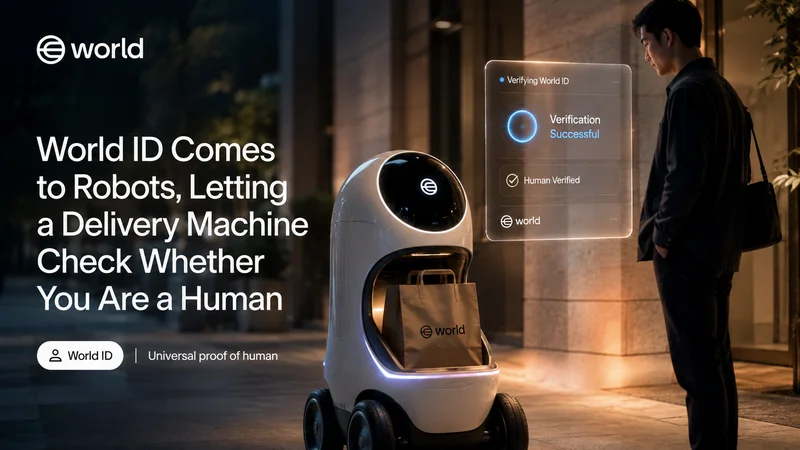
For thirty years the working assumption behind almost every system on the internet was that the thing on the other end was a person. In 2024 that assumption stopped being true, and it has not been true since. World and peaq made World ID available to robots and machines running peaqOS, through robotic.sh. A machine can now request and verify a World ID proof, confirming that it is dealing with a real and unique human and, where the interaction calls for it, that the person completing an action is the same person who started it. The machine receives a proof. It does not receive a name, a face or anything else.
The mechanism is a zero-knowledge proof presented through World App, a wallet built by project contributor Tools for Humanity, and the notable commercial detail is that machines running peaqOS can perform the check natively, without an API key and without a per-verification charge. What that removes is not a fee so much as a decision. An engineer building a delivery robot no longer has to justify a per-interaction cost against the convenience of simply issuing a four-digit code.
Why proof of human became a physical problem
The case for proving humanness online is now so well established it is close to boring. The case for proving it in the street is new.
Automated traffic overtook human traffic for the first time on record in 2024 and reached 53% of all web requests in 2025, with malicious automation alone accounting for 40%. Thales blocked 17.2 trillion malicious bot requests in a year and recorded a twelve-and-a-half-fold rise in AI-driven attacks. Human activity is now the minority share of the internet and still falling.
None of that, on its own, explains why a robot needs to check anything. The reason is that the same period moved autonomous machines out of the warehouse and onto the pavement, where they meet strangers and have to decide something about them. A delivery robot arriving at a door has a question no web service ever had to answer in physical space, which is whether the person reaching for the compartment is entitled to what is inside it.
The two networks that arrived at the same problem from opposite ends
What makes this integration interesting is that neither party built toward it directly. Each solved half of a problem and the halves turned out to fit.
World spent three years building a way for a person to prove humanness without disclosing identity, reaching nearly 18 million people verified at an Orb across 160 countries, and in April 2026 shipped a rebuilt World ID with enterprise partners and face-continuity features. peaq spent the same period building the opposite side, an economic identity layer for machines, and by March 2026 had onboarded more than 3.3 million machines, robots, devices, vehicles and agents with verified machine identities across more than 60 applications in 22 industries, processing over 200 million transactions. In May it demonstrated a Serve Robotics delivery robot completing work and being paid onchain under peaqOS.
One network can prove a human is real without saying who they are. The other can give a machine an identity, a wallet and a way to discover services. Until Friday, a robot that wanted to check a human had no standard way to ask.
peaq provides the coordination layer that makes the request possible. Machines use peaq decentralised identifiers for their own identity, discover the verification service through the Machine Market and run the exchange from request through to result. The process can also produce a verifiable auditable record that the interaction happened, with the proof metadata redacted, which means an operator can demonstrate that a check occurred without holding what the check revealed.
The economics of not knowing
The strongest argument for this design is not privacy in the abstract. It is that identity data is an asset with a negative carrying cost, and the number is published every year.
Customer personal data is the most frequently compromised category in breaches, appearing in 52% of them, and costs about $160 for every record exposed. Anonymised data is the cheapest thing an organisation can lose, at $115 a record, a difference of $45 on every single row. The global average breach reached a record $4.99 million in the 2026 report, up 12%, and $11.5 million in the United States. Healthcare has been the costliest sector for thirteen consecutive years, which matters here because the medication delivery case is the one the integration leads with.
Every field an operator collects in order to confirm that a person is who they say they are becomes a row in a database that someone will eventually try to steal. A verification model in which the machine receives a proof rather than an identity does not merely reduce that risk. It removes the row.
What the alternatives actually give you
Set the options side by side against the criteria a machine-to-human handover needs, and the gap is wider than the announcement claims.
A pickup code proves nothing about the person holding it. It is a bearer instrument, which is a polite way of saying it works exactly as well for whoever has it, and codes travel by screenshot. An account login is slightly better on continuity and considerably worse on data, because creating the account is the moment the operator starts collecting the information it would rather not hold. An identity document check does establish a real, unique person and does link the start of an interaction to its end, and it does so by taking a copy of a passport or a driving licence, which is the most expensive possible answer to a question that was only ever about presence.
World ID is the only column in that comparison that satisfies all five. It establishes a real human, establishes uniqueness, links initiator to completer, resists transfer because the credential is bound to the person rather than to a string, and leaves the operator holding nothing worth stealing.
The medication scenario shows what that looks like in sequence. A patient verifies through World App before the order is accepted. The pharmacist verifies before the medication is loaded and the compartment is sealed. When the robot arrives, the patient verifies again, and the system establishes that the recipient is the same human associated with the order before it unlocks. Three verifications, a sealed chain of custody, and at no point does the robot learn a patient's name or what condition they are being treated for. Compare that with the status quo, in which a courier reads a label that contains both.
The design also covers the case where uniqueness matters more than identity. A robot handing out promotional products can enforce a one-per-human rule without keeping a list of who received one, which is the sort of thing that is trivially easy with a database and surprisingly hard without one. Shared machines are the same pattern in reverse, where an operator can establish that a user is a real, unique person without asking them to open an account first.
What has to go right
Proof of human at the edge is a harder problem than proof of human on a web page, and four questions will decide how far this goes.
Reach is the first. A verification is only useful if the person standing in front of the robot can complete it, and Orb verification is deliberately an in-person, one-time process. World has been addressing exactly this constraint, with distribution across 160 countries and a smaller Orb form factor intended to make verification points as common as cash machines, and the density of those points in any given city is what determines whether the medication scenario is a demonstration or a service.
Fallback is the second. Any physical system needs an answer for the person whose phone is flat, and designing that path without reintroducing the code that the whole model replaces is the interesting engineering problem. The peaq audit record helps here, because it gives an operator a way to show that a documented exception occurred rather than an undocumented one.
Presence is the third. A zero-knowledge proof establishes that a verified human authorised the request. Establishing that the human is physically at the door, rather than authorising remotely, is a separate problem, and it is the reason the announcement is careful to describe continuity between initiator and completer rather than claiming proximity. The face-continuity work World shipped in April is the natural place for that to be solved.
Regulation is the fourth and the most consequential. Biometric verification attracts scrutiny in a way that a pickup code never will, and the architecture World has built is a direct answer to it: the Orb converts images to a code, sends everything to the person's own device and deletes its copy, so the credential lives with its owner rather than in a company's database. That the machine on the other side receives no identity at all is the same argument extended one layer outward, and it is a materially easier case to make to a regulator than any system that retains what it collects.
What to watch
The honest read on this integration is that it is small in engineering terms and unusually well-aimed. Neither company built a new primitive on Friday. World already had proof of human, peaq already had machine identity and a service market, and the work was connecting them so that a robot can ask a question it has always needed to ask and receive an answer that contains nothing it should not have. That is what good infrastructure integrations look like, and it is why the absence of an API key and a per-verification charge matters more than it sounds. Pricing is what decides whether a check becomes a default or stays a feature, and a free native call inside the operating system a machine already runs is about as close to a default as a design decision gets.
Three things will show whether it lands, and none of them is a press release. The first is whether any of the 3.3 million machines already carrying peaq identities actually starts asking. A capability available to a fleet is not the same as a capability the fleet uses, and the number to watch is verifications performed rather than machines eligible. The second is whether the pattern escapes delivery. Delivery is the obvious first case because the handover is discrete and the failure mode is legible, but the larger prize is every shared machine that currently demands an account before it will do anything, from charging points to lockers to rental vehicles and the wider DePIN estate, where the operator collects a full identity in order to answer a question about presence. The third is the medication case specifically, because healthcare is where the cost of holding identity data is highest and where a three-point verified chain of custody is worth the most.
Underneath all of it sits a shift in what a credential is for. For most of the digital era, proving something about yourself meant handing over enough information for someone else to check it, and the person doing the proving carried the risk of everything they disclosed. What World and peaq have wired together inverts that. The robot at the door learns exactly one thing, which is that the person in front of it is a real human and the right one, and it learns it without acquiring a single fact it could later lose. The internet spent thirty years assuming the other end was a person and building nothing to check. The machines arriving on the pavement do not have that luxury, and they are being given a way to ask that does not require anyone to answer.
Don’t forget to like and share the story!
Vested Interest Disclosure: HackerNoon has reviewed the report for quality, but the claims herein belong to the author. #DYOR.