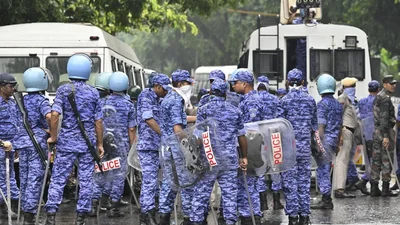
The story so far: At least one of the 80 protesters injured in police action during the Monday (July 20, 2026) march to Parliament called by Cockroach Janta Party (CJP) sustained pellet gun injuries. The victim identified as Shaikh Irshad Mansoori (25), a resident of Gurugram, underwent surgery at a government hospital to remove the pellets lodged under his eye. Most pellets were lodged in the upper part his body.
Another video of a woman being stunned by a “shock baton,” also emerged on Tuesday (July 21, 2026). The usage of pellet guns and shock batons against civilian protesters, appear to be the first in Delhi.
What are pellet guns?
They are a form of non-lethal crowd-control method used by police and military worldwide. The other popular measures are tear gas, water cannon, pepper spray, taser guns among others.
Pellet guns are also popular in hunting and pest control. Intended to immobilise an individual, they fare effective over short ranges up to 500 yards but when fired from close quarters can be lethal, particularly when sensitive parts like eyes are hit. The pellets can penetrate soft tissues.
There are standing instructions to open minimal fire at protesters and if necessary “below their waist.” A cartridge of a pellet gun contains few hundred pellets made of lead and disperses few hundred metres when fired. Pellets can be of various shapes either like ball bearings or irregular. When fired, the cartridge disperses few hundred pellets over few hundred metres depending on the type.
They are manufactured at the Ordinance Factory, Ishapore.
How could pellet guns be used during July 20 protest in Delhi?
While Delhi Police has denied its use against protesters, pellets guns and shock batons are part of the gear of the Rapid Action Force (RAF) —the anti-riot unit under CRPF— which was deployed alongside police personnel on July 20 and continues to be deployed near the Jantar Mantar protest site.
On Monday (July 20, 2026), the victim Shaikh Irshad Mansoori was hit near Palika Bazaar by a RAF official. His friend said that there are around 30-40 injuries on his face and all over his body. Four of them, including one in the neck, penetrated deeply, which is why he underwent surgery.
Originally from Jabalpur in Madhya Pradesh, Mr. Mansoori works at a private company in Gurugram and was attending the protests in solidarity. He also had some visa-related work in New Delhi, which he was supposed to finish after the protest on Monday (July 20, 2026).
What is the first known usage of pellet guns?
Pellet guns were first deployed in Jammu and Kashmir after Kashmir Valley’s summer unrest of 2010 that claimed the lives of 112 protesters in police firing. The then Congress-led government at the Centre deployed pellet guns as a “non-lethal” measure to avoid civilian fatalities.
After violent protests broke in the Kashmir Valley post July 8, 2016 —when Hizbul Mujahideen (HM) commander Burhan Wani was killed in an encounter with security forces— several people were blinded due to injuries inflicted from pellet guns, used by the Central Reserve Police Force (CRPF) as a crowd control measure.
Why and when were its specifications changed?
In 2016, BJP-PDP government faced severe criticism for using pellet guns with several political parties asking for its complete withdrawal. Due to injuries inflicted by pellet guns, 13 people were killed in 2016 and more than 250 were injured, while few lost their vision.
In 2017, a year later, the first batch of less lethal “plastic bullets” were dispatched to the Kashmir Valley. The plastic bullets were tested at the Terminal Ballistics Research Laboratory (TBRL) in Chandigarh and could be fired from the weapons the security sforces already have. Instead of metal, the round of ammunition had a plastic head.
In 2016, 1,022 CRPF personnel were also injured during pelting of stones by protesters. Out of this, 956 were injured in pelting of stones in the Valley between July 8-16 during the unrest.
What is the last known usage of pellet guns in the country?
They were last known to have been used during the 2024 farmers protest at Khanuari and Shambhu Barrier along the Punjab-Haryana border. Though the police denied the use of pellet guns, farmer leaders had alleged then that several persons were injured.
In 2023, they were used against protesters in ethnic-strife torn Manipur leading to a huge public outrage.
What about shock batons?
Shock batons are also part of the RAF personnel gear.
In 2021, the Ministry of Home Affairs (MHA), through the Border Security Force (BSF), prescribed Qualitative Requirements (QRs) for handheld ‘Shock Batons’ intended for self-defence and operational use by security personnel. It said that the equipment should be light weight, with a maximum weight of 1 kg and a length ranging from 450 mm to 700 mm, ensuring ease of carriage and handling. It must be constructed from high-impact resistant material, capable of functioning reliably in temperatures ranging from −20°C to +50°C and offering a minimum level of water resistance.
The shock baton should have a service life of at least five years and be powered by a rechargeable battery. Additional requirements include the capability to deliver at least 1,000 quarter-second shock bursts on a full charge, thereby ensuring sustained operational effectiveness in field conditions.
Published - July 22, 2026 11:06 am IST