Legendary singer, Usha Uthup, once said that Lata Mangeshkar’s music pushed women into the kitchen. But Asha Bhosle pulled them away.
Bhosle, who died in Mumbai on April 12 at the age of 92, did not just sing great songs (the greatest any Indian vocalist ever sang, if you ask me), she changed what a woman’s feelings were allowed to sound like.
For a long time in Hindi film music, desire was thin. The heroine could love, ache and wait, but she could not quite want – not in a way that sounded immediate, playful and definitely not self-aware.
With older forms of shringarin classical music, and even with her elder sister Lata Mangeshkar’s music, desire often felt like it was being held carefully, protected and softened. It was there, no doubt, but it was, well, also not there. If you listen to it, you will feel the emotion, but you will also feel the restraint around it. With Asha, that restraint went away.
It is in that sense that her voice did something radical. It removed the distance between what was felt and what was sung. Where others held emotion with care, she leaned into it. Where longing was disembodied, she made it physical – with breath, husk, rasp. She could stretch a word until it felt like touch.
And there was always a sense that she knew exactly what she was doing. Sometimes you could imagine her almost laughing while singing, showing you she already knows what her voice is doing to you. There is an intentional boldness in her voice. She does not hide inside the song. She stands within it, aware of her voice, aware of her texture, her pull. It is not just that she expresses desire but that she knows she is expressing it and she lets you feel that knowing.
Asha’s voice doesn’t move through a tune in a straight line either. She slides into notes instead of hitting them cleanly, turns them slightly and lets them fall. Sometimes she arrives a fraction of a second late, sometimes she stays a fraction of a second longer. Those small choices change how words in a single line feel: one moment it hesitates, the next it teases, but finally it settles. Each word is handled on its own, each disjunct from the sentence of which it forms a part.
The slides, turns, and small inflections in her music are all intentional and real. Everything is expressive, and almost physical as I said. I invite you to listen to Aao Huzoor Tumko and observe how each word disjunctively carries an emotion. “Aao” opens out like an invitation, “huzoor” slows down and lingers, “tumko” is firm – each word throughout the song is given its own inflection, rather than being absorbed into the line within which it occurs.
The sensuality of Asha’s voice was not sexiness imported from elsewhere. It was local, familiar, just newly visible. Asha wasn’t using the language of Western sensuality – no heavy projection where unnecessary, no performance of boldness that may feel forced into a song. To be sure, I am noticing only a difference in vocal idiom, not making a value judgment on western form of music which I equally enjoy.
Asha Bhosle imbued the feeling within the word instead of pushing it outward separate from the words. In songs like Piya Tu Ab To Aaja and Yeh Mera Dil, she lets the words convey the emotion. In Dum Maro Dum, she doesn’t hit the word “dum” percussively, she keeps it loose, almost letting it sit on her breath.
Even at its most sensuous, her voice keeps the ease of someone speaking, not announcing. It is conversational and casual. Perhaps that is why it stuck – Asha used the small inflections of everyday speech, the playfulness that exists in how we speak to one another. It never felt overdone. It was always proportionate.
There's definitely some similarity with Geeta Dutt but with an important distinction. In a song like Babuji Dheere Chalna or Waqt Ne Kiya, Geeta doesn’t work each word. The feeling hangs over the entire line and even the song and you unmistakably remember the mood, but not the individual shaping of syllables, unlike in Asha’s music.
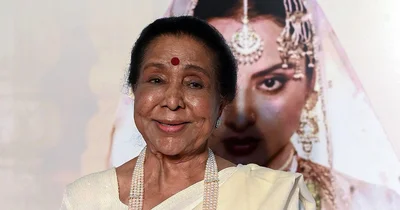
A portrait of Asha Bhosle at her residence in Mumbai. Photo by Francis Mascarenhas/Reuters.
When someone sings, we usually listen for what the song is saying and what emotion it expresses. Roland Barthes says there is something else, more immediate: the sound of the body producing the voice. He calls this the “grain”. It is the material presence of the singer – the throat, the mouth, the breath – inside the sound. The grain is what he describes as erotic – not in a sexualised sense, but in the sense that it creates a direct, almost physical relation between singer and listener. You don’t just hear the voice but feel its production.
In Asha Bhosle’s singing, that grain is constant. The sensuality (or any other emotion for that matter) does not come only from the sung word. It comes from how she forms the word, how she holds it, how she releases it. You hear the body in the voice, word by word.
Asha’s elder sister’s music is often called pure. The problem with the word “pure” in India is that it very often means “clean and restrained”.
But what could be purer than feeling? Purity is taken to mean a removal of excess. But does it not actually mean something unmediated? Something that has not been separated from the body that produces it. In that sense, feeling when it is fully inhabited and not stepped away from, is already pure. Asha’s voice never moved away from how she felt – it stayed with it, close to the body. Pure.
Over a career that stretched across decades, genres and generations, she remained impossible to contain. Romantic songs, cabaret songs, ghazals, folk melodies, pop experiments – each became a site of experimenting. But she never lost her core philosophy: that a voice is not just for singing, but for inhabiting feeling fully.
In the end, what she leaves behind is a voice that never stepped away from itself. It stayed close – to the word, to feeling itself, to the body. You don’t just hear it, you hear it being made physically. And the intimacy that that production produces remains unmatched.
Parv Tyagi is a lawyer and alumnus of National Law School, Bangalore.
Also read:
Legendary singer Asha Bhosle (1933-2026) was the queen of fun times
How Asha Bhosle arrived on the ghazal scene with ‘Umrao Jaan’