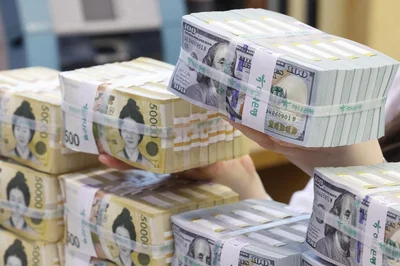
A banker sorts Korean won and U.S. dollars at a Hana Bank in Seoul, April 3. Yonhap
DWF Labs Managing Partner Andrei Grachev
In early 2026, reports emerged that Korea's Financial Services Commission (FSC) was preparing corporate digital asset investment guidelines that would exclude dollar-denominated stablecoins like USDT and USDC from the approved list.
The FSC has since indicated that the framework remains under discussion, but the regulatory direction is unmistakable. Seoul is signalling that the future of digital payments in Korea will run on Korean rails.
This was not a defensive move. It was a strategic one. For those of us who have spent years tracking stablecoin adoption across Asia, it marks the moment Korea shifted from being a speculative crypto market to becoming, potentially, the most important proving ground for national currency stablecoins in the world.
Real stablecoin story is in Asia
The global conversation about stablecoins remains disproportionately focused on the United States. Congressional debates over USDC regulation and Tether reserve composition dominates headlines.
But the actual usage data tells a different story. Asia accounts for roughly 60 percent of real stablecoin payment volume globally. The widely cited $30 to 35 trillion annual figure masks what is actually happening on the ground: The bulk of that activity is concentrated in the China-Hong Kong-Singapore corridor, with Korea emerging as the critical fourth node. Our research into Korea’s won-denominated stablecoin opportunity bears this out.
Between June 2024 and June 2025, the Asia-Pacific region recorded $2.4 trillion in onchain stablecoin activity, a 69 percent year-on-year increase. Singapore and Hong Kong have established themselves as the second and third largest stablecoin hubs after the United States. However, distribution remains heavily skewed toward dollar-pegged assets. Korean won-pegged stablecoins represent less than one percent of the total market. That gap is where Korea’s opportunity lies.
Korea’s digital asset market is unlike any other in Asia. With 18 million retail holders, roughly a third of the population, the country has one of the highest crypto participation rates in the world. Tether often trades at a premium of around five percent above global prices on Korean exchanges, a phenomenon known as the "kimchi premium," which has persisted in various forms since 2017, when it peaked at an extraordinary 54.5 percent.
The premium is not simply a curiosity. It is a structural signal. It reflects the collision between enormous domestic demand for digital assets and strict capital controls that limit fund transfers in and out of the country. Korean investors have been paying a premium for dollar-denominated stablecoins for years because no viable Korean alternative exists. The FSC’s recent moves suggest Seoul has recognized this dynamic and decided to resolve it on its own terms.
What Seoul is actually building
The regulatory framework emerging in Korea is arguably the most thoughtful stablecoin regime in Asia. The FSC’s proposed licensing system reportedly mandates 100 percent reserves in highly liquid assets like bank deposits and government bonds, with built-in redemption protections for holders. A government-sponsored bill is expected by the end of 2026, with full enforcement to follow.
But regulation is only half the story. The infrastructure being built is what makes Korea’s approach distinctive. A consortium of eight major commercial banks is developing a shared won-pegged stablecoin. This is not a startup experiment. It is a coordinated national financial infrastructure.
Kakao Pay CEO Shin Won-keun announces details of Kakao's "super wallet" initiative during a stablecoin symposium at a hotel in Seoul, December 2025. Courtesy of Kakao Pay
Meanwhile, Korea’s two technology giants are racing to build the consumer layer. Kakao has announced plans for a won-based stablecoin ecosystem connecting KakaoPay, KakaoBank and KakaoTalk into a unified digital wallet, developing wallet-to-wallet payment systems that bypass traditional intermediaries entirely.
Naver’s $10.3 billion acquisition of Dunamu, the operator of Upbit, signals an even more ambitious play: a blockchain-AI hybrid platform linking search, payments and digital assets, with a dedicated Layer 2 solution for stablecoin payments.
When your country’s two dominant consumer platforms and its banking sector are all building stablecoin infrastructure simultaneously, you are not witnessing an experiment. You are witnessing a coordinated shift in how a nation intends to move money.
Asian stablecoin divergence
Korea’s approach becomes clearer when compared with its neighbors. China maintains a blanket ban on private stablecoins, channeling all digital currency ambitions through the centrally issued e-CNY. Beijing’s position is ideologically consistent but commercially restrictive: The digital yuan serves the state’s surveillance and monetary policy objectives, not the market’s need for programmable, interoperable digital money.
Singapore has taken the opposite approach, recognizing stablecoins as regulated activity under the Payment Services Act since 2020 and finalizing a dedicated framework in 2023. Hong Kong enacted its Stablecoins Ordinance in August 2025, becoming only the second major Asian jurisdiction after Japan with standalone stablecoin legislation. Both city-states have positioned themselves as neutral hubs for dollar-denominated stablecoin flows.
Korea is charting a third path by encouraging private stablecoin development anchored to the won rather than the dollar. This is not protectionism. It is a recognition that a country with tech-native citizens and a persistent capital controls regime cannot afford to have its digital payment future denominated by someone else’s currency.
Song Eon-seog, floor leader of the main opposition People Power Party, speaks during a meeting with Korea's top five cryptocurrency exchange executives at Coinone's headquarters in Seoul, March 25. Yonhap
The implications extend well beyond Korea’s borders. If Seoul succeeds in launching a credible, liquid and well-regulated won-based stablecoin ecosystem, it will provide a template for every mid-sized economy wrestling with the question of how to participate in the stablecoin revolution without ceding monetary sovereignty to the dollar.
For the digital asset industry, the near-term opportunity is significant. A functioning won-based stablecoin would reduce the kimchi premium, unlock deeper liquidity on Korean exchanges and create entirely new corridors for cross-border settlement in the region. For institutional investors, it would mean access to one of Asia’s most active retail markets through a regulated, transparent infrastructure rather than through the back door of dollar-denominated proxies.
The transition will not be seamless. Interoperability between the banking consortium’s stablecoin and the consumer platforms’ proprietary systems remains an open question.
The FSC’s reserve requirements, while prudent, may create friction for issuers accustomed to more flexible regimes elsewhere. And the speed at which Korea’s regulatory framework translates into live infrastructure will depend heavily on coordination between regulators, banks and technology firms that do not have a long history of working together in this space.
But the direction is unmistakable. Korea has 18 million reasons to build this, and the regulatory will, corporate investment and technical talent to pull it off. The rest of Asia and the stablecoin industry globally should be paying much closer attention.
Andrei Grachev is Managing Partner at DWF Labs, one of the largest digital asset market makers and multi-stage Web3 investment firm.