Those margins had soared from US$20 ($34) a barrel in February to a peak of about US$120 since the Middle East war started.
The airline expected to spend $3.74 billion to $3.98b on fuel this half, up from the $3.02b it had estimated when releasing its first-half results less than two months ago.
It had made international network changes, capacity adjustments and fare increases in response.
Qantas did not fly to the Middle East.
Its nearest year-round destinations were Bengaluru, direct from Sydney, and Paris, direct from Perth.
It flew to Rome from early May to late October.
When it launched that route in 2022 it was the first nonstop flight between Australia and continental Europe, following the Qantas Perth-London service launched in 2018.
Qantas said demand for international travel to Europe was strong.
“In response, the group has redeployed capacity from the US and its domestic network to increase flights to Paris and Rome.”
The airline’s US destinations were New York, San Francisco, Las Vegas, Los Angeles and Dallas.
Qantas said it had provided additional support to customers booked to travel on partner airlines to the Middle East, with this including more flexibility to move flights or receive a refund.
The airline is in the oneworld alliance, which includes Qatar Airways, Cathay Pacific and Oman Air.
Qantas said for the fourth quarter – April, May and June – it had cut domestic capacity by about 5%.
It was working with the Government and jet fuel suppliers to get confidence about fuel supply for the rest of April and well into May.
“We are closely monitoring the situation given the ongoing uncertainty in global fuel supply chains.”
It said affected Qantas and Jetstar customers were being contacted and offered alternative flights or refunds.
Qantas airline said it was still in a strong financial position.
An interim dividend of A$300 million and A19.8c a share ($362m and 23.93c at today’s exchange rate) would be paid on April 15.
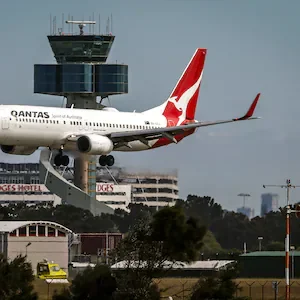
Qantas says it has cut domestic capacity by about 5% for the fourth quarter. Photo / David Gray, AFP
Air NZ v Qantas
Forsyth Barr head of research Andy Bowley said the crack spread had oscillated between US$100 and US$120 for the past week.
That was five or six times the pre-war premium jet fuel customers usually paid.
He said Air New Zealand was well-hedged too, at about 83% when its first-half results were issued in late February.
Hedging in this context broadly meant if oil prices rose, airlines were protected.
If prices fell, they might miss out on cheaper fuel, but avoided risk.
Bowley said Air New Zealand’s level of crude oil hedging would be higher now the airline, like Qantas, had cut capacity.
Air New Zealand chief executive Nikhil Ravishankar last week emailed customers about the airline’s response to the Iran conflict.
He confirmed the airline’s fuel bill had more than doubled, costing an extra $4.5m a day.
The airline said it was pencilling in more schedule changes for May and June, affecting about 1% of customers.
Asked if Air NZ should also issue a market update, Bowley said: “I’d be surprised if we were talking in six weeks’ time and they hadn’t put anything out.”
He said Air New Zealand’s problem was how volatile the situation was.
“The problem they’ve got at the moment is the potential outcomes are pretty wide.”
Brent crude was at US$97.95 this afternoon and prices have been unusually volatile since the conflict began on February 28.
Iran slammed a US blockade around its ports as a “grave violation” of its sovereignty, AFP reported this afternoon.
The blockade came into force at 1am Monday, New Zealand time.
US Vice-President JD Vance told Fox News some progress had been made in negotiations with the Iranians.
But he also said Iran’s regime had engaged in “economic terrorism against the entire world” by threatening ships in the Strait of Hormuz.
Vance said the new US blockade would apply economic pressure on Iran by preventing Iranian ships getting through the strait.
John Weekes is a business journalist covering aviation. He previously covered consumer affairs, crime, politics and courts.
Stay ahead with the latest market moves, corporate updates, and economic insights by subscribing to our Business newsletter – your essential weekly round-up of all the business news you need.