Click here for more articles by Kormedi.com.
SBS' Friday-Saturday drama "Agent Kim Reactivated" is enjoying a remarkable rise in popularity.
Starring So Ji-sub, the series follows a devoted father who embarks on a relentless quest for revenge after his daughter goes missing. On Saturday, the eighth episode recorded a nationwide viewership rating of 23.1 percent, setting a new series high. It became the second highest-rated SBS Friday-Saturday drama of all time, behind only "The Penthouse 2" with 29.2 percent, surpassing its previous record of 22.3 percent set by episode 6.
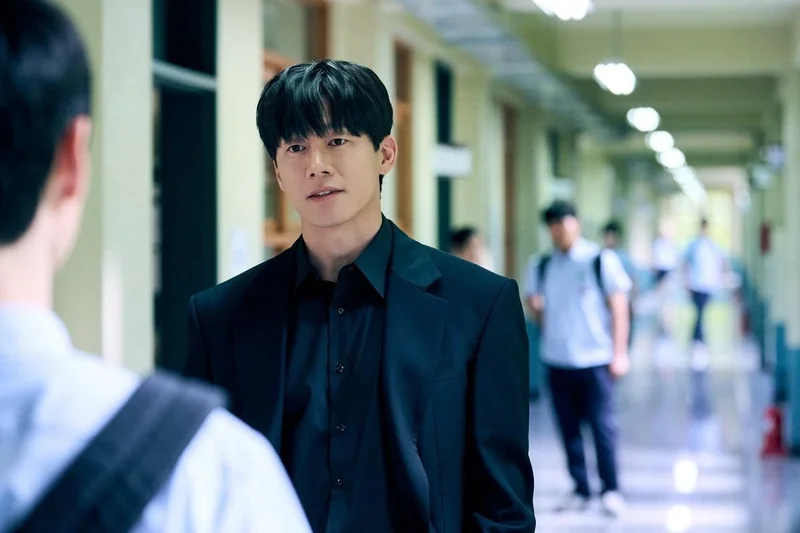
Netflix original series "Teach You a Lesson" has also emerged as one of this summer's biggest hits. According to Netflix, the drama ranked sixth among the most-watched titles worldwide on the platform during the first half of 2026.
The two dramas share one defining characteristic: neither shies away from graphic violence.
"Agent Kim Reactivated" features bloody revenge scenes in nearly every episode as the protagonist fights to rescue his daughter. Graphic depictions of bodily mutilation — including scenes of scalping — have been broadcast with a level of intensity more commonly associated with adults-only films.
"Teach You a Lesson" takes a similar approach. Its two protagonists (played by Kim Moo-yul and Jin Ki-joo), members of a fictional Ministry of Education task force dedicated to protecting teachers' authority, routinely resort to violence under the banner of correcting students' behavior. The show's portrayal has even prompted criticism that its version of "true education" amounts to "fighting violence with more violence."
Golden age for violent dramas
A psychiatrist who operates a mental health clinic in Seoul's Gangnam District cited recent psychological research in an interview with Kormedi.com, suggesting that the more negative a person's emotional state is, the more likely they are to seek out negative or disturbing content.
The study, published in January 2025 in a journal affiliated with Nature, was conducted by researchers at Stanford University, the Massachusetts Institute of Technology and University College London. It examined the relationship between internet browsing habits and mental health among 1,145 participants.
Participants were allowed to browse the internet freely for 20 minutes a day over five days before completing mental health surveys. The researchers found that those who spent more time consuming negative online content tended to report poorer mental health.
When reversed, a similar pattern emerges. Participants who reported being in a worse mood before going online were more likely to visit websites containing negative information. In other words, people in a negative emotional state appeared to gravitate toward content that further reinforced those feelings, creating a potentially self-perpetuating cycle.
"The causal relationship is still being investigated," the psychiatrist said. "However, many psychologists and mental health specialists already agree that people experiencing more negative emotions are more likely to choose negative or violent content."
The psychiatrist added, "One has to be cautious about drawing conclusions, but popular tastes often reflect society's collective psychological state. From that perspective, it's difficult to view the current popularity of violence-centered dramas such as 'Agent Kim Reactivated' and 'Teach You a Lesson' as an entirely positive phenomenon."
Media scholars, however, offer a different interpretation, arguing that stories centered on violence and the triumph of justice have always resonated with audiences.
Yu Kyung-han, a professor of media and communication at Jeonbuk National University, said he disagrees with the notion that anger-driven narratives have only recently become popular.
"Some argue that dramas dealing with anger and violence are especially popular these days, but I don't agree," Yu said. "Stories reflecting frustration with reality and the desire to see justice served have been among humanity's best-selling narratives throughout history. Even 'The Story of Hong Gildong' is built on the same emotional foundation."
He added that the media landscape itself has fundamentally changed.
"We no longer live in an era when viewers passively consume whatever television networks broadcast. In the age of streaming services like Netflix, audiences actively choose what they want to watch. Explaining the success of these dramas simply as a reflection of public anger is an overly simplistic interpretation."
Still, Yu argued that experts should pay close attention to what audiences find relatable in these justice-driven stories and consider how those sentiments might be reflected in real life.
"Why are 'Agent Kim Reactivated' and 'Teach You a Lesson' successful? Because these kinds of stories have always sold well. They tap into one of the oldest emotional impulses in history," he said. "What's important is understanding which aspects resonate with viewers and what kind of vicarious satisfaction they seek. True catharsis doesn't come from watching a protagonist beat people up or destroy things. It comes when the justice portrayed on screen is realized in the real world."
This article from Kormedi.com, Korea’s top health care and medical portal, is translated by a generative AI system and edited by The Korea Times.